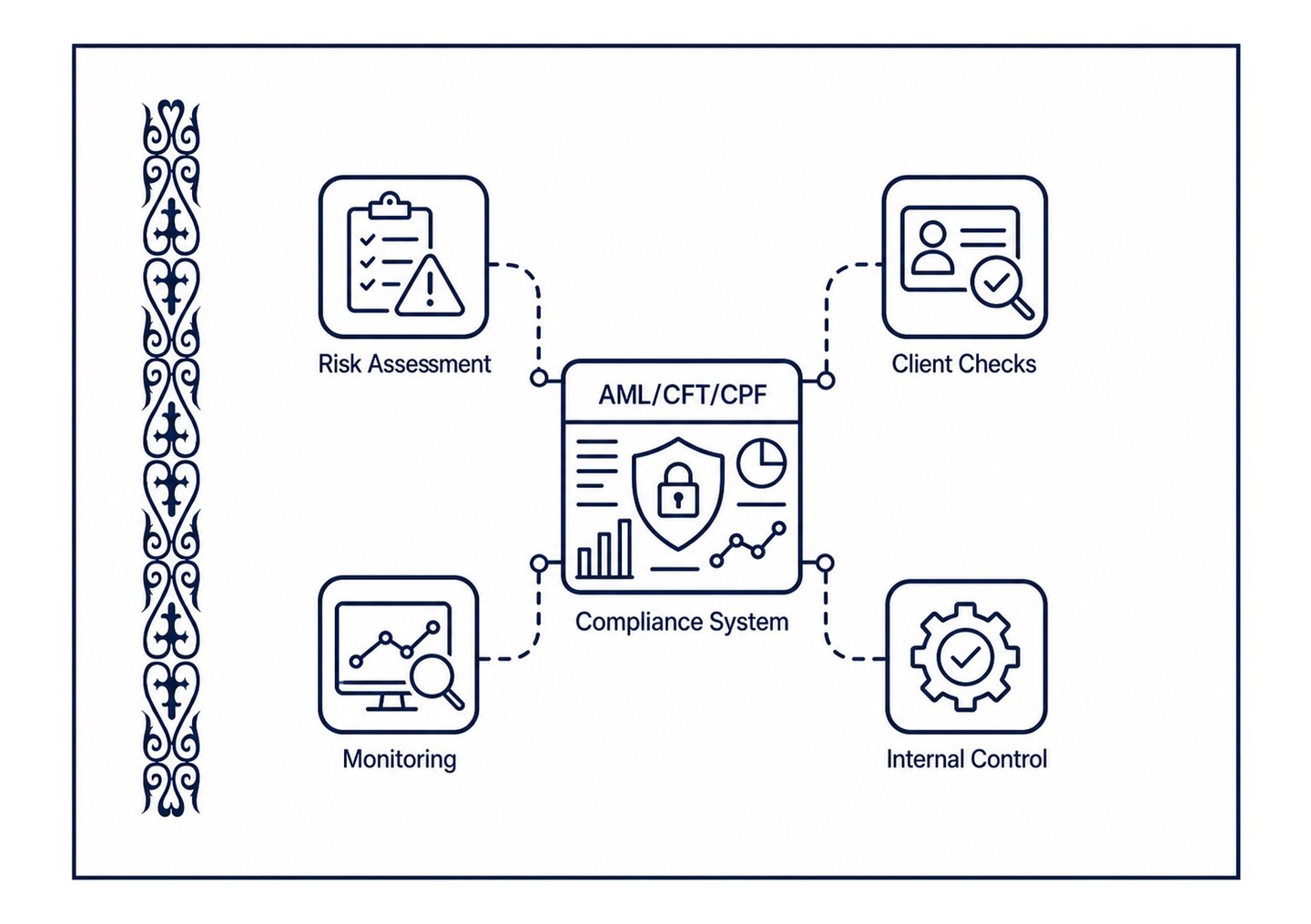
For a payment organization, compliance with countering the legalization of income, the financing of terrorism and the financing of the proliferation of weapons of mass destruction (AML/CFT/CPF) is not an appendix to the main business. It is part of the model of work itself. If a company participates in payments, services clients, connects merchants, works with transfers or takes part in the movement of money, the state expects it to understand its risks and manage them.
In practice the problem is often not that there are no documents. Documents usually exist: internal control rules, questionnaires, forms, orders, journals, instructions. The problem is different — they do not work. Employees do not understand when to carry out identification, how to assess a client, what to consider a suspicious operation, when to update information and how to record a decision. For the regulator such a set of documents looks formal.
1. Why formal documents do not protect the company
Internal AML/CFT/CPF documents must correspond to the real business model. If a company works with B2B clients, couriers, marketplaces, aggregators, internet acquiring or special accounts, this must be visible in the rules, the questionnaire, the risk matrix and the monitoring procedures. A universal document downloaded for any organization does not explain how exactly this company identifies and reduces risk.
A formal approach is especially dangerous during a check. The regulator looks not only at the presence of rules, but also at whether they were applied. Whether there is a risk assessment of clients, whether information was updated, whether employees were trained, whether decisions were recorded, whether unusual operations were considered, whether a responsible employee is appointed and whether they understand their functions.
2. Risk assessment must be a living instrument
Risk assessment is not a table for the sake of a report. It must explain which clients, products, channels, countries, operations and methods of service create elevated risk. For a payment organization it is important to look separately at the type of payment service, the method of connecting the client, the remoteness, the volume of operations, the frequency of payments, the economic meaning, the geography and the category of client.
A good risk assessment helps make practical decisions. One client can be accepted by the standard procedure. For another, additional documents need to be requested. For a third — enhanced monitoring must be established. For a fourth — service must be refused. If the risk assessment does not affect the company's actions, it does not perform its function.
3. Client identification is not just a questionnaire
Identification begins with understanding who the client is, who their representative is, who the beneficial owner is and what the purpose of the business relationship is. For legal entities it is important to check the registration data, the ownership structure, the powers of the signatory, the type of activity, the sources of funds and the connection of operations with the declared business model. For individuals, the documents, the status, the nature of operations and signs of unusual behavior matter.
In practice the questionnaire is often filled out once and forgotten. This is a mistake. The information must be updated if the director, the participant, the beneficiary, the type of activity, the turnover, the settlement model or the client's risk profile changes. A payment organization must see not only the client at the entrance, but also their behavior during the service.
4. Monitoring of operations and suspicious signs
Monitoring of operations does not mean that every operation is automatically suspicious. Its task is to see the mismatch between the client's profile and the actual behavior. If a company declared one model while the operations show another, you need to investigate. If the turnover has grown sharply without explanation, payments are split, money quickly passes in transit or counterparties are not connected with the client's activity, compliance must not be limited to a mark of "operation carried out".
Decisions on operations must be recorded. It is important not only to identify a sign, but also to show how the company assessed it: requested documents, received an explanation, enhanced monitoring, refused the operation, sent a message or closed the question as explainable. Without recording, even a correct decision looks unconfirmed.
5. The role of the compliance officer
The employee responsible for AML/CFT/CPF must not be a formal figure in an order. They must have access to information, the right to request documents, participate in the assessment of clients, initiate internal checks, organize training and interact with management. If the compliance officer exists only on paper, the system does not work.
For a payment organization it is important that compliance is built into the operational processes. The manager connects the client, the accountant sees the payments, the technical team sees the system, the lawyer sees the contracts, the compliance officer sees the risk. If these blocks do not exchange information, suspicious signs may pass the company by.
6. Training of employees and internal discipline
Employees must understand not only the text of the rules, but also practical scenarios. What to do if a client refuses to disclose the beneficiary. How to react to an unusual turnover. When to pass the question to the compliance officer. Which documents cannot be accepted formally. Why a client cannot be connected before the check is completed.
Training must be confirmed documentarily, but the point is not the signature in the journal. The point is that employees really know how to act. In a payment organization one incorrectly connected client can create not only a regulatory risk, but also a banking, reputational and commercial risk.
7. Typical mistakes of payment organizations
The most frequent mistakes are repeated from project to project. A company prepares documents after the regulator's request, and not before launch. The internal control rules do not correspond to the business model. Client questionnaires are filled out formally. The risk assessment does not affect decisions. Employee training is not conducted in substance. Suspicious operations are not analyzed or are analyzed without recording the result.
All these mistakes can be corrected, but it is better not to bring things to the moment when the company explains to the regulator why the internal control system existed only in the form of files.
8. How Qozhan Consulting helps
Qozhan Consulting helps payment organizations build documents and processes for AML/CFT/CPF to fit the real business model. We analyze products, clients, payment flows, contracts, the banking model, internal roles and prepare rules, questionnaires, risk matrices, monitoring and training procedures. If the documents already exist, we check whether they work in practice and what needs to be changed before a check or the launch of a new product.
Conclusion
Compliance for a payment organization is not a folder of documents, but a working decision-making system. It must help the company understand the client, see the risk, record actions and explain its position to the bank, the regulator and internal management. The earlier AML/CFT/CPF is built into the business model, the more sustainably the payment project works.