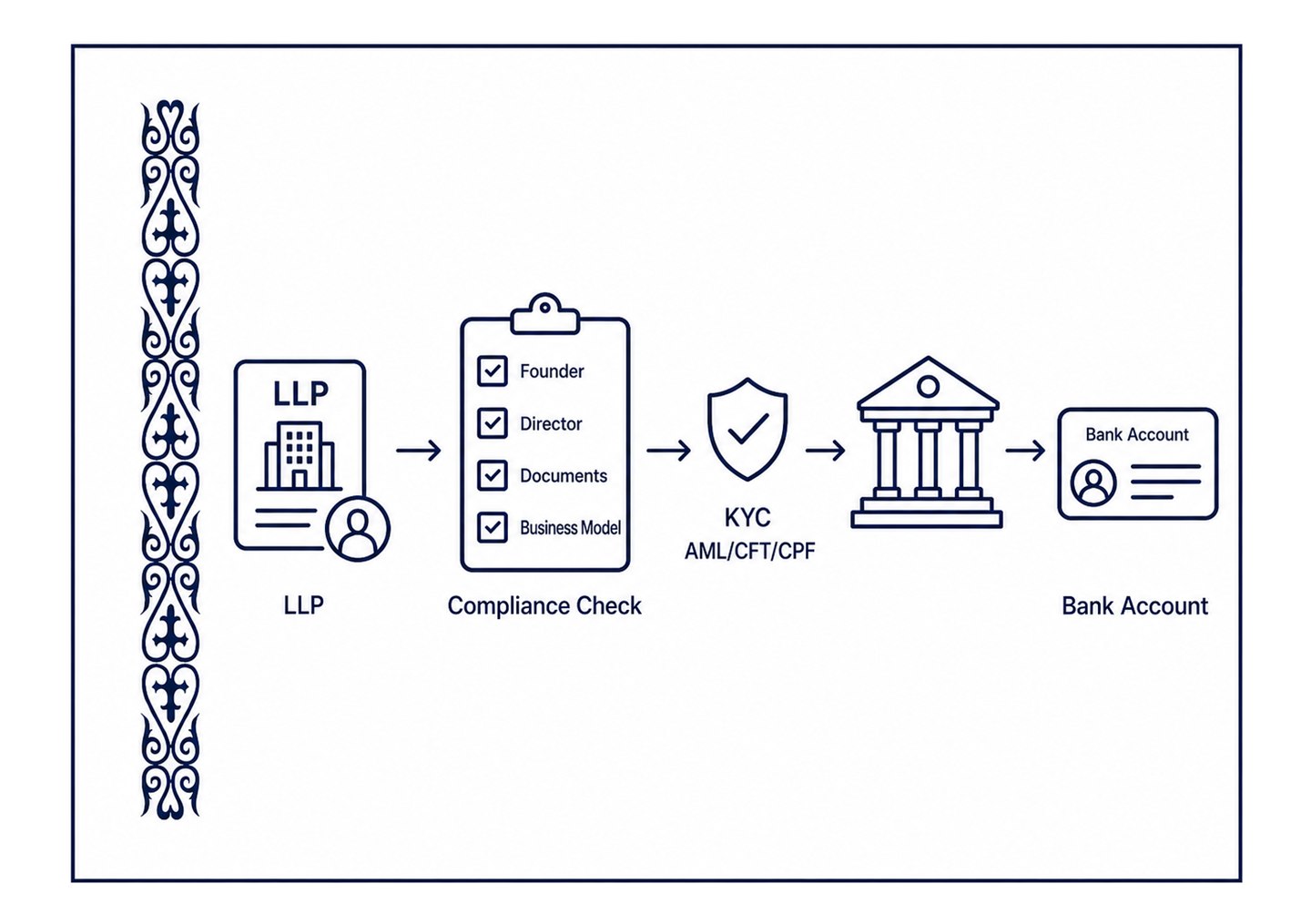
For a limited liability partnership (LLP) with foreign participation, company registration is only the first stage. In practice, business starts working not after obtaining the business identification number (BIN), but after opening a current account, connecting internet banking and passing bank compliance. It is at this stage that many foreign clients first encounter the fact that the bank assesses not only the documents, but also the economic meaning of the future activity.
A bank in Kazakhstan is not obliged to open an account automatically just because the company is registered. It must understand who owns the company, who manages the account, what the business will do, which countries and counterparties participate in the settlements, where the money will come from and what operations are planned. For companies with foreign participation this check is usually deeper, because the bank sees a cross-border element and is obliged to take into account anti-money-laundering requirements, sanctions risks and its internal risk policy.
That is why it is better to plan account opening before registering the LLP. If the company structure, the director, the address, the types of activity and the documents are initially prepared without taking the bank check into account, the account may open slowly or not open at all.
1. Why the bank asks foreign business more questions
Foreign participation in itself is not a problem. Kazakhstani banks work with non-residents, foreign participants and international groups. The question is different: the bank needs to make sure that the company is not used as a technical link for unclear payments, circumvention of restrictions, transit of money or an activity that the client cannot explain documentarily.
Usually the bank checks three layers of information:
The first layer is legal. Who is the participant of the LLP, who is the director, what powers the signatory has, whether the constituent documents are drawn up correctly. The second layer is factual. Where the business is located, who really makes decisions, whether there are employees, an office, a website, contracts, suppliers and clients. The third layer is financial. What payments are planned, where the money will come from, to which countries funds will be sent and whether this corresponds to the declared activity.
If the answers to these questions do not match each other, the bank may request additional documents. For example, a company declares consulting services in Kazakhstan but expects large payments for goods from several countries. Or the director is abroad but has to manage the account daily. Such inconsistencies do not always mean a violation, but they require explanation.
2. The beneficial owner and the ownership structure
One of the bank's key questions is who the ultimate beneficial owner is. If the participant of a Kazakhstani LLP is a foreign company, the bank will almost always look further: who owns this foreign company, who controls the decisions and whether there are several levels of a holding structure between the participant and the ultimate owner.
For a simple structure clear corporate documents are enough. For a complex structure an ownership chart must be prepared in advance. It should show the participants, the percentages, the countries of registration and the ultimate individual or group of persons who control the business.
In practice the bank may request:
- an extract from the trade register of the foreign company;
- the charter or an equivalent corporate document;
- the decision to establish the Kazakhstani LLP;
- documents on the director and the representative;
- the ownership structure up to the ultimate beneficiary;
- documents confirming the source of funds;
- a description of the group of companies and the business purpose of presence in Kazakhstan.
If the foreign documents are drawn up in another language, translation, notarization, apostille or legalization are needed in advance — depending on the country. The mistake of many clients is that they start collecting these documents after the bank's request. As a result the account is postponed, while the company is already registered and waiting for launch.
3. The director and personal presence
For the bank, not only the participant matters, but also the director. The director manages the account, signs documents, gets access to internet banking and is responsible for the company's daily operations. If the director is a foreign citizen, the bank may require their personal presence for identification, signing of bank documents and setting up access.
Here two questions must be distinguished. The first — whether a foreign citizen can be a director. The second — whether they will practically be able to pass the bank procedure and manage the account. Legally, the appointment of a director and the actual banking service are different stages, but for launching the business they are connected.
Before submitting documents to the bank, it is advisable to check:
Whether the director has an individual identification number (IIN). Whether the director can personally come to Kazakhstan for bank identification. Whether the director needs a Kazakhstani number for SMS codes and confirmation of operations. Whether the bank will connect remote account management for a foreign director. Whether the company has a local employee or representative who can accompany banking matters.
If the director does not plan to come to Kazakhstan, this must be taken into account in advance. Sometimes the solution is to appoint a local director, sometimes — to choose a bank with a suitable procedure, sometimes — to change the company's launch route. There is no universal answer: much depends on citizenship, the bank, the business structure and future operations.
4. What the bank wants to understand about the business model
Bank compliance is not limited to the question "what does the company do". The bank wants to see that the activity has business logic. For this it is important to describe the business model in plain language: who the client is, what is being sold, who the supplier is, how the price is formed, what documents close the transaction and why Kazakhstan is needed in this structure.
A good description of the business model usually answers several questions:
- what services or goods the LLP will provide;
- to whom the company will issue invoices;
- from which countries the money will come;
- to which countries payments will go;
- what contracts already exist or are planned;
- whether there will be employees in Kazakhstan;
- whether there will be import, export, licenses, payment services or regulated activity.
The bank looks not only at the words, but also at confirmations. If the company talks about supplies, contracts, invoices, logistics, a warehouse or an explanation of the chain are needed. If it is about IT services, contracts, terms of reference, a website, the team profile and an understanding of who actually renders the service are useful. If the company declares consulting, the bank may ask to show the subject of the consulting services and future clients.
5. Why the bank may refuse or delay account opening
A bank's refusal is not always connected with a violation of the law. Sometimes the bank is simply not ready to accept the risk of a particular client. The reason may be the participant's country of registration, an opaque ownership structure, the absence of a clear business model, sanctions risk, an incomplete set of documents or contradictions between the declared activity and the expected payments.
Most often a delay arises for the following reasons:
- the foreign documents are not legalized or not translated properly;
- the ultimate beneficiary is not disclosed;
- the director cannot pass identification;
- the company's participant is registered in a jurisdiction with elevated compliance risk;
- the business model is described too generally;
- the planned payments do not match the type of activity;
- there are no contracts, website, commercial offer or other confirmations of the reality of the business;
- the company wants to carry out operations that the bank classifies as high risk.
It is important not to argue with the bank formally, but to close the question in substance. If the bank asks about the source of funds, you need to show the source. If the bank asks for the ownership structure, you need to give a chart and documents. If the bank does not understand an operation, you need to explain its economic meaning.
6. How to prepare for account opening before registering the LLP
The most correct approach is not to wait until the company is registered. Even before creating the LLP you need to understand which bank will potentially be suitable, what documents compliance will request and who will manage the account. This is especially important if the participant is a foreign company, the director is a non-resident, and the settlements will go through several countries.
The working algorithm looks like this:
First — determine the future business model and the main directions of payments. Second — check the ownership structure and prepare a chart of beneficiaries. Third — collect the foreign corporate documents with translation and certification. Fourth — determine the director in advance and their readiness to pass bank identification. Fifth — prepare contracts, commercial offers, a description of services or supply chains. Sixth — choose a bank not only by tariffs, but also by its readiness to work with the specific structure.
This approach saves time. The company does not lose weeks on reworking documents after registration and does not end up in a situation where the LLP is already created but it is impossible to open an account.
7. How Qozhan Consulting helps
Qozhan Consulting accompanies the opening of a current account not as a separate banking formality, but as part of launching a foreign business in Kazakhstan. We analyze the participant's structure, the documents, the director, the business model and future payments in advance in order to prepare the company for bank compliance.
Usually our work includes:
- checking the ownership structure and documents of the foreign participant;
- preparing a description of the business model for the bank;
- help in collecting documents on the director and beneficiaries;
- coordinating translations, notarization, apostille or legalization;
- accompanying communication with the bank;
- explaining to the client which operations may raise questions after the account is opened.
The goal is not just to open an account, but to make it so that the company can actually use the account after opening: receive money, pay counterparties, pass currency control and not face blocks because of unprepared documentation.
Conclusion
A current account for an LLP with foreign participation is not a technical final step after registration. It is a separate check of the business. The bank looks at the ownership structure, the director, the beneficiary, the documents, the countries of payments and the economic meaning of the operations. The earlier a company prepares for this check, the higher the chance of opening an account without protracted questions and starting work in Kazakhstan calmly.