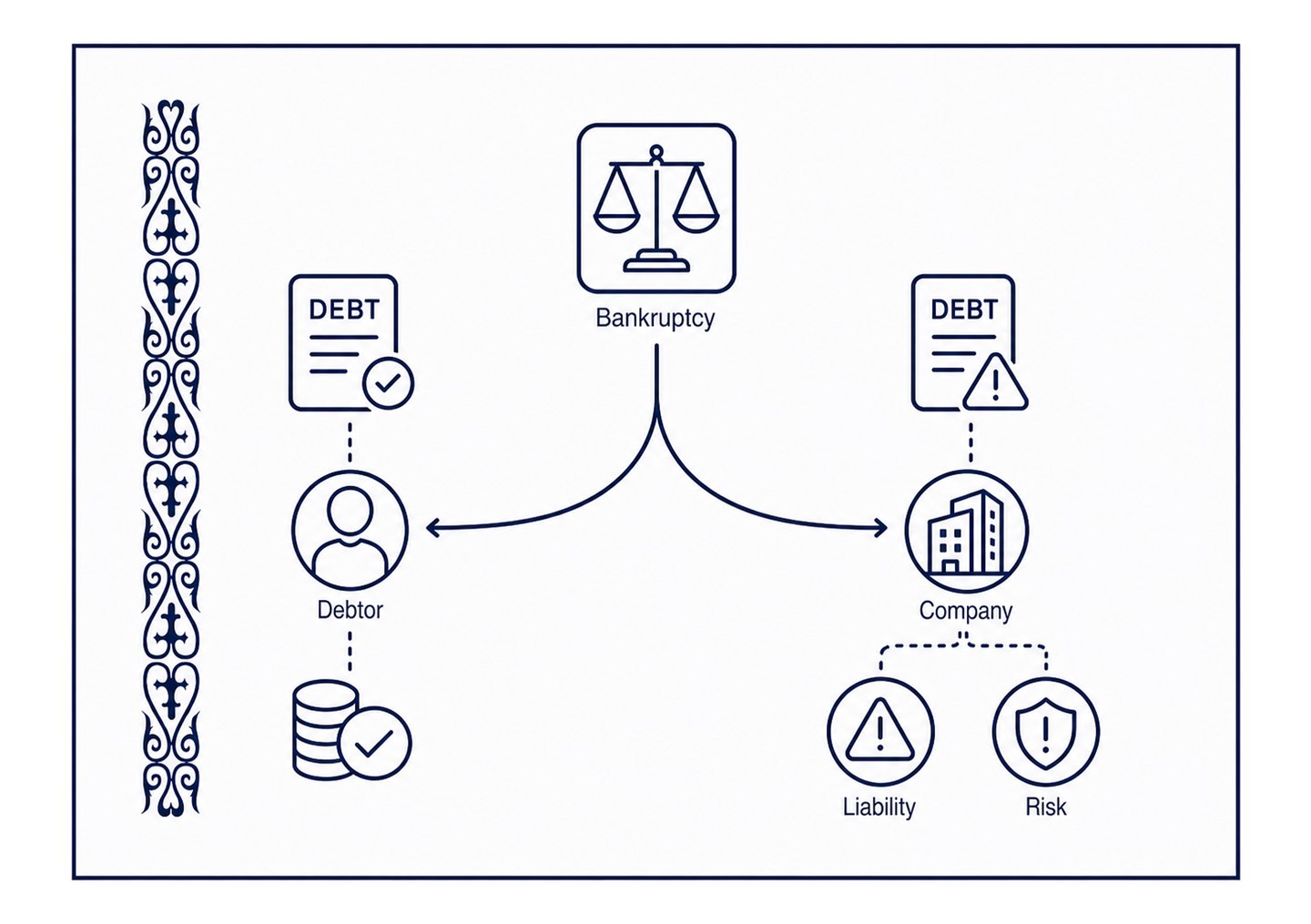
The word "bankruptcy" is often perceived as a final point, when nothing can be done anymore. But in reality, bankruptcy in Kazakhstan is not a single procedure and not a universal way to "write off all debts". For an individual, it may be out-of-court bankruptcy, court bankruptcy or restoration of solvency. For a business, it may be rehabilitation or bankruptcy of a legal entity. For the director and founder of an LLP, bankruptcy may be not only a way to close the company's problem, but also a source of personal risks if the actions of management led to insolvency.
Therefore, bankruptcy should not be treated as a simple technical service. Before filing an application, it is necessary to understand who has the right to apply, which procedure is suitable, which debts are written off, which are not, whether there is property, whether there were transactions in recent years, whether questions of intentional or false bankruptcy may arise, and whether the director or participant may be held subsidiarily liable.
Bankruptcy of an individual: first understand whether the law applies
The Law on Restoration of Solvency and Bankruptcy of Citizens applies to citizens of the Republic of Kazakhstan. This is an important limitation. If a person has a residence permit in Kazakhstan but is not a citizen of the RK, the applicability of the procedure must be checked separately. It cannot be automatically assumed that any foreign citizen with debts in Kazakhstan can go through individual bankruptcy under Kazakhstan rules.
For citizens of the RK, three main options are provided: out-of-court bankruptcy, court bankruptcy and restoration of solvency. Each option solves its own task and is not suitable for everyone.
Out-of-court bankruptcy of citizens: when the simplified procedure applies
Out-of-court bankruptcy is a simplified procedure for citizens whose debt does not exceed 1600 monthly calculation indices (MCI), who have no property and who meet the established conditions. Usually this concerns debts to banks, microfinance organizations and collection agencies.
In practice, several conditions matter. The debt must correspond to the threshold of 1600 MCI. The debtor must have no property, including property held in common ownership. The obligations must be in long-term arrears. A debt settlement procedure with the creditor must also have been carried out, if the law requires it.
The application is filed through electronic services, including eGov or e-Salyq Azamat. The procedure lasts 6 months. But this does not mean that the debtor simply files an application and is automatically released from debts. State bodies check compliance with the conditions, creditors are reflected in the application, and the debtor's data is analyzed.
Out-of-court bankruptcy is not chosen "for a single loan"
One of the frequent mistakes is to think that you can declare yourself bankrupt only for one inconvenient loan while continuing to pay the rest. Bankruptcy is a procedure concerning the entire debt situation, not a selective write-off of a single obligation.
If the debtor does not list all creditors or tries to hide part of the obligations, this may lead to a refusal or termination of the procedure. Therefore, before filing an application, it is necessary to collect the full picture: banks, microfinance organizations, collectors, private individuals, court decisions, enforcement proceedings, taxes, alimony and other obligations.
Court bankruptcy of citizens: when court cannot be avoided
Court bankruptcy applies when the debt exceeds 1600 MCI, there is property, or the debt does not fall under the conditions of the out-of-court procedure. Unlike out-of-court bankruptcy, here the process goes through the court and a financial manager.
In court bankruptcy, the debtor's property may be included in the property mass and sold to settle with creditors. The financial manager analyzes property, transactions, income, obligations and the debtor's behavior. If property was withdrawn, gifted, sold at an understated price or re-registered to close persons, such transactions may become the subject of analysis and challenge.
Court bankruptcy should not be perceived as a convenient "write off the debts" button. It is a public procedure with a check of the property situation and consequences for the debtor.
Restoration of solvency: when it is better not to go bankrupt
Restoration of solvency is suitable for those who have a stable income and the ability to repay debts according to a plan. The meaning of this procedure is not to be declared bankrupt, but to restructure the debt. The court may approve a solvency restoration plan that allows the debtor to repay obligations over a certain period, usually up to 5 years.
This option may be better if the citizen has a job, property, income prospects and a wish to preserve business reputation. Restoration of solvency is not always suitable, but it should not be ignored. Sometimes it is a less painful path for the debtor than bankruptcy.
What consequences an individual's bankruptcy has
Bankruptcy does not pass without consequences. After a citizen is declared bankrupt, restrictions apply: a ban on receiving loans and credits for 5 years, monitoring of the financial condition for 3 years, and repeated bankruptcy is possible only after 7 years. The procedure also affects the credit history and the attitude of banks to future applications.
In addition, not all obligations are terminated. Usually, certain categories of debts are not written off, for example alimony, compensation for harm to life and health, damage in criminal cases and some obligations collected to the budget or established by court acts. Therefore, before filing an application, it is necessary to understand which debts specifically can be terminated and which will remain.
Bankruptcy of a legal entity: this is already a different logic
Bankruptcy of a company is regulated by a different system. For legal entities and individual entrepreneurs, the legislation on rehabilitation and bankruptcy applies. Here the key question is whether the debtor has sustained insolvency, whether the business can be restored, or whether the company must in fact be liquidated through the bankruptcy procedure.
If the business is experiencing temporary difficulties but has a chance to recover, rehabilitation may be considered. If, however, assets are insufficient, activity has stopped, there are more debts than property, and recovery is impossible, it may be a matter of bankruptcy.
Who can initiate bankruptcy of a legal entity
The application may be filed by the debtor itself, if it understands that it cannot fulfill its obligations and there are grounds for bankruptcy. In certain cases, the debtor may have an obligation to apply to the court, for example when a decision on liquidation has been made but the property is insufficient for a full settlement with creditors.
A creditor may also initiate the procedure if the debtor does not fulfill obligations and there are grounds provided by law. Tax authorities and other authorized persons may also participate in the procedures in cases established by law.
For a creditor, the debtor's bankruptcy is not always the best path. Sometimes ordinary recovery through court and enforcement proceedings is faster. But if the debtor is in fact empty, assets are withdrawn, and there are many creditors, bankruptcy may become a way to check transactions, collect property and raise the question of liability of controlling persons.
Rehabilitation of a legal entity: when the business can still be saved
Rehabilitation applies when there is a chance to restore the company's solvency. In this case, the goal is not to liquidate the business, but to give it the opportunity to settle with creditors according to a plan. The payment schedule may be revised, part of the assets may be sold, expenses may be optimized, and the order of settlements may change.
For a business, this is an important alternative to bankruptcy. But rehabilitation requires a real economic basis. You cannot simply declare that the company wants to recover if it has no income, assets, clients, management model and a clear plan.
Bankruptcy of an LLP and liability of participants
A limited liability partnership (LLP) is an independent legal entity. As a general rule, the participants of an LLP are not liable for the company's obligations and bear the risk of losses within their contributions. This is precisely why an LLP is often chosen as a form of business: it separates the company's risks from the participants' personal assets.
But this rule does not mean full protection under any circumstances. If bankruptcy is caused by bad-faith actions of the participants, the director or other controlling persons, the question of subsidiary liability may arise. In simple terms, if the company's property is insufficient and it is proved that the bankruptcy was caused by the culpable actions of specific persons, the debt may be recovered from them personally.
Subsidiary liability of the director and founder
Subsidiary liability is one of the most sensitive risks in the bankruptcy of a legal entity. It may arise in the case of intentional bankruptcy, breach of management duties, withdrawal of assets, conclusion of knowingly unprofitable transactions, concealment of property, fictitious increase of debt or other actions that worsened the company's financial position.
For the director, the risk is especially high, because it is the director who is responsible for current activities, documents, accounting, transactions, payments, preservation of property and a timely reaction to insolvency. If the director continues to take on obligations, understanding that the company can no longer pay, withdraws assets, does not keep accounting or hides documents, this may become grounds for claims.
A participant of an LLP is also not always protected only by their share. If they actually managed the company, gave binding instructions, made decisions on the withdrawal of assets or participated in the intentional worsening of the financial position, the question of personal liability may also be raised.
Intentional bankruptcy: when the problem was created deliberately
Intentional bankruptcy is a situation when insolvency is created or increased deliberately. In practice, this may look like withdrawal of assets, sale of property to affiliated persons, fictitious transactions, refusal to collect receivables, artificial increase of debts, transfer of the business to another company or destruction of accounting.
If such actions caused major damage or grave consequences, they may entail not only civil-law consequences, but also administrative or criminal liability. Therefore, before filing for bankruptcy, it is necessary to carefully analyze the company's transactions for the preceding period, especially transactions with participants, directors, related companies and relatives.
False bankruptcy: when the debtor can actually pay
False bankruptcy is a different situation. A company or entrepreneur declares insolvency, although in fact it has the ability to satisfy creditors' claims. The goal may vary: to obtain a deferral, an installment plan, a discount on debts or to avoid fulfilling obligations.
Such an approach is dangerous. If it is established that a bankruptcy application was filed while there was the ability to pay, this may lead to liability and additional claims against the persons who made such a decision.
Why accounting and documents are decisive
In bankruptcy, documents are no less important than money. If the company has no proper accounting, contracts are lost, acts are missing, payments are not formalized, and the movement of goods or money is unclear, the procedure becomes risky for management.
The absence of documents may look like an attempt to hide real operations. Therefore, before bankruptcy, it is necessary to restore accounting and tax records, collect contracts, bank statements, primary documents, reconciliation acts, documents on assets and receivables. The worse the accounting, the higher the risk of questions to the director.
How a creditor should act if the debtor goes bankrupt
For a creditor, it is important not to miss the procedure. It is necessary to file claims, get into the register, control the manager's actions, monitor creditors' meetings, analyze the debtor's transactions and, if necessary, initiate a challenge of suspicious operations.
If a creditor simply obtained a court decision and does nothing in the bankruptcy, they may lose control over the situation. In bankruptcy, deadlines, the register of claims, the order of priority, documents and an active position matter.
How Qozhan Consulting helps
We assess which procedure is suitable: out-of-court bankruptcy, court bankruptcy, restoration of solvency, rehabilitation of a legal entity or bankruptcy of a company. For citizens, we analyze the amount of debt, property, creditors, arrears, the settlement procedure and consequences. For companies, we look at assets, obligations, transactions, accounting, the director's actions, subsidiary liability risks and the prospect of rehabilitation.
We also support creditors: we help assess whether it makes sense to initiate the debtor's bankruptcy, how to file claims, how to work with the manager, which transactions to check and whether it is possible to raise the question of personal liability of managers or participants.
Conclusion
Bankruptcy is not a universal write-off of debts and not a simple liquidation of a company. For an individual, it is necessary to correctly choose between out-of-court bankruptcy, court bankruptcy and restoration of solvency. For a legal entity, it is necessary to assess rehabilitation, bankruptcy, assets, creditors and the personal risks of the director and participants.
The biggest mistake is to go into bankruptcy without a preliminary assessment. Sometimes the procedure really helps close a debt problem. Sometimes it only opens new risks: challenge of transactions, refusal to write off debts, subsidiary liability, questions to the director and signs of intentional or false bankruptcy. Therefore, before starting the procedure, legal analysis is needed, not just a template application.