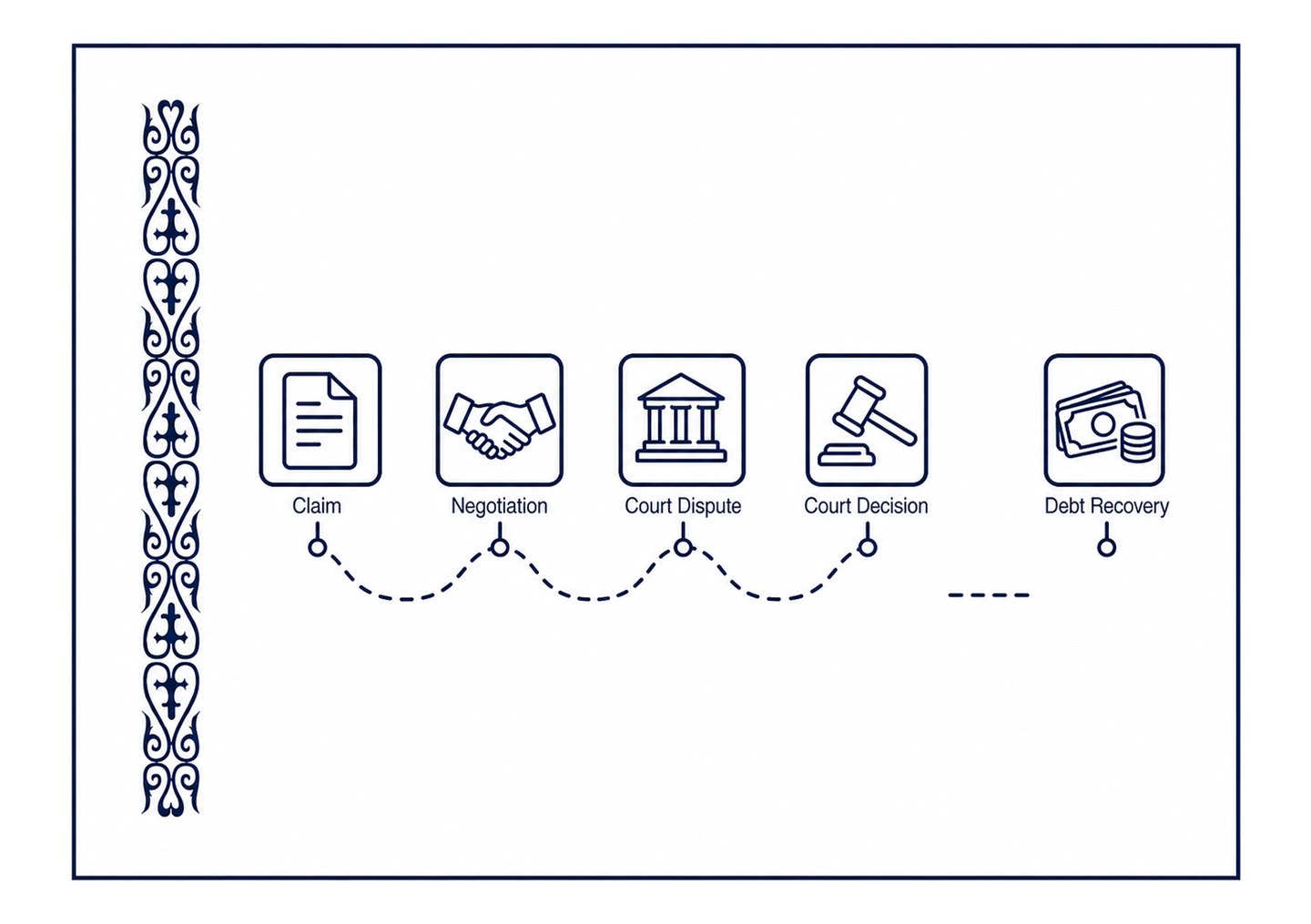
When a business faces a dispute, the first emotional request usually sounds simple: "We need to go to court". The counterparty did not pay an invoice, the supplier failed to deliver, the contractor did not perform the work, the tenant does not pay, the client refuses to sign an acceptance act, the partner breached the contract. It seems that if there is a contract and a debt, then everything further should be obvious: a lawyer prepares a claim, the court issues a judgment, the money comes back.
In practice, everything is more complicated. The court process is only one section of the road. Before the court, you need to correctly collect evidence and assess the prospects. In court, you need not just to state a position, but to prove it with documents. After the court, the judgment must be enforced. It is at this last stage that many clients understand for the first time: winning in court and actually recovering money are different things.
Therefore, claim work and a court dispute should begin not with a template claim letter and not with a statement of claim, but with an assessment of the entire chain: whether there is evidence, whether the debtor has property, whether liquidation has started, whether bankruptcy is being prepared, whether interim measures can be imposed, whether it makes sense to go to court right now and whether the future judgment can actually be enforced.
A claim letter is not a formality before court
A claim letter is often perceived as a mandatory document "for show". In fact, a good claim letter may resolve a dispute without court or, at the very least, prepare a position for a future process. In it, it is important not just to write "we ask you to pay the debt", but to show the counterparty that the company has documents, a calculation, a legal position and a readiness to go further.
In commercial disputes, a claim letter helps to record the amount of the claims, the deadlines, the grounds for the debt, the documents that confirm the position, and the consequences of refusing voluntary settlement. Sometimes a properly drafted claim letter disciplines the debtor better than long negotiations in messengers.
But there is also a downside. A weak claim letter may do harm. If it states the amount incorrectly, admits unnecessary circumstances, refers to the wrong contract or omits an important document, this same claim letter may later be used by the other side.
What to check before sending a claim letter
Before sending a claim letter, it is important to understand what the demand actually rests on. In business it often happens that the debt really exists, but the documents are poorly collected. There is correspondence, but no signed act. There is an invoice, but no confirmation of acceptance. There is a contract, but the deadlines are not specified. There is a waybill, but it was signed by a person without authority. There is a reconciliation act, but it is old or signed by the wrong person.
A lawyer must check not only the contract, but the entire evidentiary picture. If the dispute concerns supply, the contract, orders, waybills, powers of attorney, acts, payments and correspondence are needed. If the dispute concerns services, acts, reports, technical assignments, electronic correspondence and actual confirmation of the provision of services are important. If the dispute concerns a loan or a promissory note, the repayment period, the interest terms, the payments and the evidence of the transfer of money must be examined.
At this stage, the limitation period, jurisdiction, mandatory pre-trial procedure, the existence of an arbitration clause, the language of the documents and the possibility of recovering not only the principal debt, but also the penalty, interest, damages and court costs are also assessed.
Why negotiations and the claim letter should go together
In normal commercial work, a claim letter does not always mean a rupture of the relationship. Sometimes it is a way to move a dispute from emotional correspondence into a business plane. The counterparty is given a clear deadline, amount, grounds and an option for voluntary settlement. At the same time, negotiations may continue.
A good lawyer does not always immediately escalate the conflict. Sometimes it is more advantageous to offer a repayment schedule, a debt acknowledgment agreement, additional security, a letter of guarantee, a mediation agreement or a partial payment. But such documents must be drafted carefully. A simple letter "we undertake to pay later" often does not provide sufficient protection if the debtor again fails to keep the promise.
The main goal of the pre-trial stage is not just to write a claim letter, but to bring the dispute to a state in which the client understands their chances, weak points and the real cost of moving further.
When you need to go to court
Court is needed when voluntary settlement does not work, deadlines drag on, the debtor hides, transfers assets, refuses to acknowledge the debt or uses negotiations only for delay. But even in such a situation, it is important not to rush into a claim without preparation.
Before going to court, the lawyer assesses the subject of the claim. Sometimes it is necessary to recover a debt. Sometimes – to have the contract declared terminated. Sometimes – to demand the return of property. Sometimes – to challenge a transaction. Sometimes – to file several claims at once. The wording of the claims determines the state duty, the evidence, the jurisdiction and the subsequent enforcement.
Interim measures must be assessed separately. If there is a risk that the debtor will withdraw money or property, the seizure of accounts, property or a ban on performing certain actions may be considered. But interim measures are not applied automatically. The court must be shown why, without them, the enforcement of the future judgment may be difficult.
The court process: why being right alone is not enough
In business people often say: "We are right, so we will win". In court, being right alone is not enough. The court assesses evidence. If a document is not presented, not signed, contradicts another document or does not confirm the necessary fact, the position may weaken even in the case of obvious commercial unfairness.
Therefore, court work begins with evidence. It is necessary to build a chronology: when the contract was signed, what obligations arose, how they were performed, when the delay arose, which documents confirm the supply, services, payment, correspondence, acknowledgment of the debt or the counterparty's breach.
A strong court position usually looks simple. The judge should clearly understand: what the parties agreed, what one party did, what the other party did not do, what amount is subject to recovery and how this is confirmed. If a position requires too much explanation, then the documents need to be structured better.
Why winning in court does not equal getting the money back
This is the key point that must be understood before the dispute begins. A court judgment confirms the client's right. But the money comes back only when the judgment is enforced. Between the court judgment and the actual receipt of money there is a separate stage – enforcement proceedings.
After the judgment enters into legal force, it is necessary to obtain an enforcement document and present it for enforcement to an enforcement officer. Then the search for accounts, property, income, receivables, vehicles, real estate and other assets of the debtor begins. If the debtor has nothing, if the accounts are empty, if the property has already been withdrawn, if the company effectively does not operate, even a won case may not lead to a quick return of money.
This is exactly why, before filing a claim, a lawyer must give the client not only an assessment of the court prospects, but also an assessment of enforceability. The question should sound like this: "Can we win?" and immediately after: "And is there anything to recover from?".
What a lawyer should check from the enforcement standpoint
Before court, it is useful to check whether the debtor exists, whether it is in liquidation or bankruptcy, whether there are court cases with its participation, whether there are enforcement proceedings, how long the company has been operating, who its director and participants are, whether there are signs of asset withdrawal or mass debts.
If the debtor is a legal entity, it is important to understand whether it is a genuinely operating company or an empty shell. If the debtor is an individual, it is necessary to assess the existence of property, official income, other debts, marriage, pledges and restrictions.
Sometimes such a check changes the strategy. Instead of an ordinary claim, it is necessary to request interim measures faster. Sometimes it is necessary to record an acknowledgment of the debt. Sometimes it is necessary to go not only to the debtor, but also to analyze sureties, guarantors, pledgers or the possibility of challenging transactions.
Enforcement proceedings: what happens after court
After enforcement proceedings are opened, the enforcement officer applies measures of compulsory enforcement. This may be levying on money in accounts, seizure of property, prohibitions on registration actions, travel restrictions, requests to state databases, sale of property at auction and other measures within the framework of the law.
But enforcement proceedings require control. You cannot simply hand over the writ of execution and wait. It is necessary to interact with the enforcement officer, provide information about the debtor's assets, file motions, track actions, check responses from banks and state bodies, react to inaction.
For a creditor, an active position is often more important than the very fact of having an enforcement document. Enforcement is separate work, not an automatic continuation of the court judgment.
When a dispute may move into bankruptcy
If the debtor does not fulfill obligations to several creditors, hides property, ceases activity or has signs of sustained insolvency, an ordinary dispute may move into the plane of bankruptcy. For the creditor, this is already a different set of instruments.
In the bankruptcy procedure, it is important to get into the register of creditors' claims, confirm the amount of the debt, monitor the manager's actions, analyze the debtor's transactions and, if necessary, raise the question of subsidiary liability of the controlling persons. If the debtor withdrew assets in advance, ordinary enforcement proceedings may turn out to be a weak instrument, while bankruptcy is a more correct way to check the movement of property.
But bankruptcy is not always advantageous for the creditor. Sometimes it means that there will not be enough property for everyone. Therefore, the decision to move to a bankruptcy strategy must be made after a legal and financial assessment.
How Qozhan Consulting helps
We accompany the client at all stages of the dispute: analysis of documents, the claim letter, negotiations, preparation of the claim, the court process, enforcement proceedings and assessment of bankruptcy risks. For us, it is important not just to "file a claim", but to understand what result the client needs and whether it can actually be obtained.
If the client's goal is to recover money, we immediately look at the evidence and enforceability. If the goal is to defend against unfounded demands, we check the weak points of the other side's position. If the dispute can be closed by an agreement, we prepare the documents so that they actually protect the client. If court is inevitable, we build the position taking into account the evidence, deadlines, duties and future enforcement.
Conclusion
Claim work and a court dispute are not a set of template documents. This is a route from the analysis of evidence to real enforcement. Sometimes a properly prepared claim letter solves the problem without court. Sometimes court is necessary. But in any case, the client must understand the main thing: a won judgment is not yet the recovered money. Therefore, before starting a dispute, it is necessary to assess not only the legal position, but also the possibility of actual recovery.