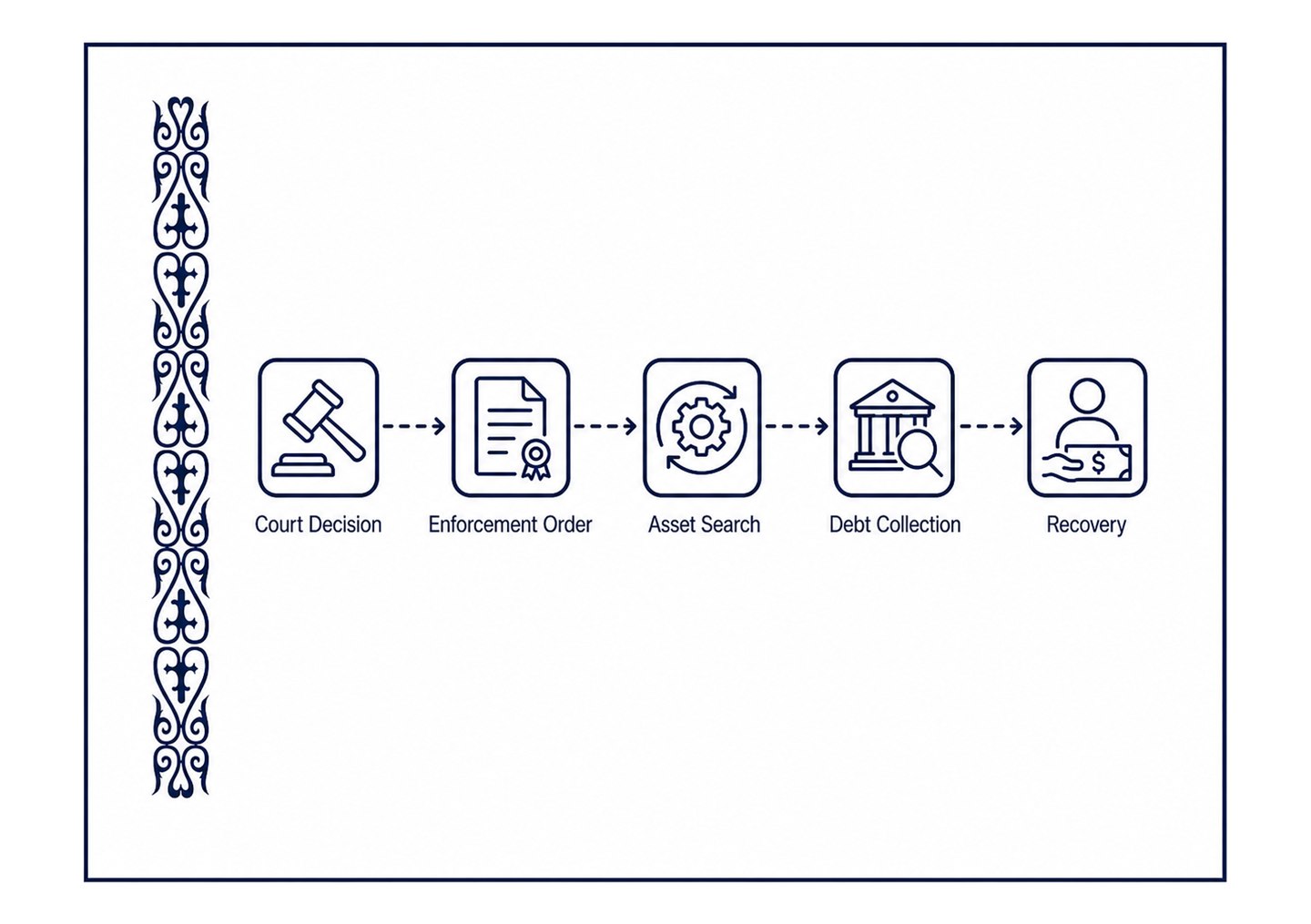
When a client wins in court, there is a natural feeling that the dispute is over. There is a judgment, the court has recognized the right, the debtor is obliged to pay or to perform certain actions. But in practice, it is precisely after the court that a second, no less important stage often begins – enforcement proceedings.
For a business, this is an especially sensitive moment. A court judgment by itself does not return money to the account. It confirms the creditor's right, but the actual result depends on whether the debtor has property, money, an operating business, open accounts, receivables, participation interests, vehicles, real estate, and how correctly the work with the enforcement officer is structured.
Therefore, enforcement proceedings should not be treated as a technical appendix to the court. Sometimes a client wins the case but does not receive money, because the debtor has already withdrawn assets, ceased activity, gone bankrupt, re-registered property or simply has nothing that can be levied upon. In such situations, not only the lawyer who conducts the court case matters, but also the lawyer who assesses the enforceability of the future judgment in advance.
In this article, we will look at what enforcement proceedings are, how they begin, what measures an enforcement officer can take, what the creditor should do, how the debtor should act, and why, before filing a claim, you need to think not only about winning in court but also about the real recovery of money.
What enforcement proceedings are, in simple terms
Enforcement proceedings are the stage at which a court judgment or another enforcement document is carried out compulsorily. If the debtor does not voluntarily pay, does not transfer property, does not vacate premises, does not fulfill an obligation or does not perform the required action, the creditor turns to an enforcement officer.
The enforcement officer does not review the dispute on its merits. Their task is to enforce the document already issued by a court, notary or other authorized body. If the enforcement document orders the recovery of money, the officer must search for the debtor's money and property. If it orders the performance of an action, the officer supervises the performance of that action within their powers.
In simple terms, the court answers the question: "Who is right?". Enforcement proceedings answer a different question: "How do you actually obtain what was awarded?".
This is exactly where many clients face disappointment. A won case does not mean that the debtor will transfer the money themselves. If the debtor does not comply with the judgment voluntarily, the mechanism of compulsory enforcement must be launched and this process must be actively controlled.
Why winning in court does not equal getting the money
In commercial disputes, it is important to distinguish in advance a legal victory from an economic result. A legal victory is a court judgment in your favor. The economic result is the money, property or actual performance that you received after the court.
There may be a large distance between these two points.
For example, a company recovers a debt from a counterparty. The court recognizes the debt, issues a writ of execution, proceedings are opened. But the debtor has no money in the accounts, no real estate, no vehicles, the employees have already been dismissed, and activity has effectively stopped. In such a situation, the court judgment exists, but getting the money quickly is difficult.
Another example: the debtor continues to operate, but money passes through other companies of the group, property is registered to third parties, and contracts are concluded through a new supplier. Formally, the debt belongs to one legal entity, while the economic activity has already been moved elsewhere.
Therefore, a lawyer should assess enforceability even before the court. It is necessary to understand:
- whether the debtor is actually operating;
- whether they have property;
- whether there are bank accounts and turnover;
- whether they are listed in registers of debtors;
- whether there are signs of bankruptcy;
- whether they have state or commercial contracts;
- whether interim measures can be taken in advance;
- whether there is a risk of asset withdrawal;
- whether there are grounds for future subsidiary liability of the director or participant.
If this is not done, the client may spend time and money on the court, obtain a positive judgment, and then face the impossibility of real recovery. Therefore, in serious disputes, we always look not only at the prospect of winning, but also at the prospect of enforcement.
Which documents can be presented for enforcement
Enforcement proceedings begin not with an ordinary letter and not with a claim letter. An enforcement document is needed. The clearest example is a writ of execution issued by the court after the judgment enters into legal force.
In addition to the writ of execution, other documents may be presented for enforcement, for example a court order, a notary's writ of execution, rulings in administrative cases and other documents that are subject to compulsory enforcement by law.
For business, three situations most often occur.
The first is a court judgment and a writ of execution. This is the classic model after claim proceedings.
The second is a court order. It may be applied to certain undisputed claims, if the law allows such a procedure.
The third is a notary's writ of execution. It may be convenient if the obligation is formalized in a way that allows turning to a notary without a full court dispute. But this instrument requires careful preparation of documents in advance. If the contract and primary documents are drawn up poorly, the notary's writ may not work or may be challenged by the debtor.
The main idea is simple: the enforcement document must comply with the requirements of the law. If it contains an error, incorrect data of the debtor, an inaccurate company name, an incorrect BIN or IIN, problems may begin already at the stage of opening the proceedings.
Deadlines for presenting the enforcement document
Deadlines cannot be ignored. In Kazakhstan, writs of execution and court orders issued on the basis of court judgments, as well as notary's writs of execution, may be presented for compulsory enforcement within three years. Special deadlines apply to certain categories of documents. For example, a period of one year may apply to rulings in administrative offense cases, unless the law establishes otherwise.
It is also important that enforcement documents for periodic payments, for example alimony or compensation for harm to health, remain valid for the entire period for which the payments are awarded. In such cases, the deadline is calculated separately for each payment.
In practice, the presentation deadline may be interrupted, for example if the enforcement document has already been presented to the enforcement officer, if the debtor has partially performed the document or is on the wanted list. But it is better not to bring the situation to disputes about deadlines. If the creditor has received an enforcement document, it must be analyzed and put into action without an unnecessary pause.
A creditor's mistake is to obtain a writ of execution, put it in a folder and return to the issue several years later. During this time, the debtor may lose assets, change address, cease activity or go bankrupt. Enforcement must be started while the debtor still exists as a functioning economic entity.
How enforcement proceedings are opened
The creditor files an application and the enforcement document. This can be done through the relevant state services, through the AIS OIP (automated information system of enforcement proceedings), or by applying to an authorized body, the state corporation or an enforcement officer, depending on the type of document and the situation.
On eGov, the service of opening enforcement proceedings on the basis of an enforcement document is provided free of charge, and the result is a ruling of the enforcement officer on opening enforcement proceedings or on refusal to open them. Online filing requires authorization and an electronic digital signature (EDS).
After enforcement proceedings are opened, the debtor is notified, and the enforcement officer begins to apply the measures provided by law. But the creditor should not expect that everything further will happen automatically. Formally, the system is launched, but effectiveness often depends on the creditor's activity and the quality of the information they provide to the enforcement officer.
If the creditor knows where the debtor's property is, which banks they use, who their counterparties are, where the office is located, what vehicles or real estate objects may be connected with them, this information must be provided. The enforcement officer has instruments, but the creditor often knows the debtor's business better than the state system does.
State and private enforcement officers
In Kazakhstan, enforcement proceedings are conducted by enforcement officers. In practice, many commercial recoveries are handled by private enforcement officers.
A private enforcement officer is a citizen of Kazakhstan who engages in private practice of enforcing enforcement documents on the basis of a license. They are not the creditor's advocate and do not become the personal representative of one party. Their status is connected with the compulsory enforcement of the document within the framework of the law.
For the creditor, it is important to choose the officer correctly and then work with them systematically. It is not enough to simply hand over the writ of execution. It is necessary to track rulings, check requests, control seizures, react to inaction and, if necessary, file applications, motions or complaints.
The remuneration of a private enforcement officer's activity depends on the category of the case and the amount of recovery. For monetary claims, a percentage of the recovery amount applies, and in case of partial performance, the payment is made proportionally to the recovered amount or the value of the property. This is important to explain to clients in advance, because enforcement proceedings also have an economic side.
What measures an enforcement officer can take
The law gives the enforcement officer a set of measures aimed at compulsory enforcement. In monetary disputes, measures related to the search for and seizure of assets are most often important.
The enforcement officer may take measures to seize the debtor's money and property, including money in bank accounts, property held by the debtor or by third parties, movable and immovable property, securities, participation interests and other property rights. Prohibitions on performing certain actions, restrictions on the disposal of property, seizure of property, levying on income and other measures may also be applied.
If the debtor is a legal entity, not only money in accounts may be important, but also participation interests, receivables, property, vehicles, equipment, warehouse stock, claims against counterparties. If the debtor is an individual, accounts, salary, real estate, vehicles, shares in companies and other property are analyzed.
A separate measure is a temporary restriction on leaving the Republic of Kazakhstan. It is applied in cases established by law to an individual or to the head of a legal entity that is a debtor. For a business, this may be a sensitive instrument, especially if the debtor or the head often travels outside Kazakhstan.
But measures should not be applied chaotically. They must be proportionate, lawful and aimed at enforcing a specific document. If the enforcement officer violates the procedure, the debtor has the right to defend themselves and to appeal the actions.
What the creditor should do after proceedings are opened
The creditor's main mistake is to believe that after handing over the writ of execution the work is finished. In practice, enforcement proceedings must be accompanied almost as carefully as a court process.
The creditor needs to:
- obtain the ruling on opening enforcement proceedings;
- verify the correctness of the debtor's data;
- provide the enforcement officer with all known information about assets;
- request measures to seize accounts and property;
- track responses from banks, state bodies and registers;
- control deadlines and the officer's actions;
- file motions if the officer is inactive;
- analyze whether assets are being withdrawn;
- if necessary, initiate additional court procedures.
Sometimes enforcement proceedings require parallel legal work. For example, if the debtor's property has been re-registered to third parties, a separate lawsuit may be required. If the debtor goes bankrupt, claims must be filed in the bankruptcy procedure. If the head or participant brought the company to the impossibility of paying its debts, the question of subsidiary liability may arise.
Therefore, enforcement proceedings are not simply "hand the document to the officer". This is a separate recovery strategy.
What the debtor should do
Enforcement proceedings are important not only for the creditor. The debtor also cannot ignore the enforcement officer's rulings. If the debtor believes that the proceedings were opened incorrectly, the amount is stated wrongly, the document has already been performed, the presentation deadline was missed or the measures are excessive, they must react officially.
The debtor may present evidence of payment, state objections, ask to clarify the enforcement procedure, apply to the court for a deferral or installment of enforcement, appeal the actions or inaction of the enforcement officer. But simply not receiving notifications, not answering requests and not opening messages is a bad strategy.
The longer the debtor stays silent, the higher the risk of account seizure, restrictions, additional costs and a worsening negotiating position. If the debt exists, it is sometimes better to build a repayment schedule or a settlement agreement than to bring the situation to a blocking of activity.
For a legal entity, it is especially important to understand: enforcement proceedings may affect not only current accounts, but also property, participation interests, receivables and business reputation. The existence of enforcement proceedings may be visible to counterparties and banks through registers and checks.
Complaint against actions or inaction of the enforcement officer
The enforcement officer has broad powers, but they are not unlimited. If the creditor sees that the officer does not take measures, does not send requests, does not react to motions, does not seize property or formally conducts the proceedings without a result, the inaction can be appealed.
The debtor, in turn, may appeal unlawful or excessive measures: the seizure of property that does not belong to the debtor, an incorrect calculation of the debt, a violation of the notification procedure, restrictions applied without grounds.
The deadlines for appeal are short. Therefore, you need to act quickly. In a number of cases, the complaint is filed with the court within ten working days from the day the action was performed or from the day the person learned of the violation of their rights.
At the same time, the complaint should not be emotional. It is necessary to show a specific violation: which action was not performed, which ruling is unlawful, which documents confirm this and what decision the court should make.
Register of debtors and reputational consequences
Enforcement proceedings may have consequences not only in the form of recovery of money. Information about the debtor may be reflected in registers, used by banks, counterparties, state bodies and the creditor itself when assessing payment discipline.
For business, this matters. A company that is listed as a debtor in enforcement proceedings may face questions from a bank, a counterparty's refusal of prepayment, problems in tenders, additional compliance requests and a worsening of business reputation.
Restrictions may also be sensitive for the head of a legal entity, if they are applied within the framework of enforcement proceedings. Therefore, it is better for the debtor not to bring the situation to compulsory measures if there is an opportunity to settle the debt earlier.
Enforcement against a legal entity: where to look for the real source of recovery
If the debtor is an LLP, it must be remembered that, as a general rule, the LLP itself is liable for its obligations with its own property. A participant of an LLP is not liable for the company's debts merely because they are a participant. The director also is not automatically liable for every debt of the company.
But this does not mean that the creditor should stop if the LLP has no money in the account. It is necessary to analyze whether there is property, receivables, assets, transactions to withdraw property, affiliated companies, signs of intentionally bringing the company to insolvency.
In certain situations, the question of subsidiary liability of the head or participant may arise, but this is no longer an ordinary enforcement action, but separate legal work. It is necessary to prove not simply the existence of a debt, but a causal link between the actions of the controlling persons and the company's inability to fulfill its obligations.
Therefore, in enforcement proceedings for the debts of a legal entity, it is important to think more broadly than "is there money in the account or not". Sometimes the real work begins with an analysis of where the assets went and who made the decisions.
Enforcement against an individual
If the debtor is an individual, enforcement proceedings are built around their personal assets and income: bank accounts, salary, vehicles, real estate, participation interests in companies, other property. At the same time, restrictions and special rules must be taken into account, because not all property can be levied upon in the same way.
For individuals, prohibitions and restrictions are especially sensitive: seizure of accounts, deductions from income, travel restrictions, being listed in registers of debtors. If the debt is significant and enforcement is impossible, the question of individual bankruptcy may arise. But bankruptcy is a separate procedure that should not be used as a simple way to "remove the debt" without analyzing the consequences.
Settlement agreement and voluntary performance
Not every enforcement proceeding should end with the sale of property. Sometimes it is more reasonable to agree on a payment schedule, partial repayment, transfer of property, set-off or another option that is faster and cheaper for both parties.
For the creditor, it is important that such agreements are formalized correctly. An oral agreement with the debtor often leads to a loss of time. If the parties agree on an installment plan, it is necessary to fix the deadlines, amounts, consequences of breach and to understand what will happen to the enforcement proceedings.
For the debtor, voluntary performance may reduce costs, preserve business reputation and avoid harsher measures. For the creditor, it is an opportunity to get money faster than through a long search for and sale of property.
Why enforcement proceedings should be considered already at the contract stage
The strongest way to improve future enforceability is to prepare documents correctly before a dispute arises. A contract must contain clear payment terms, deadlines, acts, a procedure for confirming the debt, liability, jurisdiction, documents on supply or services.
If the business works with deferred payment, the counterparty must be checked in advance. If the amount is large, it is worth thinking about security: pledge, guarantee, surety, prepayment, retention of documents, staged delivery, the right to suspend services. Sometimes properly formalized security is more important than a beautiful claim letter after a breach.
When a dispute has already arisen, interim measures in court should be considered. If there is a risk of asset withdrawal, the court may be asked to take measures before the judgment is issued. This is not always simple, but sometimes it is precisely interim measures that determine whether the judgment will actually be enforced.
How Qozhan Consulting helps
We accompany enforcement proceedings as part of an overall recovery strategy. For us, it is important not just to obtain a court judgment, but to assess whether it can be enforced and what actions will actually lead to the recovery of money.
We analyze the debtor, the enforcement document, the presentation deadlines, compulsory enforcement measures, assets, registers, possible restrictions, the enforcement officer's conduct and the prospect of additional procedures. If the officer is inactive, we prepare motions and complaints. If the debtor withdraws assets, we analyze further court instruments. If the debtor goes bankrupt, we help assess how to file claims and protect the creditor's interests.
For debtors, we also help assess the lawfulness of the enforcement officer's actions, prepare a position, appeal violations, agree on the enforcement procedure or build a lawful debt-repayment model.
Conclusion
Enforcement proceedings are not a formality after the court. This is a separate stage on which the real result of the dispute depends. You can win the case, obtain a writ of execution and still not recover the money, if you do not assess the debtor in advance and do not control enforcement.
Therefore, the right work begins earlier: with checking the counterparty, the contract, interim measures, analyzing the debtor's property and understanding how the future judgment will be enforced. A court victory is important, but for a business the result matters more – the receipt of money, the return of property or the actual performance of the obligation.
Qozhan Consulting helps clients look at the dispute in full: from the claim letter and court to enforcement proceedings and real recovery. This approach reduces the risk of obtaining a beautiful court judgment that cannot be turned into money.