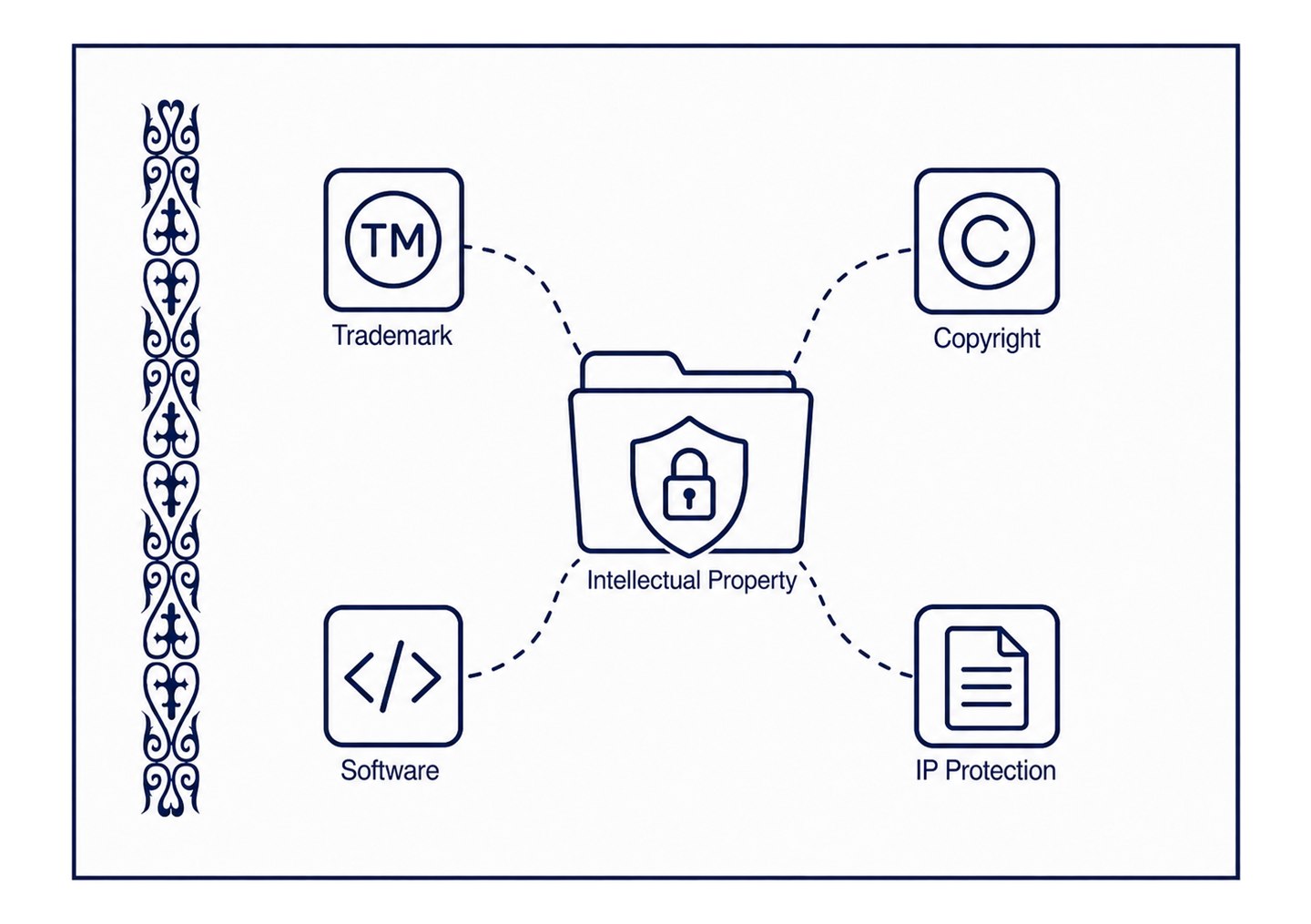
Intellectual property often sounds like something big and complex: patents, trademarks, copyrights, licenses, software, design, franchises. In practice, for a business everything is simpler. Intellectual property is what a company creates, buys, uses or sells not as an ordinary tangible good, but as the result of an idea, creativity, technology, a brand or reputation.
For a foreign business entering Kazakhstan, this topic is especially important. A company may open an LLP, obtain an IIN, BIN, EDS, open an account and start working, but at the same time fail to check who owns the logo, the website, the code, the brand, the commercial name, the contracts with designers, the photographs and the marketing materials. Formally, the business is launched, but the key assets may turn out to belong not to the company, but to a contractor, a partner or a private individual.
Therefore, it is better to perceive intellectual property not as a separate legal service, but as part of the normal setup of a business. This is especially true if the company works in IT, e-commerce, consulting, education, media, manufacturing, trade, franchising or online services.
What counts as intellectual property
In Kazakhstan law, intellectual property is conventionally divided into two large blocks.
The first block is the results of intellectual creative activity. This includes works of science, literature and art, computer programs, databases, inventions, utility models, industrial designs and other results of creative or technical labor.
The second block is means of individualization. This is what helps to distinguish one market participant, their goods or services from others. This group includes trademarks, company names, geographical indications, appellations of origin of goods and other designations.
In simple terms, a business's intellectual property may be in different places:
- in the brand name;
- in the logo;
- in the website;
- in the software code;
- in the interface design;
- in the database;
- in photographs and videos;
- in texts and presentations;
- in methodologies and training materials;
- in a technical solution;
- in the packaging;
- in commercial materials;
- in the contractual model of a franchise or license.
The mistake of many companies is that they see only the brand. In fact, the brand is only one part. The website, the code, the design, the texts, the client base, photos, advertising creatives and technical solutions may also be objects of rights or a source of dispute.
Trademark: protection of the name and logo
A trademark protects the designation by which a client recognizes a product or service. This may be a name, a logo, a combined mark, a slogan or another element that distinguishes the business in the market.
For a business, a trademark is important not only as a "brand certificate". It is needed for advertising, marketplaces, franchising, protection against copying, negotiations with investors, work with partners and the fight against unfair competitors.
If a company operates under a brand but does not register a trademark, a risk arises. Someone else may file a similar designation earlier, and then the business will have to prove its position, change the brand or conduct a dispute. This is especially sensitive if a website, advertising, packaging and a client base have already been launched.
It is important to remember: registering an LLP and registering a trademark are different things. The company name in the register of legal entities does not equal protection of the brand as a trademark. A domain name and a social media account also do not replace trademark registration.
Copyright: texts, website, design, photos, videos and code
Copyright protects works created by creative labor. Registration is not required for copyright to arise. The right arises from the moment the work is created.
In practice, for a business this concerns a very large number of materials:
- texts on the website;
- articles and presentations;
- photographs;
- videos;
- website design;
- graphics and illustrations;
- software code;
- databases;
- training materials;
- advertising creatives;
- instructions and methodologies.
But there is an important practical nuance here. The fact that a company paid for a contractor's work does not always mean that all rights automatically passed to the company. If a designer drew a logo, a developer wrote code, a photographer did a shoot, a copywriter prepared texts, the contract must be examined. The contract must clearly state which rights are transferred, in what scope, in what territory, for what period, and whether the company may modify, use and further transfer the result.
Otherwise, an unpleasant situation may arise: the website is created, the money is paid, but the rights to the source files, code, layouts or illustrations are poorly formalized. As long as everyone works calmly, this may not be a problem. But when selling the business, in a dispute with a contractor, when launching a franchise or during an investor's check, the question surfaces immediately.
Is it necessary to register copyright
Copyright does not require mandatory registration. But registration may be useful as evidence. It helps to record the object, the date, the author and information about the rightsholder. This is especially relevant for programs, databases, training materials, texts, design and other objects that may be used in commercial activity.
Registration does not create copyright from scratch, because the right arises at the moment of creation. But it may simplify proof in a dispute. For example, if it is necessary to show that a specific program, text, design or database existed with the rightsholder on a certain date.
For IT companies and online projects, this may have practical significance. When a project grows, several developers, contractors, clients and investors appear, and it is important to have not only a repository and correspondence, but also a proper legal recording of rights.
Patents: when an idea becomes a technical solution
Not every idea can be patented. In business people often say: "We have an idea, we need to protect it with a patent". But a patent protects not simply a thought or a business model, but a technical solution that meets the established requirements.
In Kazakhstan, patent protection applies to inventions, utility models and industrial designs.
An invention is a technical solution that must be new, involve an inventive step and be industrially applicable. This is a more complex object that requires serious preparation of the application.
A utility model usually relates to a technical solution that may be simpler in level, but must still have a technical essence. It is often considered for devices, structures and practical technical solutions.
An industrial design protects the external appearance of a product: the shape, configuration, ornament, combination of elements, the design that is perceived visually.
For a business, it is important to understand what exactly needs to be protected. If it is about a name – it is a trademark. If it is about a text, code or website design – it is copyright. If it is about a technical solution – possibly a patent. If it is about the external appearance of a product – an industrial design. If it is about commercial information – a confidentiality regime.
Trade secret and confidential information
Not all valuable information is registered with Qazpatent. Sometimes the most important asset of a company is the client base, commercial terms, financial model, working methodology, internal instructions, marketing strategies, suppliers, algorithms or negotiating position.
Such information is protected not through a certificate, but through a confidentiality regime. This requires contracts, internal rules, access restrictions, NDAs, trade secret regulations and a clear system of document storage.
If a company simply writes in a contract "all information is confidential", but in no way restricts access, does not mark documents and does not explain the work procedure to employees, the protection will be weak. Confidentiality must work not on paper, but in real processes.
Intellectual property in contracts with employees and contractors
Most IP risks appear not in Qazpatent, but in contracts. A company orders a logo, website, application, texts, design, brand strategy or presentation. The contractor performs the work. Then the parties sign an act. But the question of rights is often written too generally.
In the contract, it is necessary to determine in advance:
- who is the author;
- to whom the property rights pass;
- whether the company may modify the result;
- whether the result may be used in advertising and on the website;
- whether the result may be transferred to clients, partners or investors;
- whether the source files are transferred;
- whether the contractor retains the right to show the work in a portfolio;
- whether there are restrictions on territory and term;
- what happens if someone else's fonts, photographs, templates or elements were used in the work.
Documents are also important for employees. If an employee creates code, design, texts or methodologies within the framework of their job duties, it is necessary to correctly formalize the employment contract, the job description, the service assignment, acts or internal documents. Otherwise, a dispute may later arise about whether the work was created within the framework of employment or personally by the author outside the company.
Website and brand: where problems arise most often
A website is often assembled from different elements: domain, texts, photos, design, code, CMS, plugins, fonts, icons, illustrations, logo, videos, privacy policy, user agreements. Each element may have its own legal regime.
For example, a designer might have used a font whose license does not allow commercial use. A developer might have used a template without the right to resell. Photographs might have been taken from the internet without a license. Texts might have been copied from another website. At the start, this seems like a trifle, but during an advertising campaign, a rightsholder's claim or the sale of the project, all these questions become real risks.
Therefore, before launching a website, it is important to check not only the legal texts, but also the rights to the content. This is especially true if the website will be used for Google Ads, Yandex Direct, SEO promotion and international clients.
Intellectual property for foreign business in Kazakhstan
If a foreign company enters Kazakhstan, it is necessary to separately check which rights already exist abroad and which need to be formalized in Kazakhstan.
For example, a trademark registered in another country does not always automatically protect the brand in Kazakhstan. It is necessary to analyze national registration or international protection. If a foreign company transfers to a Kazakhstan LLP the right to use the brand, it is advisable to formalize a license or other contractual model.
If a Kazakhstan LLP orders a website, marketing or development from foreign contractors, it is necessary to take into account the law applicable to the contract, the language of the documents, the transfer of rights, payment, withholding tax at source and evidence of the actual transfer of the result.
For international business, intellectual property must be connected with the corporate structure. It is necessary to understand where the brand owner is located, who uses the mark, who receives income, who concludes contracts and who bears the risks in the event of a dispute.
Intellectual property and investments
When a company attracts an investor or sells a share, the check of intellectual property becomes part of due diligence. The investor wants to understand who owns the brand, whether the trademark is registered, who owns the code and the website, whether there are contracts with developers, whether the rights of third parties are being violated, whether the product can be scaled.
If the documents are not formalized, the value of the business may decrease. The buyer or investor sees a risk: the company earns on the product, but the rights to the key elements are not confirmed. In such a case, one has to urgently collect contracts, sign additional agreements, restore acts and formalize the transfer of rights.
It is better to do this in advance. Intellectual property must be assembled into a clear package: trademarks, contracts, acts, confirmation of the transfer of rights, access to source materials, registration of copyright if necessary, confidentiality and licenses.
Common mistakes
The first mistake is to believe that an idea is protected by itself. The law protects not an abstract idea, but a specific form of expression, a designation, a technical solution, a design or documented information.
The second mistake is to confuse the name of an LLP with a trademark. Registering a company does not replace registering a brand.
The third mistake is to pay a contractor for development and not formalize the transfer of rights. The money is paid, the result is received, but legally the rights may not be fully formalized.
The fourth mistake is to use images, fonts, templates and music without checking the license. This is especially sensitive in advertising and public materials.
The fifth mistake is to register a trademark too late, when the brand is already in use and changing it is expensive.
The sixth mistake is not to connect IP with the corporate structure. The brand may be on one person, the website on another, the contracts on a third, and the income is received by a fourth. For an investor, bank or partner, such a structure looks confusing.
How Qozhan Consulting helps
We help businesses look at intellectual property as part of the overall legal system. We check trademarks, contracts with contractors, rights to the website, logo, texts, code, design, confidential information and documents for the transfer of rights.
If a client is only launching a business, we help understand in advance what needs to be registered, what needs to be spelled out in contracts, which rights should pass to the company and which risks are better closed before advertising and active sales.
If the business is already operating, we can conduct an IP check: what is formalized, what is not, which documents need to be restored, where there is a risk of dispute and what needs to be prepared before an investor, partner or scaling.
Conclusion
Intellectual property is not only patents and trademarks. For a modern business, it is the brand, website, code, design, texts, photographs, methodologies, databases, contracts and confidential information. The earlier a company understands who owns these assets and how they are protected, the lower the risk that an important element of the business will turn out to be legally foreign or poorly formalized.