Business often turns to a consultant only when the problem has already occurred: the bank has requested documents, the tax authority has sent a notification, a counterparty has not paid an invoice, the contract turned out to be weak, an employee left with a dispute, and the deadline for a response has almost expired. In such a situation legal help turns into emergency response.
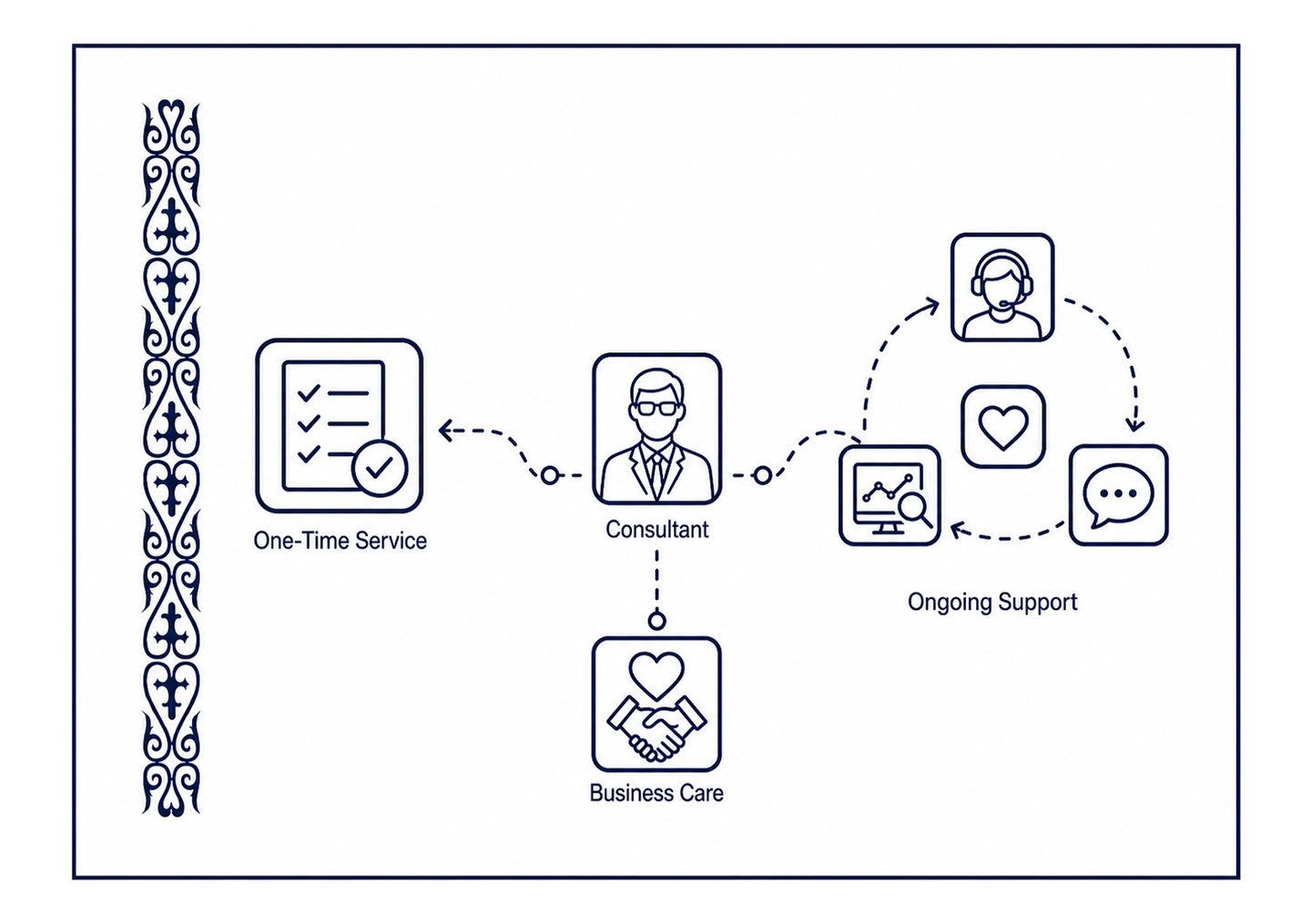
One-time services are needed and can be effective. But not all business tasks can be solved on a one-time basis. For a company that works in Kazakhstan constantly, especially with foreign participation, what is often more important is not a separate consultation, but a system of regular support.
1. When a one-time service is enough
A one-time service is suitable when the task is clear, limited and does not require constant control after completion. For example, when you need to prepare one contract, check a specific letter from the bank, get advice on a tax question, register a change or respond to one request.
In such cases one-time work is convenient: there is a specific question, a specific result and a clear cost. But it does not replace support if the problem is connected with the constant operations of the business.
2. When a one-time approach starts to harm
A problem arises when a company tries to close constant risks with one-time services. For example, each new contract is checked separately, but no one monitors the overall contractual policy. Tax questions are solved by one notification, but the accounting is not analyzed. Bank requests are closed with documents, but the business model for the bank remains unclear.
As a result, the consultant sees only a fragment of the picture each time. They can help with a specific question, but do not manage the risk as a whole.
3. What ongoing support is
Ongoing support is not a "lawyer on the phone" and not endless consultations without a result. It is a format in which the consultant knows the client's business model, their contracts, the bank, the tax regime, the ownership structure, the employees, the counterparties and the typical risks.
Support usually includes several areas:
- contracts and correspondence with counterparties;
- tax and accounting questions at the intersection with legal risks;
- bank compliance and responses to requests;
- corporate changes;
- claims work;
- support of current operational questions.
4. Why support is especially important for foreign business
A foreign company that enters Kazakhstan often does not see local technical risks. In its country a contract may work differently, the bank may ask other questions, the tax system may be more familiar, and digital procedures do not require an IIN, a BIN and an EDS. In Kazakhstan all these elements are connected with each other.
If a consultant accompanies the business constantly, they help not only to respond to problems, but also to build the route in advance:
First — the correct structure: an LLP, a branch or a representative office.
Then — the bank, the director, the powers and the documents.
After that — contracts, accounting, taxes and internal procedures.
Next — regular checking of risks, so that the business does not solve each problem anew.
5. How to calculate the cost of a mistake
A one-time consultation seems cheaper. But the cost of a mistake is often higher than the cost of regular support. If a contract does not contain a normal acceptance procedure, the company may lose payment. If a tax notification is processed incorrectly, you can get an account block. If the bank does not understand the operations, the account may become practically unusable for work.
That is why the question must be put not only like this: how much does a consultant cost? A more correct question is: how much can the absence of regular control cost?
6. What is better to give for ongoing support
Not every task needs to be handed over to a consultant on a permanent basis. But there are blocks where regularity gives real value.
- standard contracts and their updating;
- control of claims correspondence;
- legal support for the accountant;
- bank and compliance requests;
- corporate decisions and the powers of signatories;
- preparation for checks and disputed situations.
7. When it is better to combine formats
The most workable model for many companies is a combined one. Basic questions are closed within ongoing support, and large projects are drawn up as separate tasks. For example, ordinary contracts, letters and consultations go in a subscription format, while a court dispute, the registration of a license or a complex restructuring are paid for separately.
This approach is more honest for both sides. The client receives regular protection, and the consultant does not turn a complex project into hidden unpaid work.
8. How to choose a consultant
The choice of a consultant should not be based only on price. What matters is whether they understand precisely the client's business model. For a foreign company it is especially important that the consultant sees the connection between corporate law, taxes, the bank, migration, contracts and accounting.
It is useful to check:
- whether the consultant has experience working with foreign clients;
- whether they understand bank compliance;
- whether they can work with contracts and claims;
- whether they can explain risks in plain language;
- whether they are ready to accompany not only the document, but also the process.
Conclusion
A one-time service is suitable for a specific task. Ongoing support is needed where the business works regularly and risks repeat. For a company with foreign participation in Kazakhstan, support often becomes not an expense, but an element of sustainable work.
A good consultant must not just answer questions, but help the business not to bring each situation to a conflict, a block, a claim or an urgent correction.