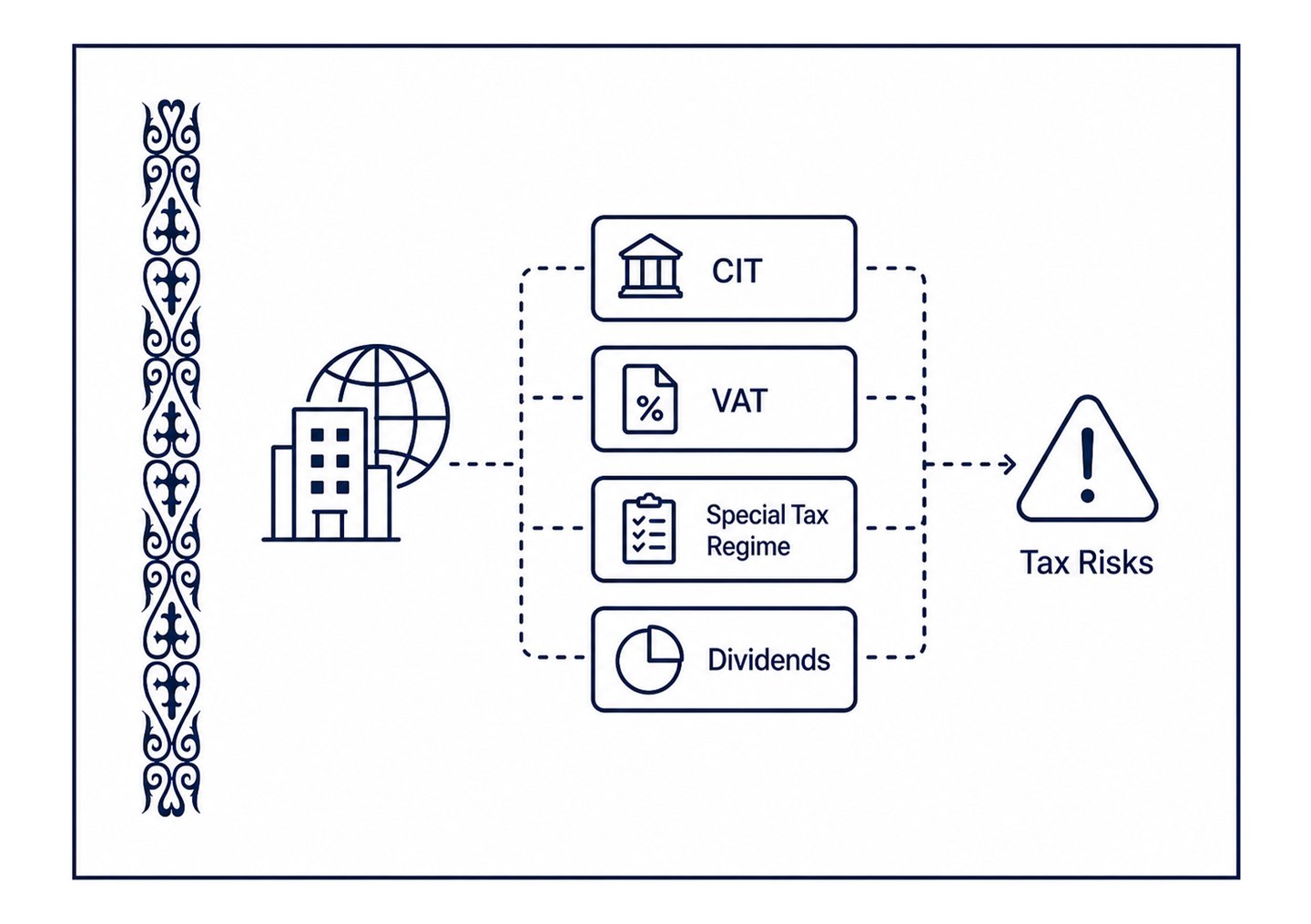
A foreign company entering the Kazakhstan market often starts with a corporate question: whether to open a limited liability partnership (LLP), a branch, a representative office or to work directly as a non-resident company. But the tax question must be raised at the same time as the corporate one. The same commercial model can produce different tax consequences depending on who concludes the contract, where the work is performed, who receives the income, how the documents are drawn up and what payments go through Kazakhstan.
From 2026 the tax environment in Kazakhstan is changing. The new Tax Code increases the importance of planning: the base rate of value added tax (VAT) is set at 16%, the threshold for mandatory VAT registration is being lowered, special tax regimes are being optimized, and approaches to administration are changing. For foreign business this means that the tax model cannot be left "for later". It must be built before the first contract and the first payment.
This article does not replace individual tax advice. Its task is to show which questions a foreign company must check at the start so as not to create a tax risk in the very first months of operation.
1. First the structure, then the taxes
Taxes depend on the structure of presence. If a foreign company creates an LLP, the Kazakhstani company becomes the taxpayer. If a branch is opened, the activity of the foreign company in Kazakhstan may be taxed through a permanent establishment. If a foreign company works directly without registration, tax consequences may arise through income from sources in Kazakhstan and withholding tax at the source of payment.
Before launch you need to choose not only the legal shell, but also the tax logic:
An LLP is a separate Kazakhstani company that keeps accounting, pays taxes and distributes dividends to the participant. A branch is part of a foreign company through which it can carry out activity in Kazakhstan. A representative office is a limited format of presence that should not turn into full commercial activity. Working without registration is possible in certain cases, but it requires checking the withholding tax, the permanent establishment and the contractual model.
A mistake at the start arises when a client chooses the structure only by the speed of registration. It is possible to open a company quickly, but if the structure does not correspond to the tax model, it is harder to correct the consequences later.
2. CIT: the profit tax of a Kazakhstani company
Corporate income tax (CIT) for a Kazakhstani LLP applies to the taxable income of the company. In a general sense, the company accounts for income, confirms expenses and pays tax on profit under the rules of the Tax Code. But for foreign business what matters is not only the rate and the declaration, but the quality of the documents that confirm the expenses and the economic meaning of the operations.
If a Kazakhstani LLP pays a foreign supplier for services, buys goods, receives a loan, pays royalties or a management fee, such operations must be drawn up especially carefully. The tax authority may look at whether the service was actually rendered, whether it is connected with the company's activity, whether there are supporting documents and whether the payment is a hidden withdrawal of profit.
On CIT, at the start you need to check:
- what income the Kazakhstani company will receive;
- what expenses will reduce the taxable income;
- what documents confirm the services of non-residents;
- whether there will be intra-group payments;
- whether transfer pricing questions arise;
- how loans, interest, royalties and management services are drawn up;
- when the profit will be distributed as dividends.
CIT is not only a calculation at the end of the year. It is a daily discipline of documents. If an expense is not confirmed, its tax value may be lost.
3. VAT: why 2026 requires attentiveness
Value added tax in 2026 becomes one of the most sensitive topics. The base VAT rate is set at 16%, and the threshold for mandatory VAT registration is lowered to 10,000 monthly calculation indices. This means that companies which could previously remain outside VAT for longer must count turnover more carefully and understand the moment of registration in advance.
For foreign business, VAT matters in several situations:
- the sale of goods or services to Kazakhstani clients;
- the import of goods into Kazakhstan;
- the acquisition of services from non-residents;
- export and the application of the zero rate;
- the refund of a VAT excess;
- work with electronic invoices;
- control of suppliers and the right to offset.
A mistake often arises not in the rate itself, but in the moment of registration and the documents. A company may approach the threshold but fail to track the turnover. Or take VAT for offset on a supplier about which questions will later arise. Or export goods but fail to collect the full package of supporting documents. That is why VAT must be handled not only as a tax, but also as a separate document flow.
4. Special tax regimes: not always suitable for foreign business
A special tax regime (STR) often attracts business by its simplicity. But it is important for a foreign company to understand that a simplified regime does not always correspond to the real model of work. In 2026 special tax regimes are being optimized, and a company must assess the right to apply a regime not formally, but by its actual activity.
An STR may be convenient for a small business, but it is not always suitable if there is foreign economic activity, large B2B clients, regulated services, significant expenses, VAT, payments to non-residents or plans for investment. In addition, counterparties on the general regime may look at the supplier's tax status from the point of view of their own deductions and internal compliance.
Before choosing an STR you need to check:
Whether the activity corresponds to the restrictions of the chosen regime. Whether the company needs VAT to work with large counterparties. How the regime affects clients' expenses and documents. Whether import, export or work with non-residents is planned. Whether after a few months it will be necessary to switch to the general regime.
The tax regime must correspond to the business. If the business is artificially adjusted to fit the regime, the risk arises already at the moment of the first serious contract.
5. Dividends to a foreign participant
When a Kazakhstani LLP earns a profit, the foreign participant often plans to receive dividends. But dividends are not just a transfer of money to the founder. First the company must correctly form the financial result, pay taxes, make a corporate decision and assess the withholding tax at the source of payment.
For dividends several conditions are important:
- the profit must be confirmed by accounting and reporting;
- there must be a participant's decision on the distribution of profit;
- there must be no corporate restrictions on the payment;
- the withholding tax rate must be determined;
- when applying an international treaty, the tax residency of the recipient must be confirmed;
- the bank may request documents on the grounds for the payment.
If dividends are paid without preparation, the question may arise at once in several places: with the accountant, the bank, the tax authority and the foreign participant. That is why the distribution of profit is better planned in advance, and not drawn up on the last day before the payment.
6. Non-resident income and withholding tax
If a Kazakhstani company pays a foreign company for services, royalties, interest, dividends or other income, an obligation may arise to withhold tax at the source of payment. This is one of the most frequent questions in work with foreign business, because a payment to a non-resident cannot always be treated as an ordinary expense.
You need to check not only the contract, but also the actual nature of the income. For example, payment for software may be qualified differently depending on the conditions: as a service, a license, a royalty or a purchase of the right of use. Management services of a group of companies also require confirmation: who rendered the service, when, and what result the Kazakhstani business received.
The practical algorithm:
First — determine the type of the non-resident's income. Second — check whether the income relates to sources in Kazakhstan. Third — determine the withholding tax rate under the Tax Code. Fourth — check whether an international treaty can be applied. Fifth — collect a residency certificate and other supporting documents. Sixth — reflect the payment in accounting and reporting.
If this analysis is not done before the payment, the company may make a mistake with the rate, fail to withhold the tax or apply a benefit without documents.
7. Permanent establishment: the risk of working without registration
A foreign company may believe that it works with Kazakhstan remotely and therefore has no tax presence. But if activity is actually carried out through a place of business, staff, a dependent representative or the regular performance of contracts in Kazakhstan, a risk of a permanent establishment may arise.
A permanent establishment is not always an office with a sign. The risk may appear if a foreign company regularly conducts negotiations, manages a project, renders services, places employees or representatives in Kazakhstan. Construction, installation, service, consulting and technical projects need to be looked at especially carefully.
If there is a risk of a permanent establishment, you need to assess in advance:
- where the work is actually performed;
- who signs and performs the contracts;
- whether there are representatives in Kazakhstan;
- how long the project lasts;
- what functions the foreign company performs;
- what provisions there are in the international treaty on the avoidance of double taxation.
An incorrect assessment of a permanent establishment may lead to additional charges, reporting for past periods and a dispute with the tax authority.
8. Real mistakes of foreign companies at the start
Most tax problems arise not because of complex schemes, but because of simple decisions made without a tax check. A company opens an LLP, chooses a regime, signs the first contract, receives money, and discusses the tax consequences later. At that moment part of the mistakes has already been made.
The following situations are most common:
- the company chose an STR, although the business model requires the general regime;
- the threshold for VAT registration is not tracked;
- payments to non-residents are made without analysis of the withholding tax;
- the services of a foreign group are not confirmed by reports and a result;
- dividends are planned without taking into account tax and bank documents;
- import or export is drawn up without a link between the contract, the invoice, the payment and the customs documents;
- the director does not receive a regular tax picture of the business;
- accounting is connected after the operations have already gone through.
These mistakes can be prevented if the tax model is prepared before launch. This does not complicate the business, but on the contrary makes it manageable.
9. How Qozhan Consulting helps
Qozhan Consulting helps foreign companies build a tax model for working in Kazakhstan. We look at the structure of presence, contracts, payments, VAT, CIT, STR, dividends, withholding tax, permanent establishment and accounting together.
Our task is not just to name the tax rate, but to show the client how their model will work in practice: who issues the invoice, who receives the money, what documents are signed, what tax arises, what the bank will see and how it will be reflected in accounting.
Conclusion
Taxes for foreign companies in Kazakhstan in 2026 must be planned before registration, the contract and the first payment. CIT, VAT, STR, dividends, withholding tax and the risk of a permanent establishment depend on the structure of the business and the actual operations. The earlier a company builds up its tax model, the lower the risk that a working project turns into a tax dispute.