When a business is only entering the market, a trademark is often perceived as something secondary. First they come up with a name, launch a website, make a logo, set up advertising, print business cards, open an Instagram, buy packaging, and only then wonder: "Can this name even be protected?"
In practice, it is better to do the opposite. If the brand will be used seriously, the trademark must be checked before the website, the advertising campaign and the packaging are launched. Otherwise, you may invest money in a name that is already taken, is hard to register or is too similar to someone else's mark. In such a situation, the problem appears not at the moment of filing the application, but later – when the brand is already in use, the client has launched advertising, and changing the name becomes expensive and inconvenient.
In Kazakhstan, a trademark is not just a logo or a beautiful name. It is a legal instrument that allows the owner to secure the right to use a designation in relation to specific goods or services. After registration, the owner may use the mark themselves, transfer the right to it, grant licenses, protect themselves against copying and build a more stable business model around the brand.
What counts as a trademark
A trademark is a designation that helps to distinguish the goods or services of one person from the goods or services of another person. In simple terms, it is the mark by which a client recognizes your business in the market.
Word designations, logos, letter and numeric elements, three-dimensional shapes, combined designations, color solutions and other elements or their combinations may be registered as a trademark. In practice, the most frequently registered are:
- the name of the company or product;
- the logo;
- the name of a service;
- the name of a product line;
- a slogan, if it has distinctive character;
- a combined mark that contains both a word and graphics.
It is important to understand: registering an LLP, having a domain, a social media page or a logo design do not by themselves provide full protection of the brand as a trademark. A company may be named one way, the domain may be free, but this does not mean that the same or a similar designation can safely be used as a brand.
For example, a client may register an LLP with a certain name, buy a domain and launch advertising. But if a similar trademark has already been registered by another person in the relevant class of goods or services, the client may face problems: from a refusal to register to claims from the rightsholder.
Why clearance should be done before launching the brand
The main mistake is to start trademark registration after the brand has already entered the market. Before filing an application, it is necessary to check not only an exact match of the name, but also similar designations. The examination looks not only at whether identical words are written in the application. What matters is the sound, meaning, visual similarity, translation, transliteration, Latin and Cyrillic script, as well as for which goods or services the mark is claimed.
Suppose a foreign client enters Kazakhstan with an English name. It is necessary to check not only the Latin spelling, but also the possible Cyrillic spelling, the pronunciation, abbreviations, visual variations of the logo and designations close in meaning. For the Kazakhstan market this is especially important, because a brand may be used simultaneously in Russian, Kazakh and English.
Clearance before registration helps to answer several questions:
- whether the chosen designation can be registered at all;
- whether there are similar registered or filed marks;
- in which classes of the International Classification of Goods and Services the application should be filed;
- whether to file a word mark, a logo or both variants separately;
- whether the name needs to be changed before launch;
- what risks may arise in advertising and in the sale of goods.
If the clearance shows a high risk of refusal, it is sometimes better to slightly change the name at the start. This is unpleasant, but much cheaper than changing the brand after the website, packaging, advertising and contracts with partners have already been launched.
A trademark does not protect everything at once, only the selected goods and services
A trademark is registered not "for everything in general", but in relation to specific goods and services. For this, the International Classification of Goods and Services (Nice Classification, ICGS) is used. In it, goods and services are divided by classes.
This is one of the most important practical points. If a client registers a brand only for one group of services, this does not mean automatic protection across all areas of the business. For example, a mark may be registered for IT services but not cover educational services, the sale of goods or advertising services. If the business develops more broadly, this must be taken into account in advance.
When choosing classes, it is important not to go to two extremes. The first extreme is to indicate too few classes and then discover that the actual activity is not covered by the registration. The second extreme is to claim too many classes "just in case". This increases the cost, complicates the application and may be inappropriate if the client does not intend to use the mark in those areas.
The normal approach begins with an analysis of the business. It is necessary to look at what the client sells now, what services they provide, what they plan to launch in the near future, which areas are important for advertising and which goods or services will be indicated in the contracts. After that, the ICGS classes and the wording of the goods or services are selected.
Who can file the application
The applicant may be an individual or a legal entity. For a foreign business, this means that a trademark may be registered in the name of a foreign company, a Kazakhstan LLP or, in certain cases, an individual.
The choice of applicant must be made deliberately. If the brand belongs to a foreign parent company and will be used in different countries, it is logical to consider registration in the name of the foreign company. If the brand is created for the Kazakhstan market and will be used by a local LLP, it is sometimes more convenient to register the mark in the name of the Kazakhstan company. If a group of companies has several legal entities, it is necessary to understand in advance who will be the owner of the mark and who will actually use the brand.
Here it is important not only to file the application, but also not to create a future conflict within the business. It happens that a trademark is registered in the name of the founder as an individual, although the company actually uses the brand. As long as the relations within the business are good, this seems unimportant. But when selling a share, when a partner exits, when attracting an investor or in a dispute between participants, the question of who owns the brand may become very sensitive.
How the application is filed
The application is filed through electronic systems, including the e-government portal and the Qazpatent personal account. An electronic digital signature is used for filing. If the application is filed through a representative, a power of attorney is needed.
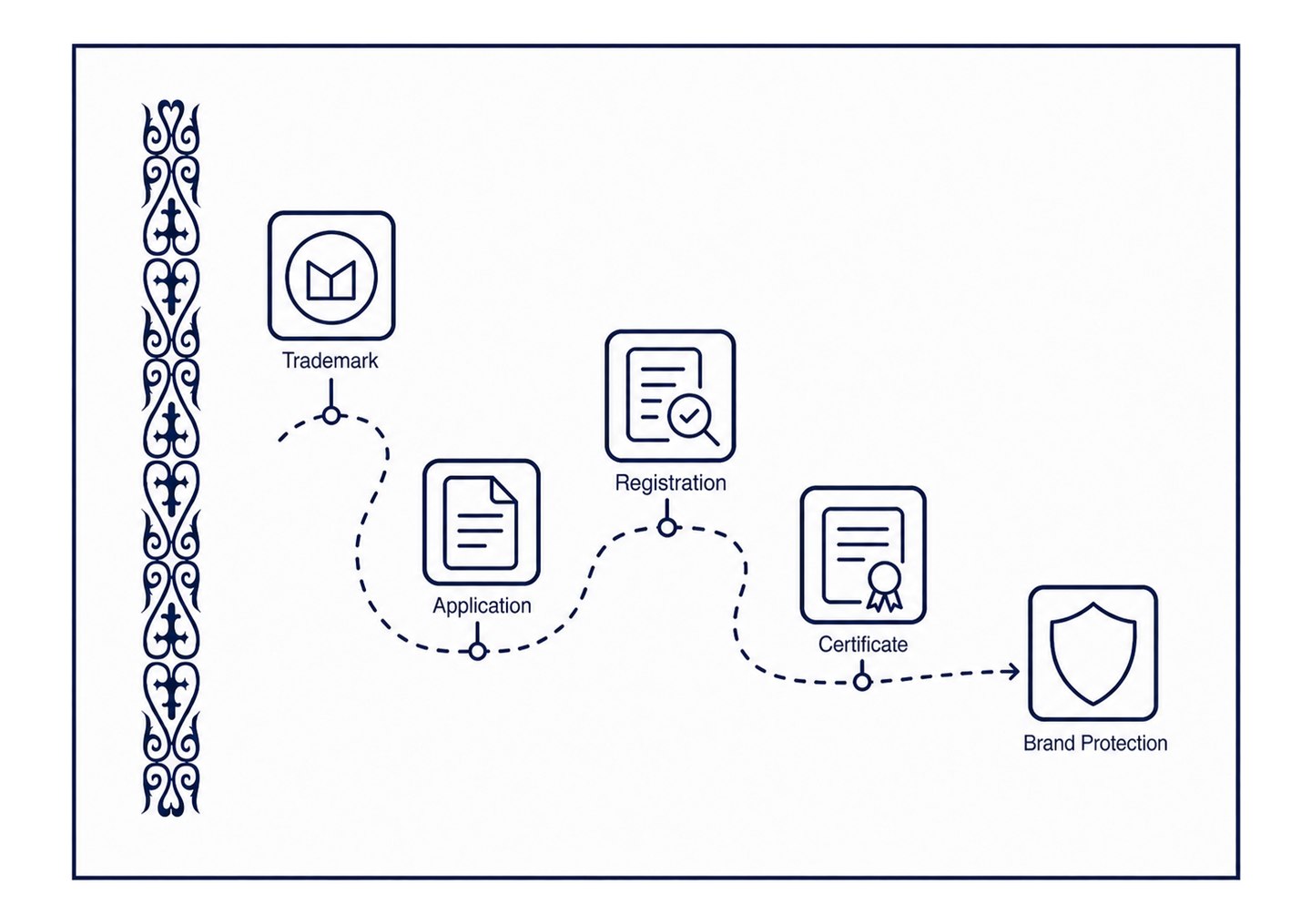
In practice, the process begins not with filling out a form, but with preparation:
- It is determined what exactly to register: a word, a logo, a combined mark or several variants.
- The presence of similar designations in the registers is checked.
- The applicant is chosen.
- The ICGS classes and the list of goods or services are selected.
- The image of the mark is prepared, if a logo or combined mark is filed.
- The application is filled out.
- The application is signed with an EDS.
- Qazpatent services are paid for.
- The application undergoes examination.
If the applicant is a foreign company, the documents and the authority of the representative are checked separately. It is important that the power of attorney allow not only to file the application, but also to respond to requests, receive notifications, pay for services, conduct correspondence and complete the registration procedure.
How long registration takes
Trademark registration is not an instant procedure. The examination of the application takes place in two stages.
The first stage is the preliminary examination. It is carried out within one month from the date of receipt of the application. At this stage, the composition of the application, the presence of the necessary documents and compliance with formal requirements are checked. If everything is in order, the applicant is sent a notification that the application has been accepted for consideration.
The second stage is the full examination. It is carried out within seven months from the date of filing the application. At this stage, the designation itself is checked: whether it can be registered, whether there are grounds for refusal, whether it is similar to earlier registered or filed designations, and whether it complies with the requirements of the law.
After a positive decision, the works related to registration in the state register, the issuance of the certificate and the publication of information are paid for. Therefore, in a normal project one should count not on several days, but on several months. If the application passes without requests and disputes, the process can usually be planned as a long-term procedure that is better to start in advance.
How much registration costs
The cost depends on the status of the applicant, the number of ICGS classes and the number of names of goods or services. According to Qazpatent tariffs, the acceptance of an application and the conducting of the examination for the registration of a trademark costs 117,812.50 tenge including VAT for legal entities, 88,359.38 tenge for small and medium-sized businesses, and 82,468.75 tenge for individuals. These amounts are indicated for the basic model of up to three ICGS classes with a limited number of names of goods or services in each class.
Separately, the works related to the registration of the trademark in the state register, the issuance of the certificate and the publication of information about the registration are paid for. For an ordinary trademark of up to three classes, this amount is 37,849.64 tenge.
If there are more classes or the list of goods and services is wider, additional payments arise. Therefore, before filing an application, it is necessary not just to ask "how much does a trademark cost", but first to understand in which classes it will be registered and what volume of goods or services the business needs.
Tariffs may be updated, so before filing an application we always check the current cost on the Qazpatent website and calculate the payments for the specific application.
Why an application may be refused
A refusal may be related both to the designation itself and to the similar rights of other persons. The most frequent reasons are:
- the designation is too general and does not distinguish the goods or services of one business from another;
- the name describes the goods or service itself;
- the mark may mislead the consumer;
- the designation is similar to an already registered or filed trademark;
- the classes or the list of goods and services are chosen incorrectly;
- the application is drawn up formally, without taking the requirements into account;
- the application is signed by the wrong person or filed without the necessary authority.
Sometimes a client is sure that their name is unique because they came up with it themselves. But for the examination, what matters is not only whether the client invented the word, but whether it has distinctive character and whether it creates a conflict with already existing rights.
What happens after registration
After registration, the trademark is entered into the State Register of Trademarks of the Republic of Kazakhstan. The right is confirmed by an entry in the register and an extract. The owner obtains the exclusive right to use and dispose of the trademark in relation to those goods and services for which it is registered.
The term of validity of the registration is ten years from the date of filing the application. After that, the registration can be renewed each time for the next ten years. If the mark is really important for the business, the renewal deadlines must be monitored in advance.
After registration, it is important to maintain the mark properly further:
- use it in advertising, documents, on the website and packaging;
- monitor similar applications and infringements;
- make changes to the register if the owner, address, company name or representative changes;
- formalize licenses if the mark is used by other persons;
- record the transfer of rights if the brand is sold or moved to another company.
A trademark is not a document that is obtained once and forgotten. It is an asset that must be connected with the real activity of the business.
A separate nuance for foreign business
Foreign clients often think that if a mark is registered in another country, then it is automatically protected in Kazakhstan. This is not always the case. Legal protection of trademarks in Kazakhstan is granted on the basis of state registration in Kazakhstan or by virtue of international treaties.
If the brand is already registered abroad, it is possible to analyze international registration under the Madrid System or a national filing in Kazakhstan. The choice depends on where the mark is already registered, which countries the business needs, what the brand ownership structure is and how urgently protection is needed specifically in Kazakhstan.
For a company that really enters the Kazakhstan market, it is important to check the brand locally: in Russian, Kazakh and English, in Latin and Cyrillic script, taking into account how the mark will sound and be perceived by consumers.
How Qozhan Consulting helps
We begin not with filing the application, but with an analysis of the brand. We check the designation, similar marks, the ICGS classes, the applicant, the documents and the further model of use. After that, we prepare the application, the power of attorney, and accompany the filing, payment, correspondence with Qazpatent and receipt of the result.
If the client is only entering the Kazakhstan market, we connect the trademark with other issues: registration of an LLP, contracts with contractors, rights to the logo and website, domain, advertising, franchise, licenses and brand protection.
Conclusion
It is better to register a trademark not when the brand has already become a problem, but before the active launch of the business. Correct registration begins with checking the designation, choosing the classes and understanding who should be the owner of the brand. For a foreign client this is especially important, because a mistake in the trademark may affect advertising, the website, contracts, packaging and the further development of the business in Kazakhstan.