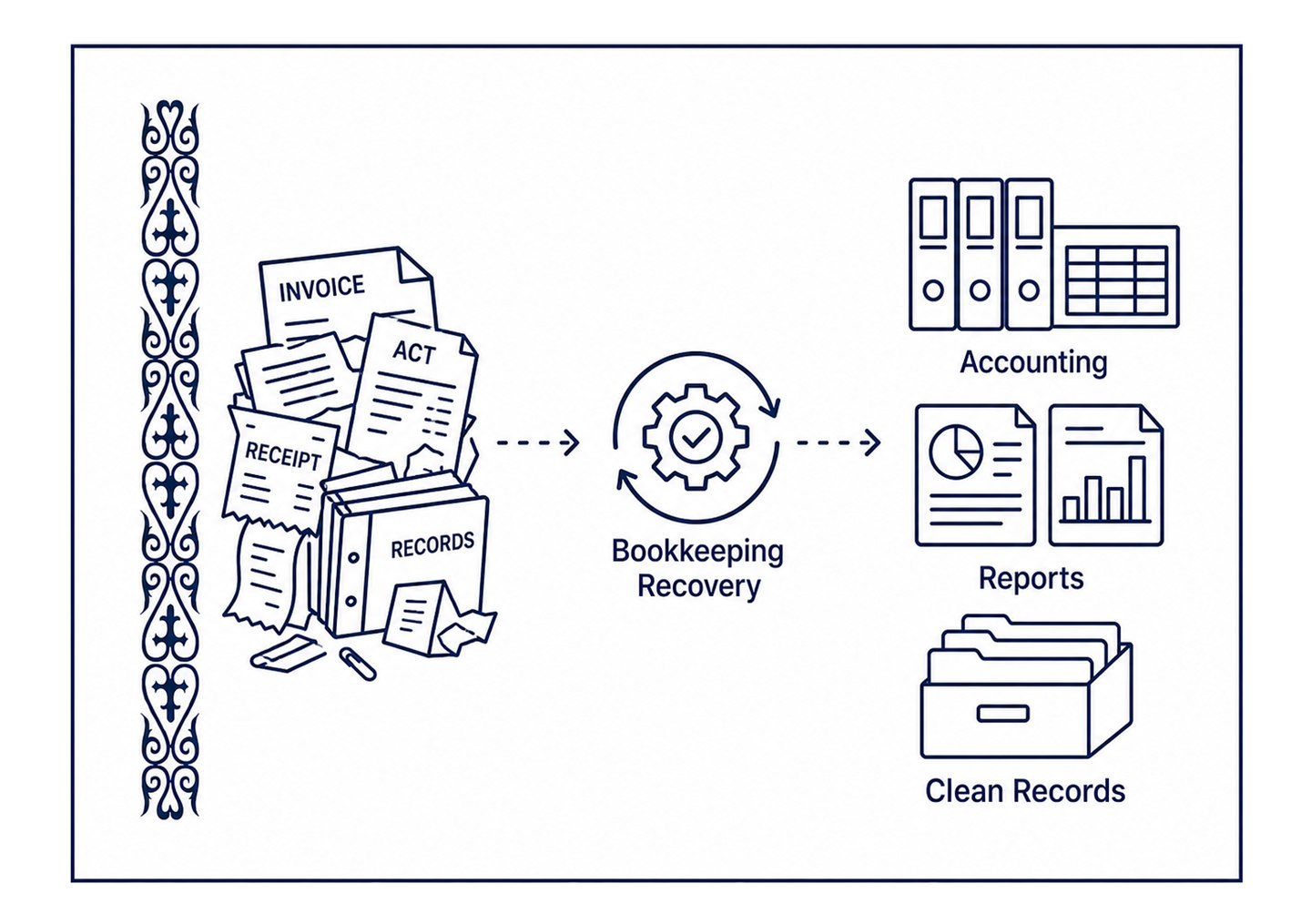
Accounting in Kazakhstan long ago ceased to be a technical function where it is enough to file a declaration once a quarter and close the documents. For business, accounting today is connected with taxes, banks, contracts, electronic invoices, payroll payments, currency control and evidence in case of a dispute. If accounting is kept formally, the problem usually does not show up immediately. A company may work for several months without noticeable consequences, but then receive a tax notification, an account freeze, a bank's refusal to make a payment or an inability to confirm expenses.
With the adoption of the new Tax Code, the role of accounting becomes even higher. Changes in tax administration, the new value added tax rate, the reduction and modification of special tax regimes, more active digital reconciliation of data and work through information systems make accounting not an auxiliary task but part of the business management system. A mistake in accounting now becomes visible faster to the tax authority, the bank and the counterparty.
That is why accounting support should be viewed not as a service of filling out forms, but as a regular legal and financial discipline. In well-structured accounting it is clear what operations the company performs, where the money comes from, why the expenses arose, what taxes should be charged and what documents confirm the position of the business.
1. What formal accounting means
Formal accounting arises when documents are collected not according to the meaning of the operation, but only in order to close the reporting period. On the surface everything may look fine: declarations are filed, there is no tax debt, the accounting software is maintained. But inside the accounting there is no connection between the contract, the act, the invoice, the payment, the warehouse, the salary and the tax reporting.
In practice, formal accounting is usually visible by several signs:
- primary documents are signed retroactively or are missing altogether;
- certificates of completed work do not match the terms of the contract;
- electronic invoices are not matched with actual supplies;
- payments go through with a general purpose that does not reveal the economic meaning;
- the director does not understand which taxes are charged and why;
- there are discrepancies on the personal tax account, but no one analyzes them;
- receivables and payables live in the software separately from the real correspondence with counterparties.
Such accounting may not hinder a business at an early stage, but it becomes dangerous when turnover grows, an accountant changes, bank financing opens, a tax audit takes place or a share in the company is sold. The longer accounting has been kept formally, the more expensive its restoration becomes.
2. Why accounting became critically important after the tax changes
The new tax regime for business increases the importance of accurate accounting. The increase of the base VAT rate to 16%, the lowering of the threshold for mandatory VAT registration and the change of special tax regimes require a company to understand in advance when it enters a new tax status and what consequences this creates.
It is a mistake to think that the tax burden is determined only by the declaration. In 2026 a company's tax position is formed from several sources: electronic invoices, tax registers, payments, counterparties' data, customs documents, payroll payments and reporting. If one element does not match another, the system may generate a risk even before the business itself notices the problem.
That is why accounting is needed not only for reporting. It is needed for daily control of the business:
- to see the moment of approaching the value added tax threshold;
- to understand whether a special tax regime can be applied;
- to distinguish operating expenses from expenses that the tax authority may not accept;
- to prepare documents on imports, exports and non-residents' services in a timely manner;
- to reconcile data with suppliers and buyers before receiving a notification;
- to plan cash flow taking tax payments into account.
Strong accounting does not replace a tax strategy, but it provides the basis for it. Without correct data it is impossible to assess risks on VAT, corporate income tax, payroll taxes, currency operations and settlements with non-residents.
3. Primary documents: why they matter more than a beautiful declaration
For tax and court practice, not only the declaration matters, but also proof of the reality of the operation. A company may record an expense, take VAT for offset or show a payment to a counterparty, but if there is no contract, act, waybill, invoice, correspondence and economic meaning behind the operation, such an operation becomes vulnerable.
The correct logic of accounting looks like this:
First, the contract must be clear: who, what, at what price and within what deadlines is obliged to do it. Then a primary document is drawn up: an act, a waybill, a report, an invoice or another document that confirms performance. After that a payment is made with a purpose that corresponds to the contract and the documents. Next, the operation is reflected in accounting and tax records. Finally, the data is reconciled with the counterparty, the electronic invoices and the taxpayer's personal account.
If the sequence is broken, accounting turns into an attempt to explain operations that have already been performed. Sometimes this is possible, but sometimes the documents can no longer be restored without risk. For example, if an act is signed after a conflict with a counterparty or if the supplier has been liquidated, restoration becomes not an accounting but a legal question.
4. What most often breaks in accounting
Accounting rarely collapses because of a single mistake. Usually problems accumulate in layers. First the company does not keep contracts in one place. Then the accountant sees only payments and acts, but does not see the business correspondence. Then the manager who handled the supplier changes. After a few months it turns out that, according to the documents, the service was provided, but in fact no one accepted the result.
The most sensitive zones for business in Kazakhstan are:
- VAT and electronic invoices — errors in the date, the supplier's status, codes and the link to the contract;
- settlements with non-residents — withholding tax, currency control, supporting documents;
- salary and civil-law contracts — the risk of reclassification of the relationship;
- accountable amounts — the absence of advance reports and supporting documents;
- fixed assets and warehouse — a gap between the actual property and the accounting data;
- settlements with founders — loans, contributions, returns, dividends;
- receivables — the debts are in the accounts, but legally they are already difficult to collect.
Each such zone requires not only accounting data entry, but also an understanding of the legal nature of the operation. If the director gave the company money, this is not just an inflow to the account. It may be a loan, a contribution, financial assistance or payment for future services. The taxes, the documents and the future risks depend on the chosen qualification.
5. Restoration of accounting: what is checked first
Restoration of accounting does not start with the software. It starts with diagnostics. It is necessary to understand what exactly is missing: primary documents, tax registers, personnel documents, bank statements, electronic invoices, reconciliations with counterparties or a managerial understanding of the operations.
The working order usually looks like this:
First — collect the bank statements for the restoration period and see the real movement of money. Second — export the data from the accounting software and compare it with the bank operations. Third — check the electronic invoices, acts, waybills, contracts and closing documents. Fourth — carry out a reconciliation with the tax personal account in order to see arrears, overpayment, penalties and discrepancies. Fifth — identify the operations for which there are no documents or they are drawn up incorrectly. Sixth — prepare a restoration plan: what can be corrected documentarily, what needs to be clarified through reporting, and what requires a separate legal assessment.
The main mistake in restoring accounting is to try simply to "catch up" on the reporting. If you do not understand the cause of the discrepancies, the company may file additional forms but keep the same risk. Restoration should end not only with correct reporting, but also with a clear picture of the business.
6. Why accounting matters for the bank, the investor and the court
The bank does not look at accounting as a tax inspector, but accounting affects bank compliance. If a company declares one business model while operations of a different nature go through the account, the bank has the right to ask questions. If the purpose of a payment is not connected with a contract, and the counterparties are not explained by documents, the payment may be delayed or rejected.
For an investor, accounting shows the quality of the business. Even if a company is profitable, unclear debt, weak primary documents, unconfirmed expenses and disputable tax positions reduce trust in the project. In deals to sell a share or attract a partner, it is precisely accounting that often shows how manageable the business is.
In court, accounting documents become evidence. An act, an invoice, correspondence, a payment and a reconciliation can confirm a debt. But if they contradict each other, it will be difficult for the court to reconstruct the real picture. That is why accounting and legal work must be connected: contracts, acts and payments must be drawn up in advance in such a way that they can be defended.
7. How Qozhan Consulting helps
Qozhan Consulting views accounting support not as a mechanical filing of reports, but as a system of business protection. We analyze documents, taxes, payments and contracts together, so that the company understands not only the amount of taxes, but also the source of the risk.
As part of the support we help to:
- build up the current accounting;
- check the quality of primary documents;
- restore accounting for past periods;
- reconcile data with the tax personal account;
- prepare responses to tax notifications;
- set up accounting for VAT, non-residents, salary and contracts;
- connect accounting work with the company's legal documents.
For foreign business in Kazakhstan this is especially important: accounting must be clear not only to the accountant, but also to the director, the bank, the tax authority and the foreign participant of the company.
Conclusion
Accounting in Kazakhstan is no longer a technical obligation, but part of corporate security. If accounting is kept formally, the problem may not show up for a long time, but then strike at taxes, the bank, a court dispute or a deal with an investor. Correct accounting shows the business as it really is: with clear income, expenses, taxes, documents and risks.