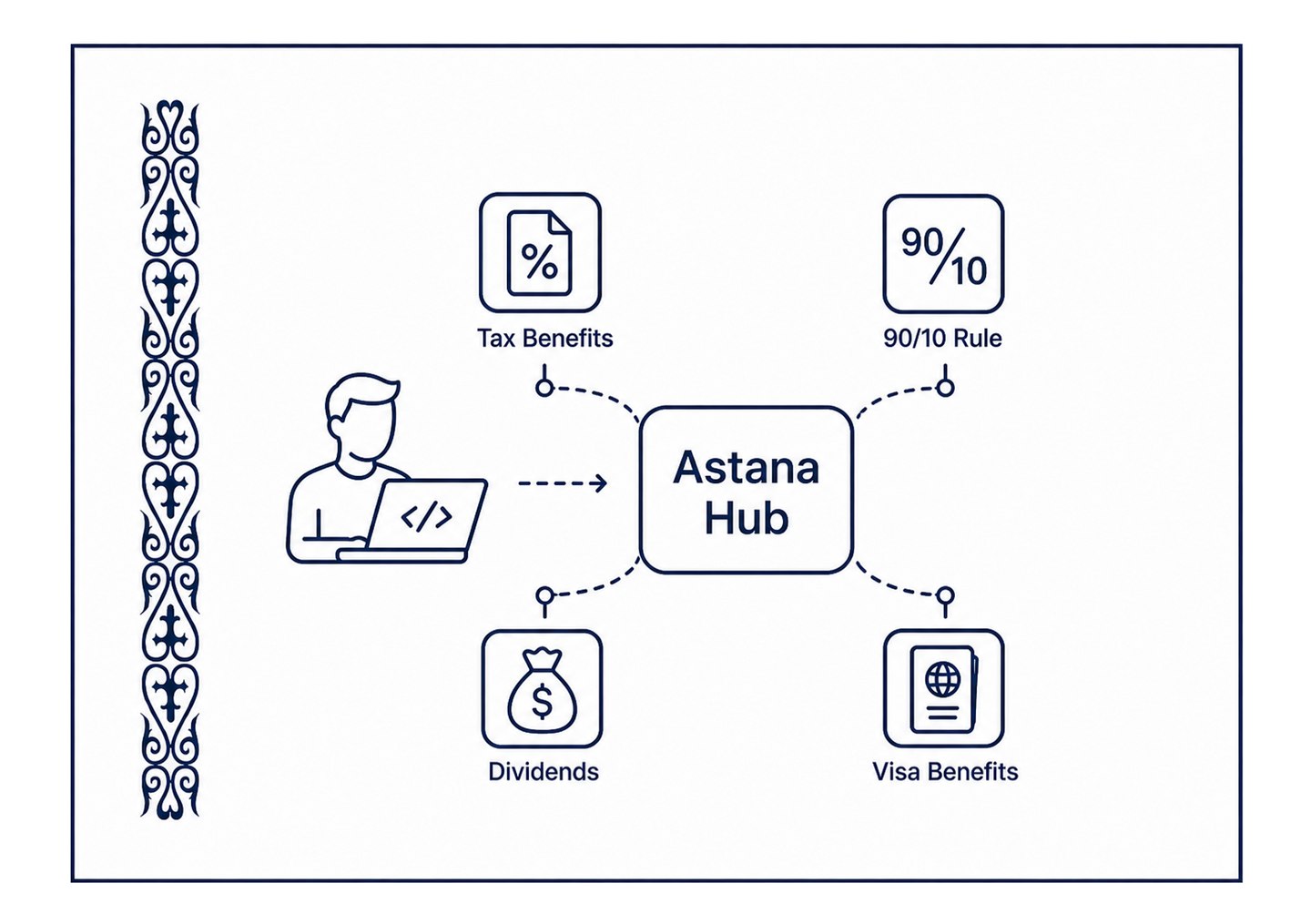
Astana Hub is often perceived as a simple way to reduce taxes for an IT company. This is too simplified a view. Participation in Astana Hub can indeed provide serious tax and migration advantages, but only if the company meets the requirements, conducts real priority activity and correctly draws up its accounting, contracts and income.
From 2026 the 90/10 rule acquires special significance. It makes the model more flexible, but at the same time requires discipline: the company must understand which income relates to priority IT activity and which is non-core.
1. Who Astana Hub is suitable for
Astana Hub is not automatically suitable for all IT projects. What matters is not that the company uses computers, a website or software. What matters is whether its activity relates to the priority types of activity in the field of information and communication technologies and whether the company can prove the reality of such activity.
Usually Astana Hub is considered by companies engaged in software development, digital platforms, IT services, technology products, SaaS models, data analytics and other areas that can be attributed to priority IT activity.
2. What participation gives
The main value of Astana Hub is not only tax benefits. For foreign business it is also a clear institutional environment, the opportunity to show the bank and partners that the company works in the IT sector, and to use certain visa advantages for specialists.
But the advantages work only if the conditions are met. You cannot register a company, obtain participant status and then conduct any activity under the guise of IT. The priority of income, the documents, the contracts, the acts and the accounting must match.
3. The 90/10 rule
The 90/10 rule means that the main part of a participant's income must fall on priority activity in the field of information and communication technologies. Non-core income is allowed only in a limited share. That is why from 2026 it is especially important to keep separate accounting and understand the structure of income in advance.
In practice it looks like this:
First — the company determines which products and services are priority IT activity.
Second — contracts with clients are formulated so that the subject corresponds to the real IT activity.
Third — accounting keeps separate records of core and non-core income.
Fourth — the company regularly checks whether the proportion of income is not violated.
Fifth — when a new area appears, its impact on the status and benefits is assessed in advance.
4. Why contracts matter
For Astana Hub what matters is not only the actual product, but also how it is drawn up documentarily. If a company develops software but the contract vaguely says "consulting services" or "marketing support", a question about the nature of the income may arise in the future.
That is why contracts, acts and invoices must show the economic essence of the operation. Accounting cannot correct a weak contract retroactively. If the documents are initially drawn up incorrectly, tax and compliance risk appears already at the moment of signing.
5. Dividends and foreign participants
For foreign founders the question of dividends is often key. They want to understand how the profit of a Kazakhstani IT company can be distributed to participants and what tax consequences will arise. Here you cannot limit yourself to a general phrase about benefits. You need to look at the participant's status, the period of ownership, the source of profit, the tax residency of the recipient and the applicable international agreements.
Before distributing dividends it is important to check:
- whether the company has the right to apply tax preferences;
- whether it complies with the 90/10 rule;
- whether there is confirmed profit according to accounting;
- who is the recipient of the dividends — an individual or a company;
- whether there are documents on the tax residency of the foreign participant.
6. Visa advantages and foreign specialists
Astana Hub may be important not only for taxes, but also for attracting foreign specialists. However, visa advantages must not be perceived as an automatic solution to all migration questions. For each foreigner you need to understand their role: founder, director, employee, contractor, family member or a temporarily arriving specialist.
In practice, first the person's function in the project is determined, and then a migration route is selected. This helps avoid a situation where the company has Astana Hub participant status, but a particular specialist is in Kazakhstan without a suitable basis.
7. The bank and compliance
The bank will look not only at Astana Hub participant status, but also at the operations. If a company receives payments from foreign clients, pays contractors, distributes dividends and works with several currencies, the bank will ask questions about the contracts, the acts, the source of the money and the economic meaning of the operations.
Participant status may help explain the IT model, but it does not replace normal documents. The bank still needs contracts, acts, invoices, the ownership structure, information about beneficiaries and a clear description of the activity.
8. Frequent mistakes of participants
- obtaining status but not keeping separate accounting of income;
- drawing up IT services with vague contracts;
- mixing core and non-core income without analysis;
- distributing dividends without checking the tax conditions;
- assuming that Astana Hub automatically solves bank compliance;
- attracting foreign specialists without a separate migration assessment.
Conclusion
Astana Hub can be a strong instrument for IT business in Kazakhstan, especially for companies with foreign founders and international clients. But it is not just a "preferential regime", but a system with conditions, documents, accounting and a verifiable business model.
In 2026 the key elements become the 90/10 rule, separate accounting, correct contracts, confirmation of IT income and careful work with dividends. If all this is built in advance, Astana Hub helps the business. If the status is used formally, it may create more questions than advantages.