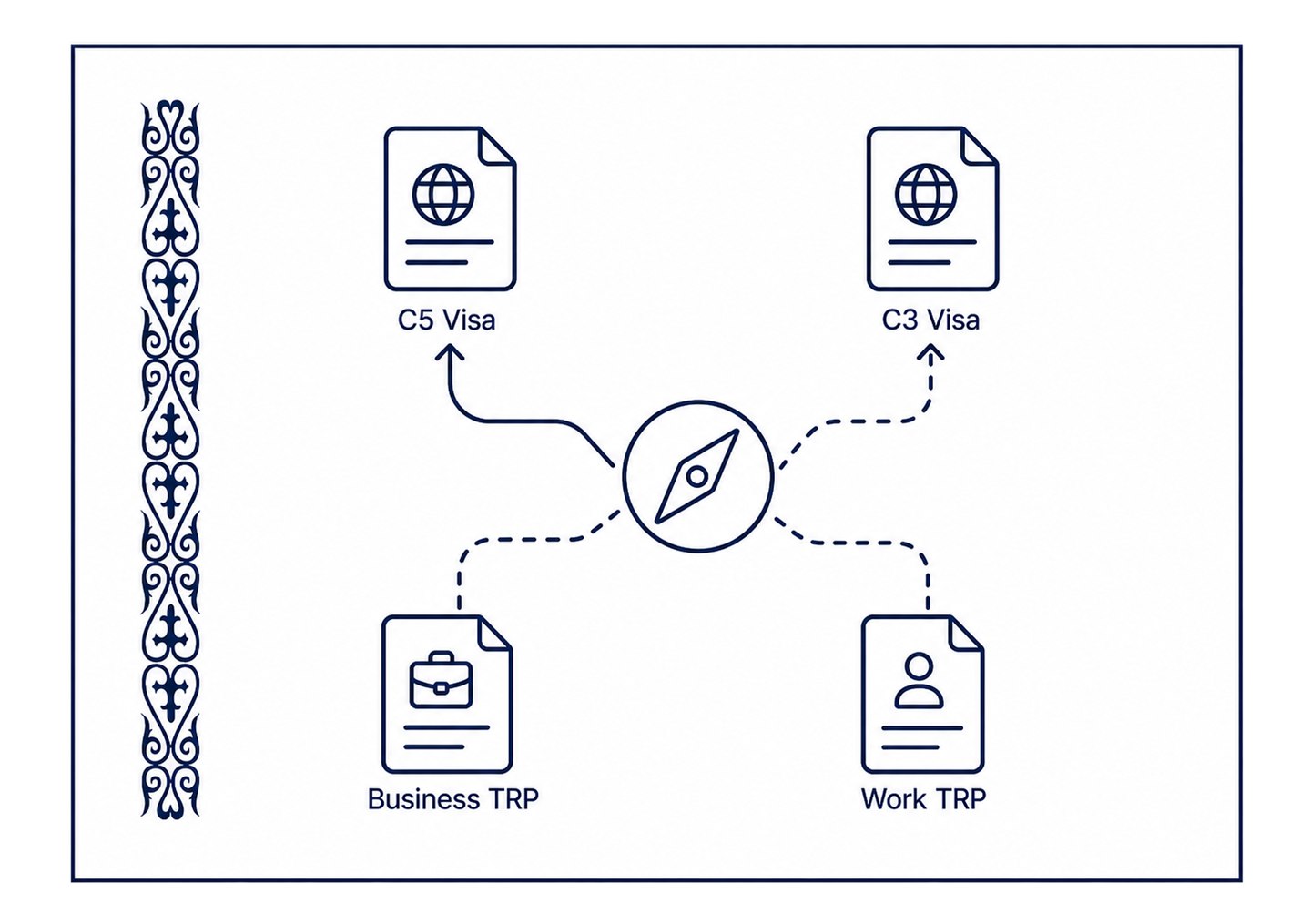
Migration documents are often confused, because in one project a founder, a director, an employee, a representative of a foreign company and a family member may occur at the same time. For each of them the logic may be different. A mistake in the choice of a visa or a temporary residence permit (TRP) can stop the registration, the work of the director, the opening of an account or the hiring of an employee.
You cannot choose a document by its name. You need to look at who exactly comes to Kazakhstan, why they come, whether they will work, whether they will receive income, whether they will manage the LLP and how long they plan to stay in the country.
1. A visa and a TRP are not the same thing
A visa answers the question of entry and stay for citizens of visa countries. A TRP answers the question of temporary residence in Kazakhstan on a certain basis. A foreigner may enter on one basis, but for a longer stay and work they will need another procedure.
That is why the route cannot be built like this: "we will get any visa, and then we will figure it out". For business this is risky. If a person is needed as a director, an employee or a business immigrant, their documents must be planned in advance.
2. C5 — a business immigrant
C5 is usually considered for foreigners who arrive for entrepreneurial activity. In the context of LLP registration this question is especially important when a foreign citizen themselves is part of the participants of a Kazakhstani company and plans to launch a business in Kazakhstan.
But C5 cannot be applied mechanically to all foreigners. If the participant is a foreign company rather than an individual, the question of C5 for the participant may be absent. If a foreign citizen is not in Kazakhstan and does not carry out entrepreneurial activity on the territory of the country, a separate assessment is also required.
3. The TRP of a business immigrant
The TRP of a business immigrant is connected with the presence of a foreigner in Kazakhstan in connection with entrepreneurial activity. It may be necessary if a foreign citizen does not just own a share, but is actually in the country and implements a business project.
The practical question always sounds like this:
Is the person a founder?
Are they physically present in Kazakhstan?
Do they participate in managing the business?
Do they plan to stay longer than the usual period of stay?
Do they have a basis for temporary residence?
4. C3 and the work TRP
C3 is usually connected with labor activity. If a foreign citizen comes as an employee or a director who actually works in Kazakhstan, the labor route must be analyzed: the permit for attracting foreign labor, exceptions, quotas, the position, citizenship and special rules.
It is important to distinguish a director as a corporate figure from a foreigner who is really in Kazakhstan and performs a labor function. If the director of a foreign LLP manages remotely from abroad, this is one situation. If they physically live and work in Kazakhstan, this is another situation.
5. Exceptions from the permit for attracting foreign labor
In Kazakhstan there are categories of persons for whom the permit of the local executive body for attracting foreign labor is not required. But this does not mean that a foreigner does not need migration documents at all. The permit for attracting foreign labor and the right to stay in Kazakhstan are different questions.
It is precisely here that a mistake often arises. A company assumes that if the permit for attracting foreign labor is not required, then it is possible not to analyze the visa, the TRP and the registration of stay. This is the wrong approach.
6. How to choose the right document
The choice begins not with the name of the visa, but with the person's role in the project.
If the person is a foreign individual participant, the business immigration route is analyzed.
If the person is a director and physically works in Kazakhstan, the labor route is analyzed.
If the person is an employee, the employment contract, the position and the rules for attracting foreign labor are examined.
If the person is a representative of a foreign company without employment in Kazakhstan, the purposes of entry and the period of stay are analyzed.
If the person works remotely from abroad, a Kazakhstani migration document may not be required, but this must be confirmed by the actual model.
7. Why you cannot use a universal instruction
Universal migration instructions are dangerous, because they do not take into account the business model. Two clients may open an identical LLP, but the migration route will be different: for one the participant is a foreign company and a local director, for the other a foreign citizen founder who comes to manage the business themselves.
The documents, the deadlines, the participation of the receiving party, the requirements for the registration of stay, the banking procedures and the further actions after entry will differ.
8. Typical mistakes
- confusing a visa and a TRP;
- assuming that a director always needs C3, regardless of the actual place of work;
- not distinguishing an individual participant from a foreign company as a participant;
- drawing up documents after entry, when the deadline has almost expired;
- not checking the exceptions from the permit for attracting foreign labor;
- building the route without taking the bank and the EDS into account.
Conclusion
C5, C3, the TRP of a business immigrant and the work TRP are not interchangeable documents. Each of them is tied to the role of the foreigner and the actual situation. For business it is important not just to enter Kazakhstan, but to choose a route that will allow legally managing, working, signing documents and passing banking procedures.
The correct migration analysis must be done before registering the company and buying a ticket. Then the foreigner's route becomes part of the overall business plan, and not an urgent problem after arrival.