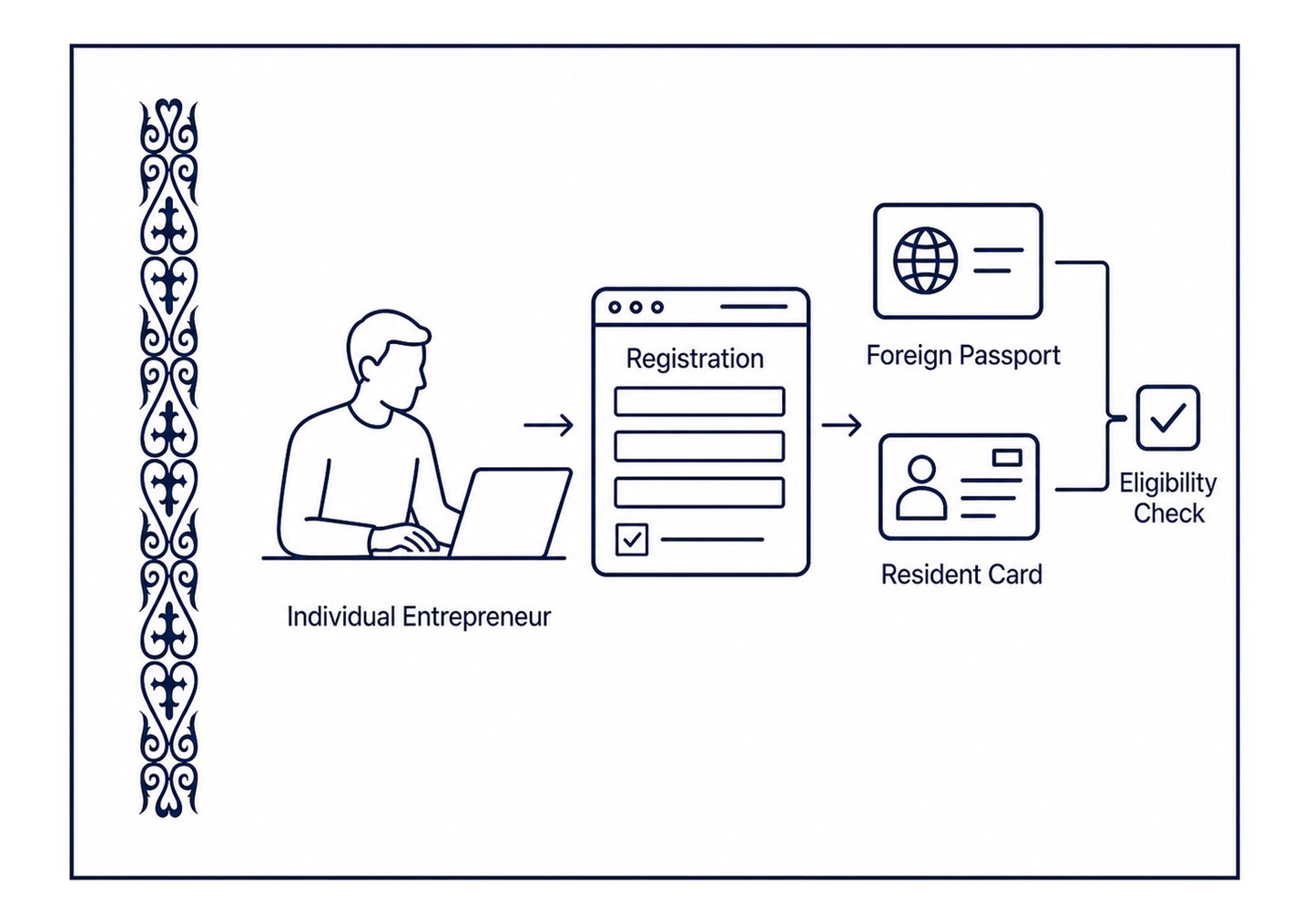
The question of an individual entrepreneur often arises for a foreign client at the very beginning of a project. The logic is clear: an individual entrepreneur seems simpler, cheaper and faster than a limited liability partnership. There is no charter, no corporate structure, fewer formalities, it is easier to open an account and start receiving money. In practice, for a foreign citizen in Kazakhstan this option often turns out not to be a working model for a normal business.
An individual entrepreneur (IE) can indeed be useful in certain situations. But if it is about permanent commercial activity, work with companies, hiring employees, bank compliance, tax planning and the development of a project, most often it is better to immediately consider a limited liability partnership (LLP).
1. Why an IE seems a convenient option
On paper an IE looks like the shortest path. A foreign citizen wants to quickly obtain an individual identification number (IIN), register as an entrepreneur, open an account and start issuing documents to clients. Such a request especially often arises from consultants, IT specialists, sales specialists, intermediaries, small service projects and foreign citizens who are temporarily in Kazakhstan.
But the convenience of an IE cannot be assessed only by the speed of registration. It is important to look at what will happen after registration: whether the person will be able to legally stay in the country, carry out activity, receive payments, confirm income, work with the bank, pass tax checks and explain their model to counterparties.
2. When a foreign citizen may theoretically consider an IE
An IE may be considered if a foreign citizen has a clear legal status in Kazakhstan and their activity really corresponds to the model of individual entrepreneurial activity. It must not be an artificial substitute for labor relations, a hidden branch of a foreign company or a way to circumvent LLP registration.
In practice, several basic conditions must first be checked.
First — whether the foreigner has an IIN. Without an IIN it is impossible to normally pass tax, banking and digital procedures.
Second — whether their migration status allows them to actually stay in Kazakhstan and carry out the declared activity.
Third — whether the activity fits the IE format. Not all types of business are convenient or permissible to conduct through an individual.
Fourth — whether the bank is ready to open an account and service the operations of such a client.
Fifth — whether large B2B clients will accept working with an IE instead of a contract with a legal entity.
3. Why an IE for a foreigner often does not work in practice
The main problem of an IE is that this format is tied to the personality of the entrepreneur. A foreign citizen does not separate the business from themselves the way it happens in an LLP. Income, obligations, tax questions, bank compliance and counterparties' claims are concentrated around one individual.
For small one-off services this may be acceptable. For a business that plans to hire people, conclude contracts with legal entities, work with foreign partners, attract investment or access banking products, such a construction becomes weak.
Typical practical difficulties look like this:
- the bank asks more questions about the source of funds, the nature of operations and the economic meaning of payments;
- counterparties may not accept an IE as a full supplier for a B2B project;
- it is harder to transfer the business, attract a partner or an investor;
- the personal liability of the entrepreneur is perceived as an elevated risk;
- when the project expands, you still have to switch to an LLP.
4. An IE must not substitute for labor relations
A separate risk arises when a foreign citizen wants to register an IE only in order to work for one company as if under a civil-law contract. If in essence the person performs a labor function, follows a schedule, receives regular pay and works as an employee, the formal registration of an IE does not always solve the question.
In such a situation you need to assess not only the tax form, but also the migration requirements, labor legislation, the risk of reclassification of the relationship and the bank's position. For a foreigner this is especially sensitive, because a mistake may affect not only taxes, but also the right to stay in Kazakhstan.
5. How an LLP is usually stronger than an IE
An LLP provides a more sustainable legal shell. The company has a separate business identification number (BIN), its own account, a director, a participant, charter capital, contracts, accounting and the ability to build a full operational model. For a foreign client this is often more important than the speed of the start.
In an LLP it is easier to separate roles:
- the participant owns the share;
- the director manages the current activity;
- the accountant keeps records and reporting;
- the company concludes contracts and bears obligations as a separate legal entity.
This is especially important when a business plans to open a corporate bank account, conclude contracts with companies, work with VAT, hire employees, obtain licenses, participate in tenders or connect to platforms.
6. When an IE may be an acceptable solution
An IE cannot be completely ruled out. In certain cases it may be a working option. For example, when a foreign citizen already has a stable legal status in Kazakhstan, conducts a small personal activity, does not plan to attract partners, does not work with regulated services and understands the tax consequences.
But even in such a situation it is important to check in advance:
- which tax regime will be applied;
- whether the chosen type of activity can be conducted in the IE format;
- what documents the bank will require;
- whether a risk of a permanent establishment of a foreign company will arise;
- whether a transition to an LLP will be needed in the near future.
7. A practical algorithm of choice
The correct choice begins not with the form of registration, but with the business model. If a client first opens an IE and then finds out that the bank does not understand the operations, a large client requires a contract with an LLP, and the type of activity requires permits, the project loses time.
First — determine who will receive the income: the foreign citizen themselves or a separate Kazakhstani company.
Second — understand where the person will physically be located and what migration document they need.
Third — check the type of activity, the tax regime and possible restrictions.
Fourth — discuss the bank account and future payments in advance.
Fifth — choose between an IE and an LLP not by the principle of "cheaper", but by the principle of "working for the project".
Conclusion
A foreign citizen may consider an IE in Kazakhstan only in limited situations. For a full business it is often a weak and inconvenient construction. If a project is connected with B2B clients, partners, banks, hiring, licenses, tax planning or a long-term presence, an LLP usually provides a more sustainable and clear model.
The main mistake is to choose an IE as a quick start without checking whether such a form can really work after registration. In Kazakhstan the form of the business must match the migration status, the taxes, the bank and the commercial logic of the project.