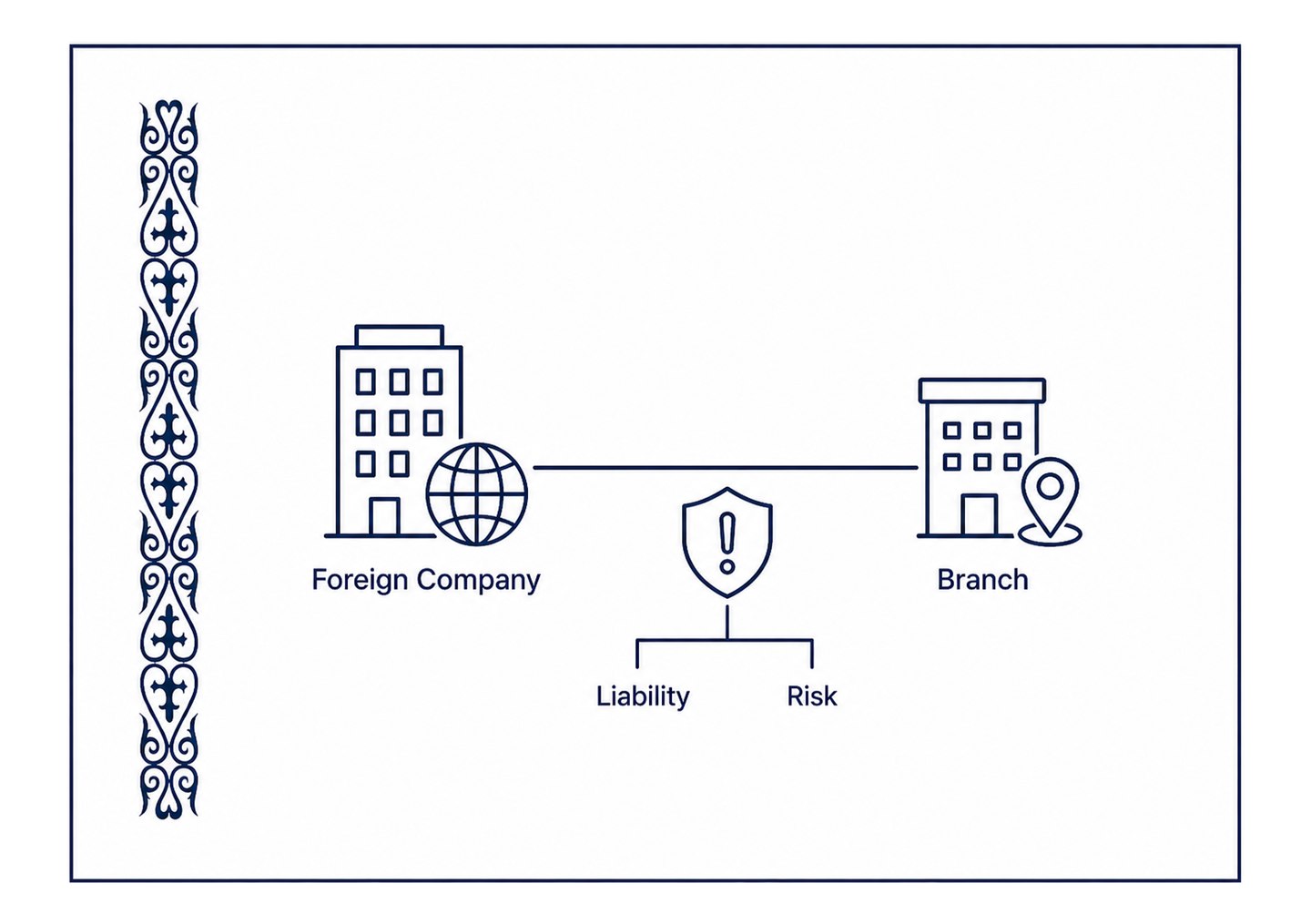
A branch of a foreign company is often considered as an alternative to an LLP. The client says: "We do not want to create a separate company, let's just open a branch". In some projects this is indeed the right logic. But a branch is not a universal replacement for an LLP, because the legal consequences of these forms are different.
The main difference is that a branch is not an independent legal entity. It acts on behalf of the foreign company. This means that behind its obligations stands the head company. For some clients this is an advantage: you can operate on behalf of a well-known international company. For others it is a risk, because the obligations of the Kazakhstan subdivision are not separated from the parent company.
1. What a branch is, in simple terms
A branch is a separate subdivision of a foreign company in Kazakhstan. It may perform all or part of the functions of the head company, including commercial activity. A branch may have a head, regulations, a bank account, employees, accounting and tax reporting in Kazakhstan.
But a branch is not a separate company. All its actions are legally connected with the foreign company that opened it.
2. When a branch may be convenient
A branch is suitable if the foreign company wants to preserve a direct presence in Kazakhstan. For example, if a major customer wants to work specifically with the foreign company, and not with its subsidiary LLP. Or if the project is connected with an international contract, where the Kazakhstan subdivision must act as part of the head company.
A branch may also be convenient for temporary projects – construction, service, engineering, consulting and other tasks – where the reputation of the parent company and its direct control matter.
3. When a branch may be inconvenient
If a foreign business wants to separate the risks of the Kazakhstan project from the parent company, a branch may not be the best option. For the obligations of a branch, the foreign company is in fact liable. If debts, claims, tax issues or contractual disputes arise, they are connected with the head company.
An LLP in this sense is often clearer: it is a separate legal entity that is liable for its debts with its own property. The participants, as a rule, bear the risk within their contributions. For many investors this is a more comfortable and safer model.
4. What documents are needed for a branch
For the registration of a branch, usually the corporate documents of the foreign company, a resolution on the creation of a branch in Kazakhstan, regulations on the branch, the appointment of a head, a power of attorney, documents on the address, translations, an apostille or legalization are needed.
Special attention must be paid to the power of attorney. The head of the branch acts on the basis of a power of attorney, and it is precisely in it that their powers must be spelled out: to sign contracts, open an account, interact with state bodies, submit documents, receive results, conduct correspondence with the bank.
5. Tax issues of a branch
A branch may form a permanent establishment of the foreign company in Kazakhstan. This means that the foreign company may acquire tax obligations in Kazakhstan for the activity of the branch. Depending on the model of work, questions of corporate income tax, VAT, payroll taxes, reporting and cross-border payments may arise.
It is important to understand in advance what the branch will do: only represent interests, perform service functions or conclude commercial contracts. The tax model depends precisely on the actual activity.
6. The bank and the branch
The bank will check not only the documents of the branch, but also the foreign parent company. It needs to understand who the ultimate beneficiaries are, what the head company does, why the branch is being opened, what payments will go through the account, who the head of the branch is and what powers they have.
If the documents of the head company are complex, multi-level or from jurisdictions with heightened compliance attention, the banking stage must be prepared in advance.
7. Branch or LLP: how to choose
A branch is worth considering if the client wants to act on behalf of the foreign company and is ready to accept the head company's responsibility for the activity of the subdivision. An LLP is better suited if it is necessary to create a separate Kazakhstan company, to limit the risks at the level of the local legal entity and to work more easily with local counterparties.
A representative office is suitable when the goal is not commercial activity, but negotiations, marketing, the search for partners and the preparation of the market.
8. How Qozhan Consulting helps
We do not offer a branch as a standard solution for everyone. First, we analyze the client's task: contracts, liability, taxes, the bank, deadlines, employees and future operations. After that, we propose a form of presence that really corresponds to the project.
Conclusion
A branch is a strong instrument if it is chosen deliberately. But if the client wants simply to "quickly enter Kazakhstan", a branch is not always simpler than an LLP. The difference in liability, the bank and taxes must be clear before registration, and not after the first claim or bank request.