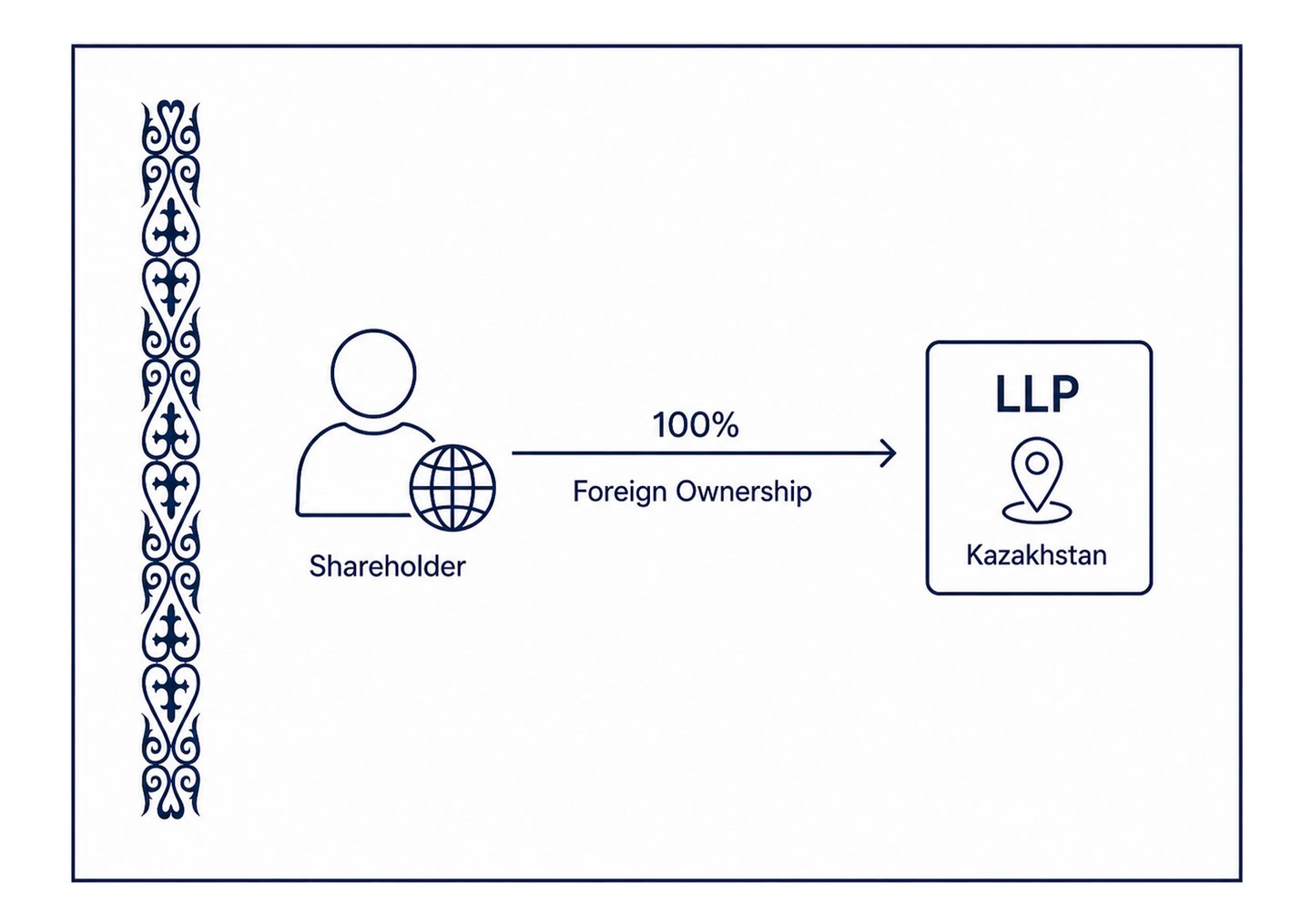
An LLP in Kazakhstan can be created with 100% foreign participation. For a foreign investor this is an important advantage: a local partner, a nominal participant or an artificial joint structure is not always needed. But the possibility of full foreign participation does not mean that all questions are resolved automatically.
Legally, you need to separately check the founder, the director, the documents of the foreign company, the bank, the type of activity, migration questions and future operations. It is precisely on these details that practical difficulties most often arise.
1. What 100% foreign participation means
100% foreign participation means that the sole participant of a Kazakhstani LLP can be a foreign citizen or a foreign company. Such an LLP is a Kazakhstani legal entity, but its participant is located outside Kazakhstan or has foreign citizenship.
It is important not to mix two levels:
The participant owns a share in the LLP.
The director manages the current activity of the LLP.
The LLP itself is a separate Kazakhstani company with its own BIN, account, contracts and tax obligations.
2. A foreign citizen as a participant
If a foreign citizen becomes a participant, the first practical question will be the IIN. Without an IIN it is impossible to correctly pass the registration and banking procedures. Next you need to assess the migration status, especially if the foreign citizen will be physically present in Kazakhstan and participate in managing the business.
Here it is important to distinguish ownership of a share and work in Kazakhstan. Ownership of a share in itself does not always mean labor activity. But if a foreign citizen comes, manages the company, signs documents, works as a director or actually carries out activity on the territory of Kazakhstan, the visa and migration route must be analyzed separately.
3. A foreign company as a participant
If a foreign company becomes a participant, the emphasis shifts to the documents of the parent structure. The Kazakhstani registering authority and the bank need to understand that the foreign company exists, who is entitled to make decisions, who its beneficiary is and who signs the documents.
Usually the following are prepared in advance:
- the registration extract or an equivalent document of the foreign company;
- the constituent documents if necessary;
- the decision to create the Kazakhstani LLP;
- a power of attorney for the representative;
- documents on the head and the powers of the signatory;
- translation, apostille or legalization depending on the country.
4. The director of the LLP and their role
The director is the central figure for a practical launch. It is precisely the director who signs documents, opens the account, interacts with the bank, tax authorities, counterparties and employees. Even if the participant is abroad, the operational life of the LLP in Kazakhstan depends on the director.
Different models are possible:
- the director is a citizen of Kazakhstan;
- the director is a foreign citizen physically present in Kazakhstan;
- the director is a foreign citizen who manages remotely;
- a temporary local director for the launch period with subsequent replacement.
Each model has its own consequences for the bank, migration, powers and internal control.
5. The bank checks not only the registration
After the registration of the LLP, the key stage becomes the opening of an account. The bank will look not only at the registration certificate, but also at the whole structure: who the participant is, who the beneficiary is, where the money comes from, what the company does, why the operations will pass through Kazakhstan and who actually manages the business.
That is why, even before registration, it is worth preparing a clear explanation of the business model:
Who is the client of the LLP?
What services or goods are sold?
From which countries will the money come?
Whom will the LLP pay?
What is the role of the foreign participant?
Where is the director located and who signs the documents?
6. Restrictions in certain areas
In most ordinary commercial projects 100% foreign participation is permissible. But in certain areas there may be special requirements: licenses, permits, restrictions on types of activity, requirements for the head, capital, experience, equipment or local presence. That is why you cannot make a universal conclusion only from the fact of LLP registration.
If a project relates to a regulated area, the special legislation is checked first, and only then the ownership structure is chosen.
7. Liability and protection of the parent company
One of the advantages of an LLP is that it is a separate legal entity. In an ordinary situation the obligations of the LLP are not automatically the obligations of its participant. This makes an LLP more convenient than a branch, where the activity of the subdivision is closely connected with the foreign company.
But limited liability does not mean full protection in any circumstances. If a participant or director abuses rights, withdraws assets, brings the company to insolvency or uses the LLP formally, certain liability risks may arise. That is why the structure must be not only registered, but also actually managed carefully.
8. How to correctly build the process
First — determine who will be the participant: a foreign citizen or a foreign company.
Second — check the documents, the IIN, the legalization, the translations and the powers.
Third — choose the director and understand the migration consequences.
Fourth — prepare the bank compliance package in advance.
Fifth — check the type of activity for the presence of licenses or special requirements.
Sixth — set up accounting, taxes and the contractual base immediately after registration.
Conclusion
100% foreign participation in an LLP in Kazakhstan is possible and is often a normal working model. But such a structure must be prepared not only formally, but also practically: the documents, the director, the bank, the taxes, migration and the type of activity must match each other.
If you think through the whole route in advance, an LLP with 100% foreign participation can become a convenient and protected form of work. If you limit yourself only to registration, difficulties will begin already at the stage of the bank, the EDS, accounts, contracts and the first operations.