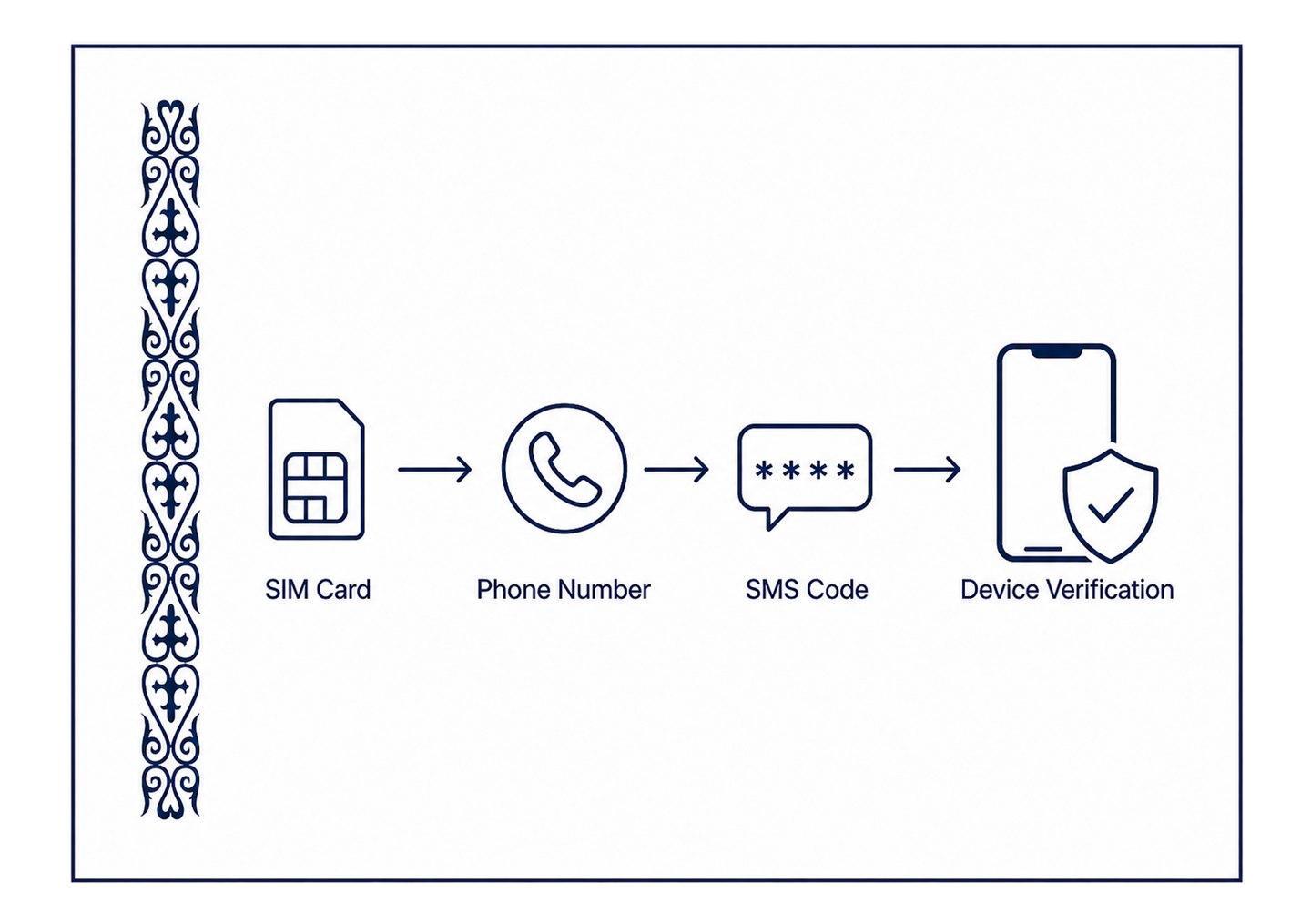
For a foreign client a Kazakhstani phone number often seems like an everyday detail. In practice it is one of the first technical elements without which it is difficult to pass digital, banking and state procedures. A Kazakhstani SIM card is needed not for communication as such, but for SMS confirmations, registration in digital services, confirmation of operations and linking to state systems.
That is why a phone number must be viewed not as an additional convenient option, but as part of a foreigner's route of entry into Kazakhstan: IIN, SIM card, electronic digital signature, bank, tax and corporate procedures.
1. Why a foreigner needs a Kazakhstani number
Kazakhstani services often use SMS as a way to confirm identity or an action. This applies to state services, banking operations, mobile government, registration in certain systems and confirmation of access. If a foreign client comes to Kazakhstan only for a few days, the absence of a number may disrupt the entire schedule.
In practice a number is needed for several tasks.
- receiving one-time SMS codes;
- linking to the mobile database of citizens where this is required;
- working with banking applications and confirming operations;
- receiving notifications from services;
- technical support for procedures with the IIN, EDS and the bank.
2. Why it is better to plan the SIM card in advance
Foreigners often assume that a SIM card can be bought at the airport or at the nearest communication store without affecting legal procedures. Sometimes this is indeed possible, but for a business route it is risky to plan this way. It is important to understand whose document the number is registered to, whether it is linked to the right IIN and whether the client will be able to receive SMS after leaving Kazakhstan.
If the number is registered hastily or to an unsuitable person, problems may later arise with access to applications, password recovery, confirmation of a banking operation or the extension of digital services.
3. The SIM card and the IIN
The IIN for a foreigner is the basic identifier. The SIM card is a technical channel of confirmations. They must work together. If a foreign citizen obtains an IIN, then registers a number and further uses this number for digital procedures, the route becomes manageable.
The optimal sequence usually looks like this:
First — obtain the IIN or make sure that it is already correctly formed.
Second — register a Kazakhstani number with correct data.
Third — check the receipt of SMS and the availability of the number in roaming, if the client leaves Kazakhstan.
Fourth — use this number for further procedures with the EDS, the bank and digital services.
4. Why it is important to keep the number after leaving
Many foreign clients come to Kazakhstan, pass registration, open a company or an account, and then leave. After a few weeks or months a need arises to confirm a login to an application, sign a document, restore access or respond to a bank's request. If the number is already blocked, lost or unavailable, a simple action turns into a new trip or a long technical procedure.
That is why, before leaving, you need to check not only the presence of the SIM card, but also the mode of its further use:
- whether the number is retained in the absence of top-ups;
- whether the receipt of SMS works abroad;
- whether the client understands how to top up the balance remotely;
- whether there is access to the operator's personal account;
- which number is indicated at the bank and in state services.
5. Device verification and IMEI
A separate question is the registration of the subscriber device and the check of the IMEI. This is important if a foreign client plans to use their phone in Kazakhstan with a local SIM card. The device must work correctly in the network, and its status must be checked in advance, especially if the phone was brought in from abroad.
There is no need to turn this into a separate legal problem if the client comes for a short period and does not plan to constantly use the device in Kazakhstan. But if the business process is tied to a Kazakhstani number and SMS, a technical failure with the device may stop banking and digital actions.
6. A physical SIM or an eSIM
In practical work a physical SIM card is often more convenient for a client who does not want to depend on the phone settings, eSIM compatibility and the operator's technical support. But the choice depends on the device, the operator and the usage scenario.
The main question is not which form is more modern. The main question is whether the number will stably receive SMS at the necessary moment. For legal and banking procedures reliability is more important than convenience.
7. Typical mistakes
Mistakes with a number seem minor, but it is precisely they that often break the schedule of a foreign client's visit.
- the number is registered but not linked to the right data;
- the client has left and cannot receive SMS;
- the number stopped working due to non-use;
- the bank uses one number, and state services another;
- the phone does not accept a local SIM card or questions arise about the IMEI.
8. How to correctly build the number into the overall route
A Kazakhstani number must be part of a plan prepared in advance. If a foreign client comes to register an LLP, obtain an EDS, open an account or pass bank compliance, the number must be registered not at the end, but at the beginning of the practical route.
First — the IIN and documents.
Then — the number and the SMS check.
After that — the EDS, the bank and digital services.
Before leaving — a check that the number will be available from abroad.
Conclusion
A Kazakhstani phone number is not just a means of communication. For a foreign client it is a technical key to SMS confirmations, the bank, state services and further support of the project. If the number is registered incorrectly or lost after leaving, many procedures become more difficult.
That is why the SIM card, SMS access and the status of the device must be planned as carefully as the IIN, the EDS and the bank account. In business projects a small technical mistake often costs more than it seems at the start.