Introduction
Businesses often start thinking about legal support only when a dispute has already appeared: a counterparty has not paid an invoice, a supplier has not delivered goods, a contractor has missed deadlines, a landlord has sent a notice, a bank has requested documents, and the client asks: “What do we do now?” In practice, a strong legal position is not created on the day a claim is filed. It is formed much earlier – in the contract, correspondence, acts, invoices, payments, claims and the company’s internal document workflow.
A business needs a lawyer not only for court. The lawyer’s role is to help the company sign contracts properly, confirm its claims, record breaches, conduct pre-trial claim work and, if necessary, go to court with a clear evidence base. A good contract does not guarantee that there will be no dispute. But it makes the dispute manageable: it is clear who must do what, within which deadlines, how performance is confirmed, how notices are sent, where the dispute will be heard and what consequences follow if a party breaches the agreement.
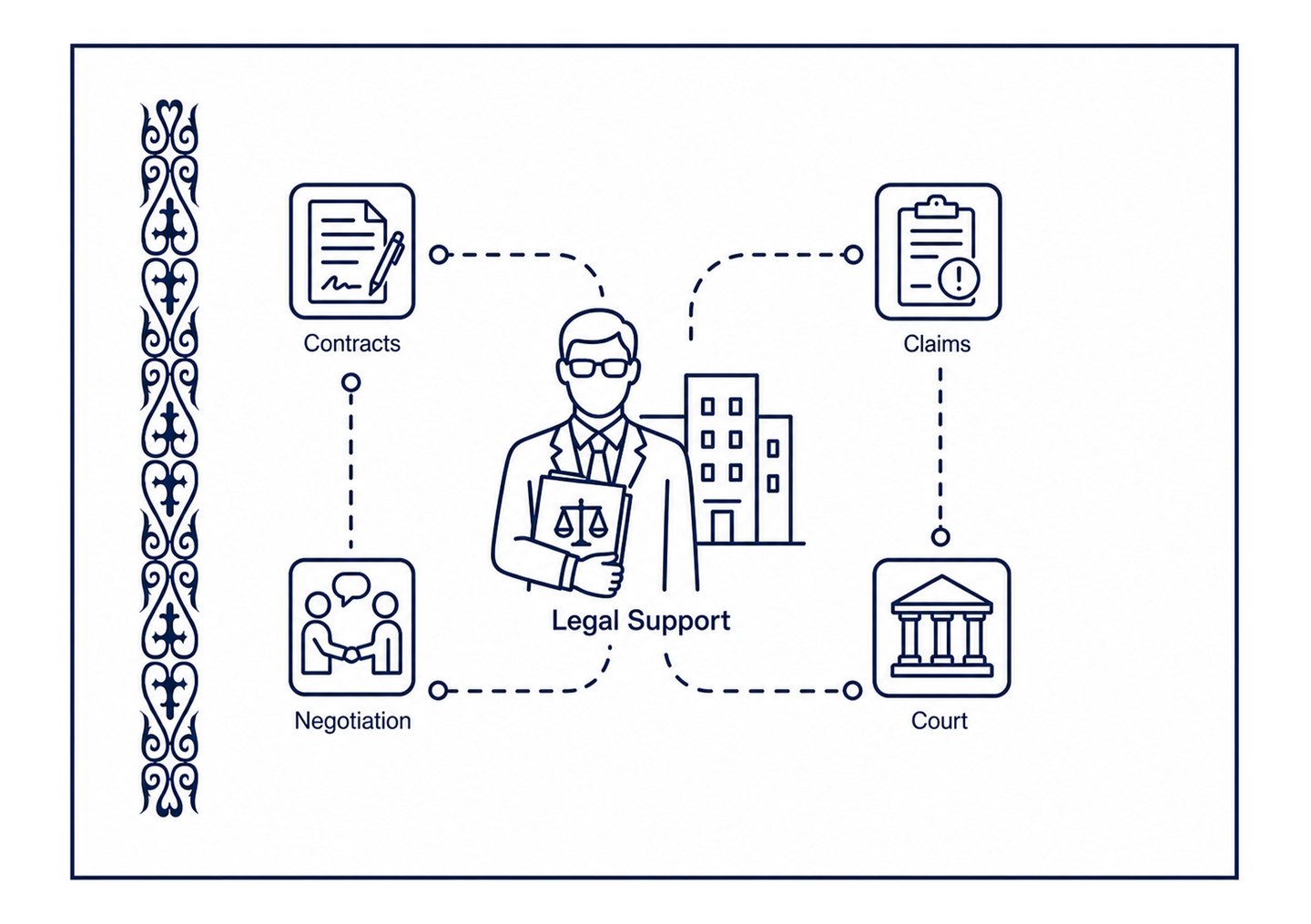
In this article, we look at legal support for business from this practical angle: how contracts can be signed, why an electronic digital signature (EDS) has become a normal business tool in Kazakhstan, why pre-trial claim work matters, when a notary’s writ of execution may help, what difficulties arise in court and why a company’s interests should be represented by a specialist who is legally entitled to provide legal assistance and participate in proceedings.
1. A contract is not a template, but future evidence
Many companies treat a contract as a formality. They find a template, replace the details, sign it and start working. This may be enough for a very simple transaction, but in commercial relations it quickly creates problems. A contract should answer the key question: if a conflict arises tomorrow, will this document help prove who is right, who breached the obligation and how much the breaching party must pay?
A contract is not only about a well-written description of the subject matter. It must explain how performance will be confirmed. If the transaction concerns services, what proves that the services were provided: an acceptance act, a report, correspondence, access to a system, a technical assignment or the actual work result? If it concerns goods, how is delivery confirmed, who accepts the goods, within what period must defects be reported and what happens in case of shortage or defective goods? If it is a works contract, who approves each stage, how are hidden works recorded, what is considered a delay and how are acceptance acts signed?
Payment terms deserve special attention. The contract must make it clear when the payment obligation arises: after signing an act, after issuing an invoice, after receiving goods, after the expiry of the period for a reasoned refusal, or according to a payment schedule. If this point is unclear, the debtor may later argue in court that the payment deadline has not yet arrived or that the result was not accepted.
Liability is a separate block. Penalties, fines, damages, withholding of payment, unilateral termination, suspension of services – all these tools work only when they are connected to the real mechanics of the transaction. If a penalty is written formally but the breach cannot be proven, it does not help. If the contract gives the right to suspend services but does not describe the notice procedure, this may also become a dispute.
2. How contracts can be signed in Kazakhstan
In Kazakhstan, businesses can sign contracts in several ways. The most familiar option is a paper contract with a handwritten signature and a stamp, if the company uses one. This format is still common, especially where the counterparty is conservative, the transaction is large, or documents are needed for a bank, auditor, notary or state authority.
The second practical format is an electronic document signed with an EDS. For Kazakhstan companies, this has already become standard practice. Kazakhstan legislation recognizes the legal force of an electronic digital signature if the statutory requirements are met. Therefore, a contract, act, addendum or other document signed by the EDS of an authorized person may have the same legal significance as a paper document.
In practice, companies use different electronic document management (EDM) systems. These may be government services, banking services, commercial EDM platforms, counterparties’ internal systems or special solutions for signing documents. But the platform itself does not replace legal review. It is necessary to understand who signs the document, whether that person has authority, which EDS key is used, whether the signature can be verified, whether the original electronic document is preserved and whether it can later be presented to a court or a bank.
The third common option is exchanging scans by e-mail or messengers. This is convenient, but not always safe. Sometimes the parties expressly state in the contract that documents sent from specific e-mail addresses are recognized as valid until originals are exchanged. This may help in day-to-day work, but in serious transactions it is better not to build the entire evidence base on scans alone. A court will assess not only the file itself, but also the sender’s authority, the content of correspondence, the parties’ subsequent conduct, payments, acts and other evidence.
There are transactions where a simple exchange of documents is not enough. In some cases, notarization, state registration, a special form, participant consent, a decision of a corporate body or compliance with an internal corporate procedure may be required. Therefore, the method of signing a contract should be considered not only technically – “how do we put a signature” – but also legally – “is this form sufficient for this particular transaction”.
3. Authority of the signatory: a small check that often saves the transaction
Even a properly drafted contract may become problematic if it is signed by a person without authority. For a limited liability partnership (LLP), the usual checks include the director, the charter, the decision on appointment, the term of authority and any restrictions on entering into transactions. If the contract is signed by a representative, a power of attorney is required. If the transaction is large or goes beyond ordinary business activities, corporate approvals may also be needed.
For foreign companies, the issue of authority is even more important. It is necessary to understand who has the right to sign under the company’s documents, whether two directors must sign jointly, whether a stamp is required, and whether apostille, legalization or translation is needed. In international transactions, it often happens that the commercial team has agreed the terms, but the person who signs has no authority to assume obligations on behalf of the company. Later, this becomes an argument in a dispute.
Electronic signing does not remove the need to check authority. An EDS confirms that a document was signed by a specific person, but it does not always answer the question of whether that person had the right to sign this particular contract. Therefore, legal review must cover both the digital part and the corporate part.
4. Which contract terms matter most before a conflict
A good contract is not only about the subject matter and price. For future protection of the business, the terms that often look “technical” are especially important.
First, the procedure for signing acceptance acts. If an act is sent to the counterparty, how many days do they have to raise comments? What happens if they remain silent? Is the act deemed accepted? What should a reasoned refusal look like? If these rules are missing, the contractor may face a situation where the work has been performed, but the client simply does not sign the act and does not pay.
Second, the procedure for notices. Where should claims, letters, termination notices, acts, invoices and delay notices be sent? To the legal address, by e-mail, through EDM, by courier or through WhatsApp? If the contract does not fix the working communication channels, the dispute may shift from the debt itself to whether the counterparty received the notice at all.
Third, jurisdiction and governing law. For Kazakhstan companies, it is usually important to determine in advance where a dispute will be heard. If the counterparty is foreign, this issue becomes even more sensitive: a Kazakhstan court, a foreign court, arbitration, the International Arbitration Centre at the Astana International Financial Centre (AIFC) or another mechanism. A mistake in this section may cause a loss of time already at the stage of filing a claim.
Fourth, evidence of performance. It is useful to link the service or delivery to specific documents: technical assignment, specification, report, act, delivery note, invoice, correspondence, system access, photo evidence or status in an account. The clearer the evidence, the less room there is for an unfair refusal to pay.
Fifth, the right to suspend performance. If the client does not pay, may the supplier suspend services? If the contractor misses deadlines, may the client terminate the contract? If one party does not provide documents, can performance deadlines be extended? These issues should be resolved in the contract in advance, not at the moment of conflict.
5. Pre-trial claim work is not just a letter before court
A claim is often treated as a formality: “We will send a letter, wait a few days and file a lawsuit.” In reality, pre-trial claim work can resolve a dispute without court or, if litigation is unavoidable, prepare a strong position for court.
A good claim should not merely demand money. It should show the counterparty that the company has documents, a clear calculation, a legal position and readiness to proceed further. The claim should identify the contract, the obligation, the breach, the amount, the payment deadline, the consequences of non-performance and the documents on which the claimant relies. If the claim is too emotional or too general, it does not help.
Pre-trial claim work also records the other party’s conduct. The counterparty may acknowledge the debt, ask for a deferral, propose a payment schedule, make a partial payment, confirm an act, refer to its comments or remain silent. All of this may later matter. Sometimes the response to a claim becomes the main evidence that the debt was not genuinely disputed.
It is important to send the claim properly. It is better to use methods that confirm sending and receipt: registered mail, courier delivery, EDM, e-mail if provided for in the contract, or another agreed channel. If the claim is sent through a messenger without confirmation of the recipient’s authority, the claimant may later face the question: did the counterparty actually receive it?
In some categories of disputes, the pre-trial procedure may be mandatory under law or under the contract. If it is not followed, the court may leave the claim without movement, return the statement of claim or require the claimant to complete the pre-trial stage. Therefore, before filing a claim, it is always necessary to check whether a claim procedure is mandatory, what waiting period applies and which documents prove compliance.
6. Notary’s writ of execution: when recovery may be possible without court
In some situations, a business may use a notary’s writ of execution instead of court proceedings. In practice, people sometimes call it a “notarial inscription”, but the more accurate term is “writ of execution”. This tool allows a creditor to obtain an enforceable document without a full court process, provided that the claim falls within the statutory categories and the debt is confirmed by proper documents.
A notary’s writ of execution may be useful when the debt is not disputed, the documents are properly prepared, the debtor has acknowledged the obligation or the situation falls within the list of claims for which a notary may issue such a writ. After that, the document may be submitted for enforcement.
But this mechanism does not fit every conflict. If there is a dispute about service quality, scope of work, counterclaims, invalidity of the contract, absence of authority, an incorrect calculation or an incomplete document package, the notarial route may not work. The debtor may also object to the writ in the prescribed manner, and then the creditor will have to defend its position in court.
Therefore, a notary’s writ of execution works best as part of a carefully designed contractual model. If the contract, acts, invoices, correspondence and acknowledgment of debt are prepared properly, this tool may be fast and useful. If the documents are weak, it will not replace full litigation work.
7. Court: preparation starts before filing the claim
When a dispute reaches court, many people think that the lawyer’s task is simply to draft a statement of claim. In reality, the claim is only the result of earlier work. Before filing, it is necessary to check documents, evidence, limitation periods, jurisdiction, state duty, prospects of recovery, possible objections of the defendant and the practical enforceability of the future decision.
In a commercial dispute, it is important to understand in advance what the company wants to achieve: recover money, terminate a contract, invalidate a transaction, compel the transfer of documents, recover a penalty, defend against claims, preserve assets or stop the counterparty’s unfair actions. The strategy depends on the goal.
A separate issue is interim measures. If there is a risk that the debtor may withdraw funds, sell property or cease operations, it is necessary to assess whether measures can be requested to help preserve the possibility of enforcement. Such measures are not applied automatically. The court needs to see the justification, the connection with the claim and the risk that the decision may become impossible to enforce.
Evidence is another key issue. The court does not reconstruct the business history for the parties. If the company did not keep correspondence, did not sign acts, did not record objections, did not send notices and cannot confirm its calculations, even a fair claim becomes weak. That is why legal work before a conflict is often more important than the court speech itself.
8. Representation in court: who may handle the case
Representation in court is not just “attending a hearing”. A representative must understand procedure, deadlines, evidence, motions, document filing, the judicial office system, appeal, enforcement and potential procedural mistakes.
In Kazakhstan, professional participation in civil cases is connected with requirements for representatives. Legal consultants who provide legal assistance and represent clients in court must comply with statutory requirements and be members of a chamber of legal consultants. For the client, this is not a formality. Membership in a chamber shows that the consultant is part of a professional regulatory system, has obligations, follows professional standards and can confirm their status in court.
Before court work begins, the representative’s authority must be properly formalized. Usually this is done through a power of attorney, and certain actions require special powers: signing a claim, changing claims, admitting a claim, entering into a settlement agreement, appealing judicial acts, receiving awarded money and carrying out other significant actions. If the authority is incomplete, the representative may face limitations directly in the process.
Modern court proceedings in Kazakhstan are largely digital. Documents are filed through electronic services, hearings may be held online, judicial acts are placed in electronic accounts and notifications arrive electronically. This is convenient, but it requires discipline. Deadlines must be monitored, documents must be uploaded in the correct format, signed with EDS, notifications must be checked and procedural dates must not be missed.
9. What most often complicates a court dispute
The first difficulty is a weak contract. If the subject matter, deadlines, acceptance procedure and liability are unclear, the dispute starts not with the breach, but with interpretation of the contract itself.
The second difficulty is unsigned or disputed acts. The company believes the service was provided, while the counterparty says there is no result. If the acceptance procedure was not agreed in advance, proving performance becomes more difficult.
The third difficulty is correspondence in messengers. It may be useful, but it is not always sufficient. It is necessary to understand who wrote the messages, on behalf of which company, whether that person had authority and whether the correspondence can be linked to a specific contract and payments.
The fourth difficulty is the wrong defendant. In groups of companies, it is easy to confuse the legal entity: negotiations were conducted under one brand, an invoice was issued by another company, the contract was signed by a third company and the money went to a fourth. Before filing a claim, it is necessary to determine the actual party to the obligation.
The fifth difficulty is the expectation that court automatically solves recovery. The court may issue a decision, but after that enforcement proceedings begin. Therefore, before going to court, it is necessary to assess not only whether the client is right, but also whether the debtor has assets, bank accounts, property and a real possibility of recovery.
10. Work before a conflict: how a business can reduce risks
Legal support before a conflict is not built on fear of litigation, but on a normal working order. A company should have clear contract templates, a process for approving non-standard terms, a procedure for signing acts, a document storage system, payment deadline control and a mechanism for sending claims.
It is useful to decide in advance who in the company may approve contracts, who signs acts, who responds to claims, who stores originals, who monitors EDM and who checks counterparties’ authority. In a small business, one person may do this. In a larger company, several departments may be involved. But the order must be clear.
For recurring transactions, it is better to have several working forms rather than one universal contract: supply, services, works, lease, loan, non-disclosure agreement (NDA), agency agreement, contract with a non-resident and contract with deferred payment. A universal template is often either too general or does not protect the specific transaction.
It is also useful to keep a claim calendar. If the counterparty does not pay an invoice, does not sign an act or misses a deadline, the company should understand when to send a reminder, when to send a claim, when to stop work, when to pass the issue to a lawyer and when to go to court. The earlier a lawyer sees the problem, the more tools are available.
11. How Qozhan Consulting helps
We support businesses not only in court, but also before a conflict. We review and draft contracts, set up document signing procedures, explain where EDS can be used and where it is better to keep a paper original, prepare claims, assess the possibility of a notary’s writ of execution, analyze litigation prospects and the practical enforceability of a future decision.
If a dispute has already arisen, we first look not only at the legal position, but also at the documents: contract, acts, invoices, payments, correspondence, authority of signatories, deadlines, pre-trial procedure and possible objections from the other side. After that, we propose a route: negotiations, claim, notary’s writ of execution, court, interim measures or another strategy.
This approach helps a business not simply “have a lawyer”, but work with documents in a way that prevents a dispute from becoming chaos. The better the contractual and pre-trial work before a conflict, the stronger the company’s position in court and at the enforcement stage.
Conclusion
Legal support for business is not only court representation. It is daily work with contracts, signatures, EDS, acts, claims, evidence and risks. A court dispute usually shows the quality of the work that was done before the conflict.
If the contract is drafted properly, documents are signed in the proper form, the claim is sent on time, evidence is preserved and the representative has professional status and understands the process, the company enters the dispute prepared. If everything was handled formally, court becomes not a way to protect rights, but an attempt to fix mistakes that could have been prevented earlier.
For business in Kazakhstan, a strong legal position does not begin with a lawsuit. It begins with a properly signed contract, clear correspondence, a well-prepared claim and timely risk assessment before the conflict becomes a court case.