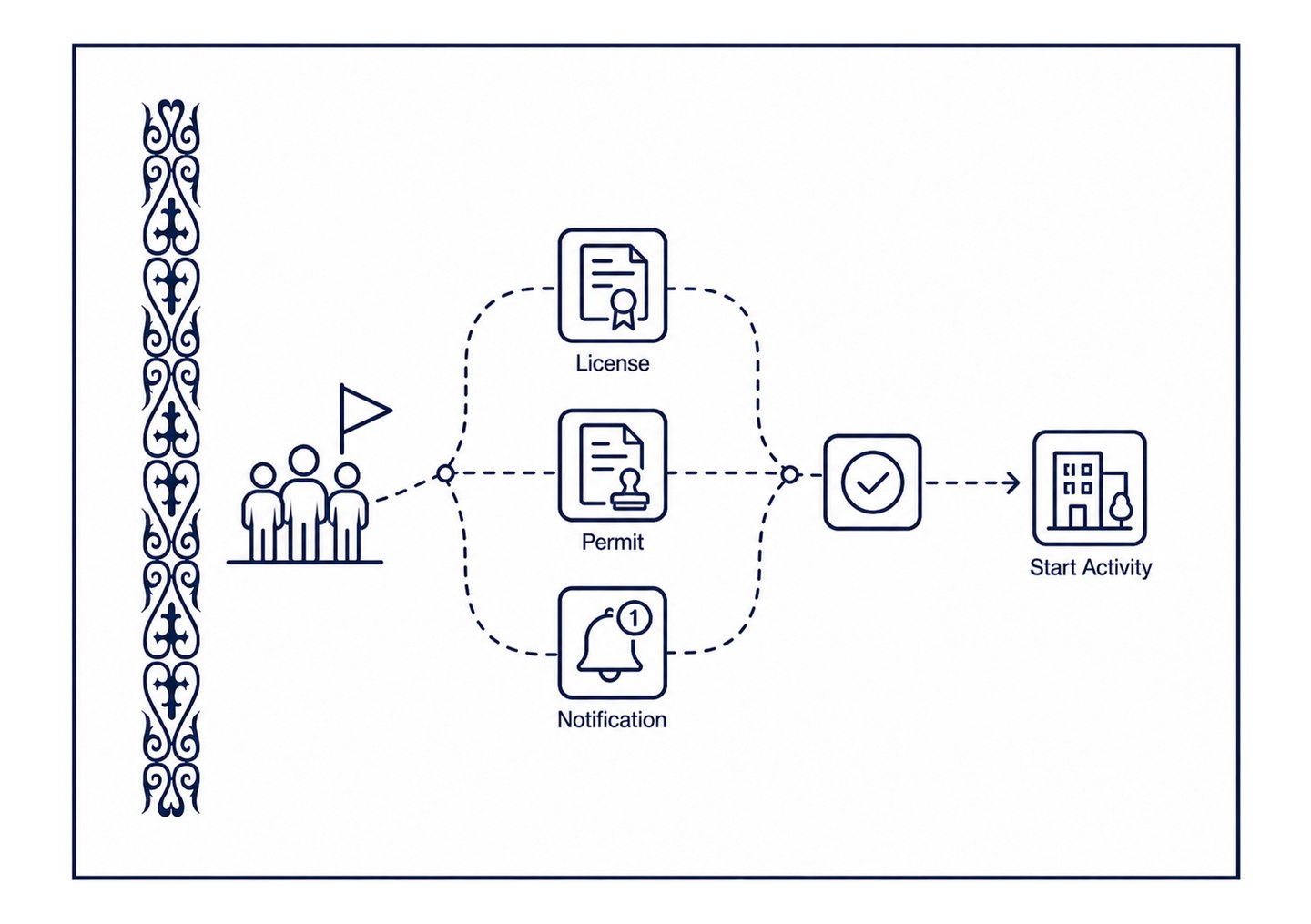
Before launching a business, an entrepreneur usually thinks about clients, a website, a contract, an office and payments. The permit regime is often checked later, once the first contract is already signed or equipment has been purchased. For some activities this order is dangerous. In Kazakhstan there are areas where activity cannot be started merely because a company is registered and ready to sell a service.
A license, a permit and a notification are different legal regimes. A mistake in understanding them can lead to fines, a ban on activity, disputes with clients, problems with the bank and questions for the director. That is why, before launching, it is important to analyze not the name of the service in a commercial offer, but the actual business model.
1. Why the name of the service does not settle the question
The same commercial wording can conceal different legal actions. A company writes "technical maintenance" on its website, but in fact performs work that requires an admission or a permit. A business calls itself an IT platform, but in reality it participates in the movement of money. A consultant speaks of project support, but in fact takes on a regulated activity.
That is why the review begins not with searching for a license by keyword, but with a description of operations. You need to understand what the company does, where it does it, to whom it provides the service, what documents it issues, what resources it uses, whose money or data it processes and what consequences arise for the client.
2. License, permit and notification: what is the difference
A license usually means that the state admits a company in advance to a certain type of activity, provided the established requirements are met. A permit may be linked to a specific action, object, operation or right. A notification is arranged more softly: the company informs the state about the start of activity, but this does not mean there are no requirements. If the activity is notification-based, the business must still comply with the established conditions.
The practical difference matters. With a license a company, as a rule, cannot start activity before obtaining the right. With a permit you need to understand which action it relates to. With a notification you must not assume that state control is absent. If a notification is filed formally while the requirements are in fact not met, the risk still remains.
3. A verification algorithm before launch
Permit analysis is better carried out before the first contracts are concluded. It should not be cumbersome, but it must be consistent.
- First — describe the actual activity in plain words: what the company does, what result the client receives and what operations take place inside the business.
- Second — check whether this activity relates to licensed types, permit procedures or the notification order.
- Third — identify the authority involved in the procedure and the requirements for the company, staff, equipment, premises, capital or internal documents.
- Fourth — check contracts and advertising. You cannot promise the client something the company is not yet entitled to perform.
- Fifth — only after this make a decision on launch, on filing documents or on changing the business model.
4. Qualification requirements matter more than the form of the application itself
Business often asks: "How do we file the documents?" But the main question is usually different: "Do we meet the requirements?" In a number of areas the requirements may concern the education and length of service of specialists, technical conditions, equipment, premises, internal control, certificates, contracts, charter capital or the experience of work performed.
If a company files an application without being substantively ready, it loses time. If it starts activity before it is ready, it creates a violation. That is why permit work is not only filling out a form on the portal. It is preparing the company for the state in which it is genuinely entitled to operate.
5. Which areas require special attention
Particular care is needed with construction, financial and payment services, certain types of import and export, medical and educational services, security activity, work with personal data, equipment, technical means and regulated services. In each such area the formal name of the business may not match its legal regime.
For example, in construction it is important to understand not only whether a license exists, but also the category, the subtypes of work, the qualification requirements and the actual scope of work. In payment projects you need to determine in advance whether the company is a payment organization, an agent, a technology provider or simply a seller of a service. This determines whether interaction with the National Bank of the Republic of Kazakhstan is required, what documents to prepare and what internal procedures to create.
6. Why it is dangerous to work "while we are getting it arranged"
The phrase "the documents are in progress" does not always protect a business. If an activity requires a license or a permit before work begins, a contract with the client does not make it lawful. Moreover, the absence of a permit document may surface later: in a dispute with a client, an inspection, bank compliance, tax analysis or a competitor's complaint.
The risk here is not only a fine. A client may refuse to pay, citing the absence of the right to perform the work. A bank may request documents on the operation. A state authority may restrict the activity. That is why it is safer first to determine the regime, then to prepare the documents and only then to launch the service in full.
7. How Qozhan Consulting helps
Qozhan Consulting helps determine whether a business needs a permit document, exactly which regime applies and what requirements must be met. We analyze not only the formal name of the service, but the actual model of work: contracts, payments, equipment, staff, future operations and interaction with clients. This approach makes it possible to understand in advance whether activity can be started or whether the structure of the project needs to be changed first.
Conclusion
A license, a permit and a notification are not a formality after launch, but part of the legal architecture of a business. If a company first starts activity and then checks the requirements, it may face restrictions after money has already been invested. The correct order is the reverse: first analysis of the regime, then preparation of the company, then obtaining a permit document or submitting a notification, and only after that — a full-scale launch.