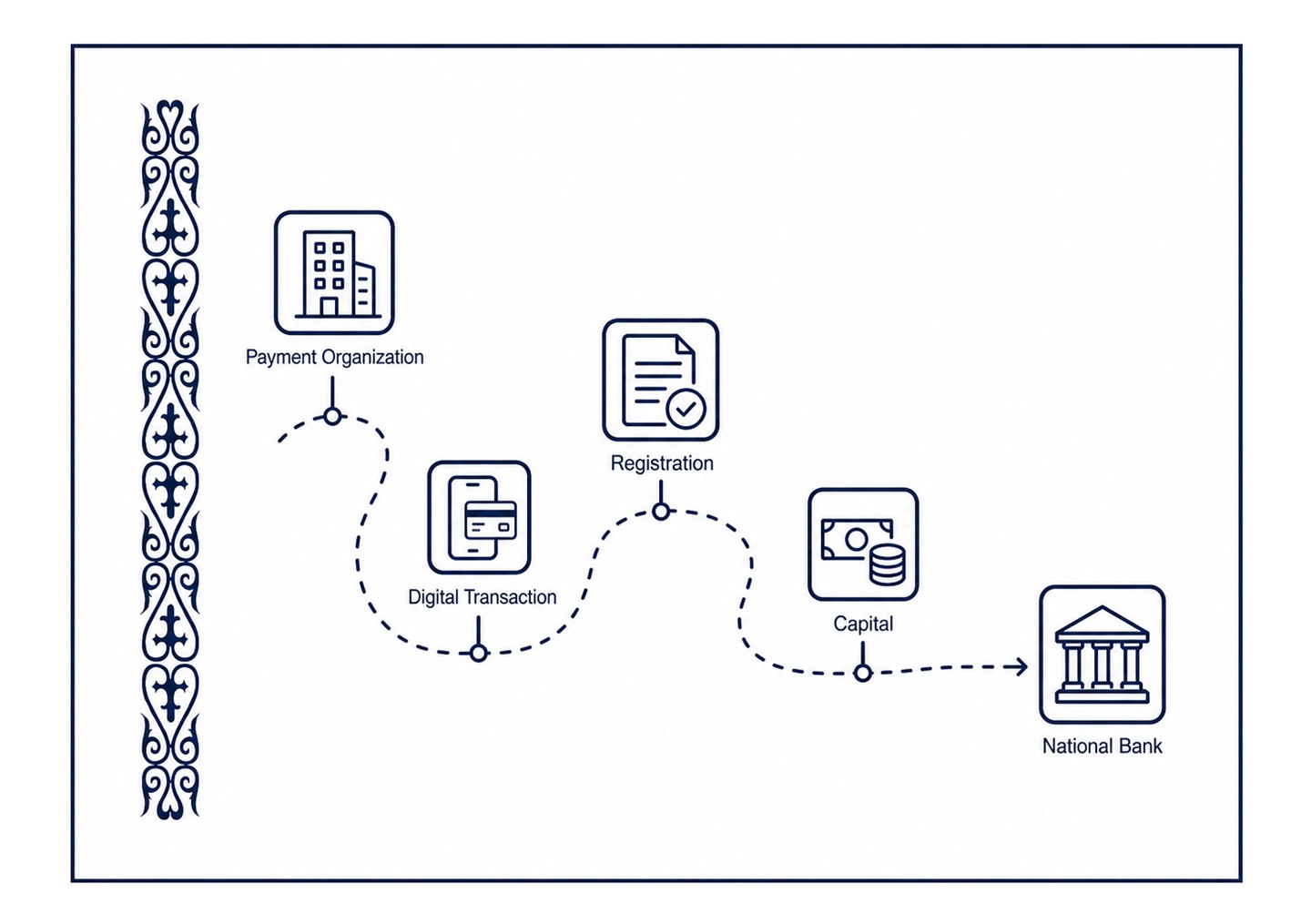
A payment organization in Kazakhstan is not just a company that receives money or helps clients make transfers. It is a participant in the regulated payment market, which must pass registration for accounting purposes with the National Bank of the Republic of Kazakhstan, have a clear business model, formed charter capital, internal documents, compliance and a procedure for interaction with a bank.
The main mistake at the start is to perceive the accounting registration as an ordinary submission of an application. In practice, the National Bank looks not only at the presence of documents, but also at whether the future payment organization can safely provide payment services. Questions arise about the capital structure, management, IT processes, the agreement with the bank, the rules of activity and the system for countering the legalization of income, the financing of terrorism and the financing of the proliferation of weapons of mass destruction (AML/CFT/CPF).
That is why preparation for the accounting registration must begin before filing the application. If documents are written after the business model has already been invented but not checked for compliance with the law, the company risks receiving remarks, a refusal or a formal registration without readiness for a real launch.
1. How a payment organization differs from an ordinary service
At an early stage many digital projects resemble a payment service: an application receives payment, withholds a commission, transfers money to the performer, keeps the client's balance or helps settle between the platform's participants. But the legal qualification depends not on the name of the application, but on what operations are actually performed with the money.
If a company only sells its own services and receives payment for itself, this is one regime. If it receives money in favor of third parties, organizes transfers, carries out payments, services electronic payment instruments or participates in settlements between clients, a question about payment services may arise.
At the start you need to answer several questions:
- who is the payer and who is the recipient of the money;
- whether the money passes through the company or through the bank;
- whether the company withholds a commission before transferring the funds;
- whether the client has a balance or a prepaid amount;
- who is responsible to the user for the payment;
- what payment services are actually provided.
If there is no clear answer to these questions, the business model must be refined before registration. The National Bank and the partner bank will look precisely at the cash flow, and not at the marketing description of the product.
2. Accounting registration: what is submitted to the National Bank
To pass the accounting registration, a payment organization submits documents through the web portal of the electronic government. The application indicates information about the head of the executive body, and documents confirming the company's readiness for activity are attached.
The package of documents is not limited to the charter. Usually it must reflect the key elements of the future activity:
- an application in the form of the National Bank;
- documents confirming the formation of the charter capital;
- the company's charter;
- a document on the procedure for interaction with a bank or an organization carrying out certain types of banking operations;
- information about the head of the IT area;
- information about the head of compliance control or the person responsible for compliance;
- internal control rules on AML/CFT/CPF;
- rules for carrying out the activity of the payment organization.
The meaning of these documents is to show: the company understands how it will receive and transmit payments, how it will account for operations, how it will protect data, how it will identify risks and how it will interact with the bank. Documents written in general phrases do not solve the task, because after registration you will have to actually work by them.
3. Charter capital: why the money must be real
The minimum amount of the charter capital depends on the type of payment services. For certain types of payment services the legislation provides for a minimum charter capital of 150,000,000 tenge. This is not a decorative requirement. The National Bank checks the documents confirming the formation of the capital, and the partner bank and compliance will look at the source of funds and the economic reality of the project.
In practice, three points are important regarding the capital:
First — the capital must be formed documentarily and confirmed by bank and corporate documents. Second — the source of funds must be explainable to the bank and compliance. Third — the amount of the capital must correspond to the chosen payment services, and not to the client's abstract desire to obtain the status of a payment organization.
If the business model assumes only a limited technical function, perhaps the status of a payment organization is not needed at all. But if the company actually works with payment services, it is dangerous to economize on the correct capital structure. Registration without readiness to finance the activity usually leads to problems after launch.
4. The partner bank and the movement of money
A payment organization does not exist in isolation from the banking infrastructure. For the accounting registration a document is needed that defines the procedure for interaction with a bank or an organization carrying out certain types of banking operations. This means that even before filing with the National Bank you need to understand which bank will participate in the settlements and exactly how the money will move.
The bank will assess not only the payment organization as a client, but also its future users, the countries of payments, the purpose of operations, refunds, disputed payments, the identification procedure and the risk of transit operations. If the business model is not ready for bank compliance, the very fact of accounting registration will not solve the problem.
Before choosing a bank, you need to describe in advance:
- what payments the company will carry out;
- whether clients' money will pass through special accounts;
- how the company separates its own money from users' money;
- what documents confirm the grounds for a payment;
- how refunds and errors are processed;
- how the bank receives information on operations;
- what limits and control procedures are applied.
The clearer the cash flow, the easier it is for the bank to make a decision. If the scheme looks like a black box, the bank will ask additional questions or refuse cooperation.
5. Internal rules: the documents must work
The rules of activity of a payment organization and the internal control rules on AML/CFT/CPF are often perceived as formal documents for submission. This is a dangerous approach. After the accounting registration, it is precisely these documents that become the internal instruction: by them employees must identify clients, assess risks, record operations, react to suspicious actions and interact with authorized bodies.
Good internal rules answer practical questions:
- who is the client of the payment organization;
- how identification is carried out;
- what documents are requested from individuals and legal entities;
- which operations are considered high risk;
- who decides on carrying out or refusing an operation;
- how the results of the check are recorded;
- how employees are trained;
- who is responsible for compliance and reporting.
If the rules are not connected with the real platform, they will not help during a check. For example, you cannot write that the client passes full identification if the application has no technical process for collecting and verifying data. You cannot indicate manual control of all operations if the service is designed for mass payments. The document must correspond to the product.
6. IT infrastructure and operational readiness
A payment organization is not only lawyers and accounting. It is also an IT system in which operations take place, data is stored, reports are generated and users' actions are recorded. That is why the documents for the accounting registration reflect information about the person responsible for administering the information and communication systems.
In practice, you need to think through in advance:
- how a user registers in the system;
- how operations are confirmed;
- how action logs are stored;
- how reports on payments are generated;
- how the protection of personal data is ensured;
- how errors, refunds and disputed operations are processed;
- how the system interacts with the bank;
- how the company will be able to provide data at the regulator's request.
If the IT system is at the idea stage while the documents are already being submitted for registration, a gap arises. On paper the company declares readiness for payment activity, but technically it cannot yet ensure it. Such a gap is dangerous not only at registration, but also at the first launch of the product.
7. What happens after the accounting registration
The accounting registration is not the finish. After inclusion in the register, the payment organization must operate in a mode of constant compliance with requirements. It is necessary to keep records of payment services, submit information, maintain compliance, train employees, update the rules and monitor changes in legislation.
After registration it is important to immediately build operational discipline:
Appoint responsible persons not formally, but with real functions. Update the internal rules to fit the actual product and the partner bank. Check the contracts with clients, performers, the bank and IT service providers. Set up the accounting of operations and reporting for the National Bank. Conduct training of employees on AML/CFT/CPF and internal procedures. Periodically assess the risks of clients, operations and products.
A company that has obtained registration but has not built up its work after it quickly faces problems: the bank asks questions, clients dispute payments, compliance does not keep up with operations, and the regulatory documents do not match the actual process.
8. How Qozhan Consulting helps
Qozhan Consulting accompanies payment projects at the stage of preparation for the accounting registration and the subsequent launch. We analyze the business model, the cash flow, the type of payment services, the capital requirements, the documents for the National Bank, the internal control rules and the banking part of the project.
Our task is not just to prepare a folder of documents. It is important to assemble a working model that can be explained to the National Bank, the partner bank, clients and the internal team. For a payment organization this is especially important: the regulatory part, compliance, IT and the contractual base must match each other.
Conclusion
A payment organization in Kazakhstan is a regulated business where the accounting registration is only the beginning. Before filing the documents you need to understand the type of payment services, the movement of money, the capital, the partner bank, internal control, the IT system and AML/CFT/CPF. The better the model is prepared before registration, the fewer problems arise after inclusion in the register.