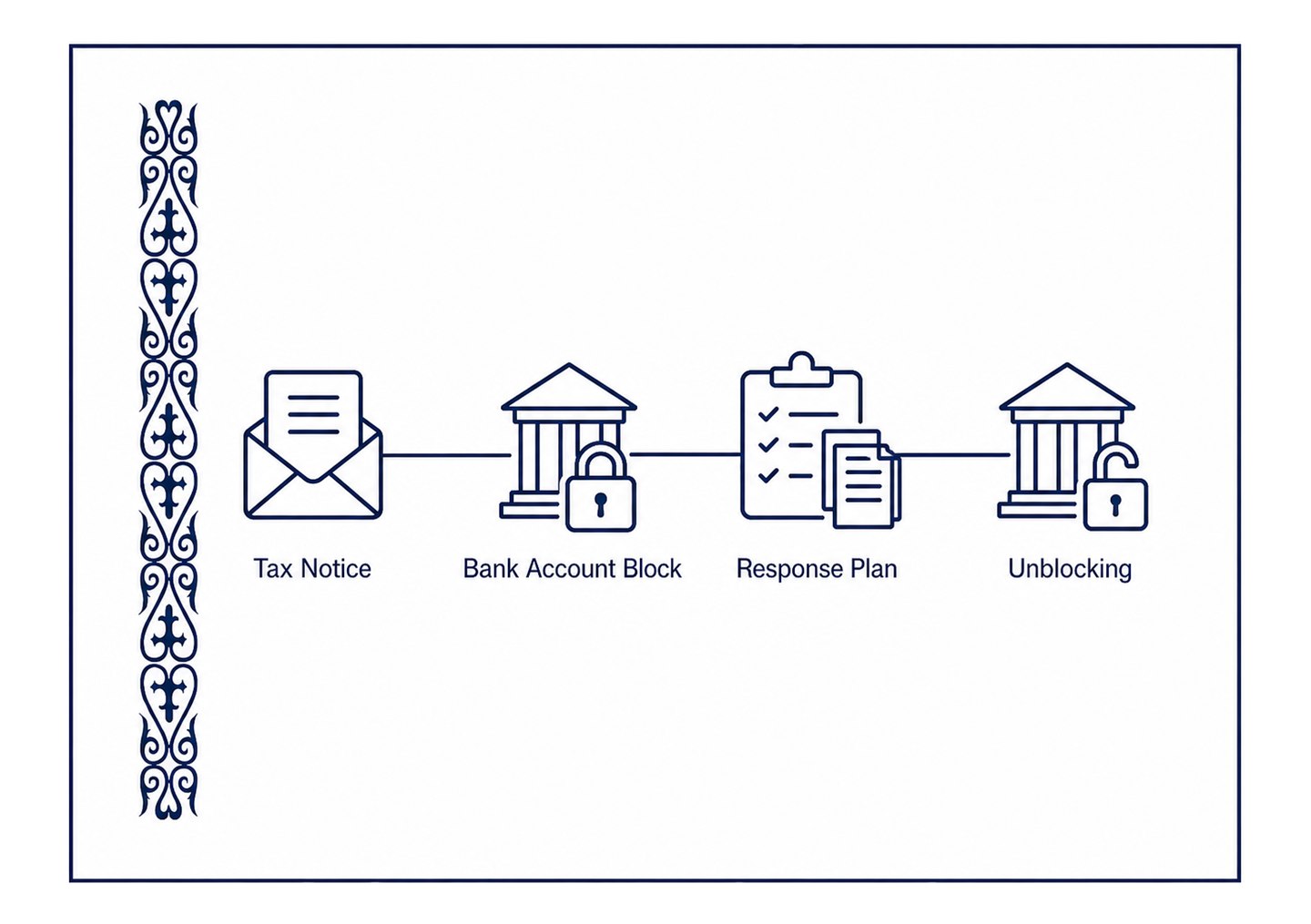
A tax document rarely comes at a convenient time. A company may learn of a problem from the Taxpayer's Cabinet, from the accountant, from the bank or already after the suspension of debit operations on the account. In such a situation the main thing is not to act at random. You need to understand which document exactly the state revenue authority has sent, what deadline is set, what action is required and what consequences will follow inaction.
Tax notifications and notices should not be perceived as identical letters with different names. Sometimes it is an informational signal, sometimes a demand to eliminate a violation, sometimes the beginning of a procedure that may lead to an account block, the accrual of a debt or a dispute. A mistake at the first stage often costs more than the tax problem itself.
1. First you need to determine what exactly has been received
The first question is not "who is to blame", but "which document has been received". In tax practice the wording, the date of delivery, the deadline for performance and the legal basis matter. If a company confuses a notification, a notice, a demand, an order or the result of desk control, it may choose the wrong reaction.
It is better to build the practical algorithm step by step:
- The first action is to record the date of receipt. In tax disputes the deadline is often more important than emotions.
- The second is to determine which document exactly has been received and what action is required of the taxpayer.
- The third is to check the data in the personal account, declarations, payments, electronic invoices and the notification itself.
- The fourth is to decide whether to comply with the demand, give an explanation, submit additional reporting, request a reconciliation or prepare an appeal.
2. Why you cannot react only through the accountant
The accountant usually sees the reporting, the personal account, payments and tax reporting forms. This is important, but not always sufficient. If the document is connected with desk control, an additional charge, a disputed transaction, an account block or the risk of an audit, a legal assessment is needed. The question may be not only in the figure, but also in the evidence, the deadlines, the tax authority's right to demand certain actions and the consequences of the chosen position.
For example, a company may technically submit an additional declaration and close the notification, but by this actually acknowledge the tax authority's position. In another situation it is better to give an explanation and attach documents. In a third — to carry out a reconciliation. In a fourth — to prepare an appeal, because complying with the demand will create a greater risk than a dispute.
3. Desk control: not always a dispute, but always a deadline
Desk control is often perceived as an automatic check based on the data of information systems. But for business its consequences are quite real. The tax authority may see discrepancies in electronic invoices, imports, VAT, CIT, accruals, payments or reporting. Sometimes a discrepancy is connected with a company's mistake. Sometimes — with a counterparty, a technical delay, an incorrect reflection of an operation or a different interpretation of the data.
The main mistake is to postpone the reaction. If a company does not manage to explain the situation or eliminate the violation within the established deadline, the question may move to a more severe stage. That is why, even when a notification seems "technical", it must be examined in substance.
4. Account unblocking: what happens in practice
The suspension of debit operations on a bank account is one of the most sensitive instruments. A company may continue to see the money on the account, but cannot freely dispose of it. For business this means a delay in payments to suppliers, salaries, taxes, rent and operating expenses.
Unblocking depends on the reason for the block. If the reason is unsubmitted reporting, the reporting must be submitted. If it is a tax debt, you need to sort out the amount, the payment, the penalty and the reflection of the payment. If it is an unfulfilled notification, you need to close exactly the demand that became the basis for the measure. Sometimes a company pays the amount, but the account is not unblocked, because the formal basis has not been eliminated. That is why it is important to work not only with the bank, but with the root cause in the state revenue authority.
5. When to give an explanation and when to appeal
Not every tax letter needs to be challenged. Sometimes a correct explanation with documents is enough. But not every demand needs to be complied with automatically. If the tax authority actually proposes to change the reporting or acknowledge a violation, it is necessary to assess the consequences. Compliance may affect VAT, CIT, deductions, losses, a future audit and relations with the counterparty.
The decision depends on the facts. If the mistake is obvious, it is better to correct it accurately and on time. If the position is disputable, arguments must be prepared. If the demand goes beyond the actual circumstances or is based on incorrect data, you need to think about an appeal. In tax matters it is important not only to "answer", but also not to create a document that will then be used against the company.
6. Typical mistakes of business
Most often problems arise because of simple management mistakes. A company does not check the Taxpayer's Cabinet regularly, does not record the date of receipt, passes the question between the accountant and the director without a responsible person, answers with general phrases, does not attach documents or tries to solve the question only through the bank. As a result the deadline passes, and the position is not formed.
The correct approach is different: one responsible employee or consultant must collect the document, check the basis, reconcile the data, prepare a decision and control performance until the restriction is actually lifted or the notification is closed.
7. How Qozhan Consulting helps
Qozhan Consulting helps companies deal with tax notifications, notices, demands and questions on account unblocking. We check the legal basis of the document, analyze the data in accounting and reporting, prepare explanations, accompany reconciliations, assess the risk of acknowledging the tax authority's position and, if necessary, prepare an appeal. Our task is not just to answer the document, but to close the problem without unnecessary tax and legal consequences.
Conclusion
A tax notification is not a reason for panic, but also not a document that can be postponed. It is important to quickly determine the type of document, the deadline, the basis and the correct reaction. In tax disputes, inaction often turns a solvable question into an account block, a debt or a full dispute with a state authority.