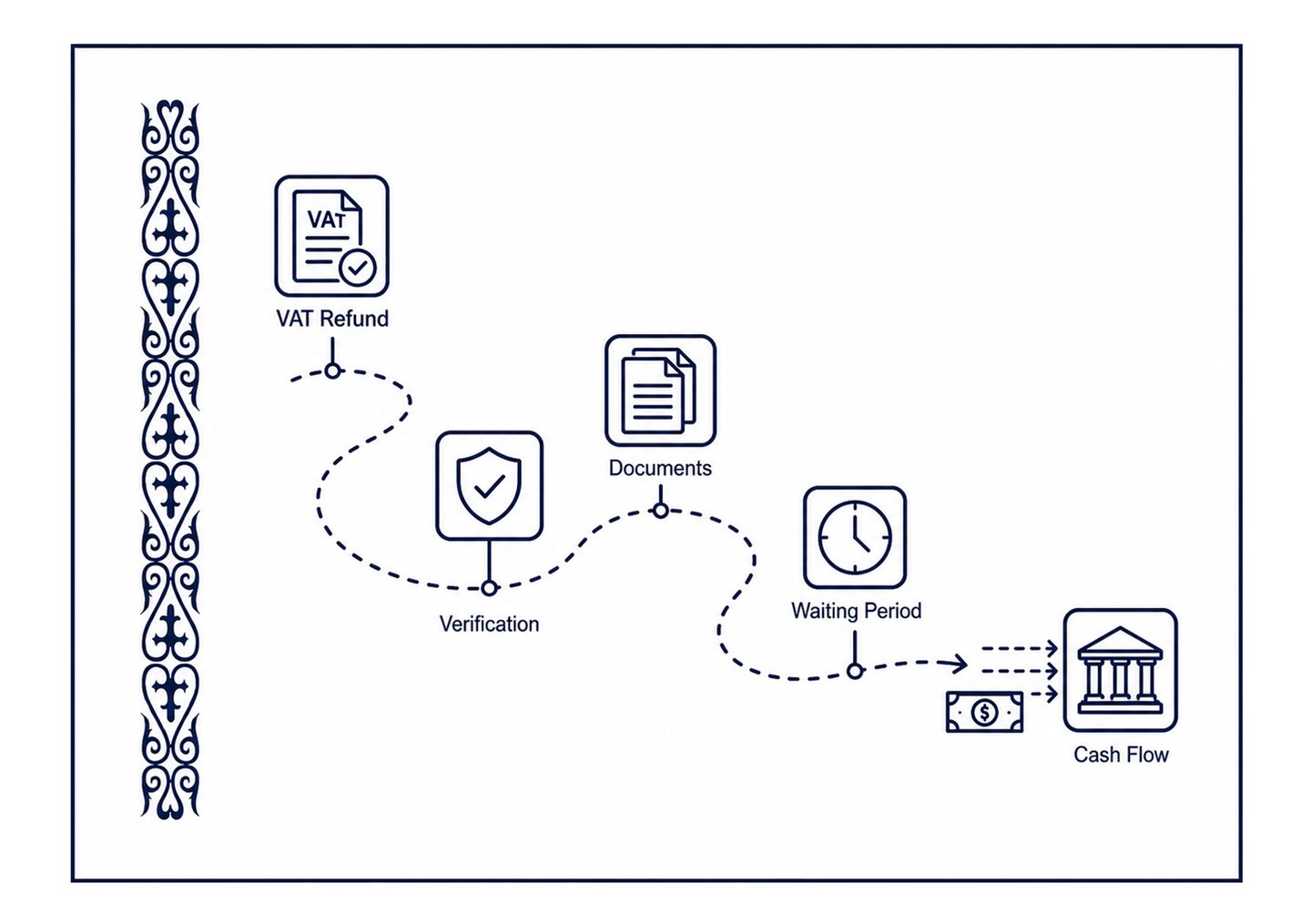
For business, value added tax often looks like clear arithmetic: if the input tax is greater than the tax charged, the difference should be returned to the account. In reality, the refund of the excess of value added tax (VAT) in Kazakhstan is arranged in a more complex way. This is not an automatic transfer of money from the budget and not a technical operation after filing the declaration. It is a tax procedure in which the company must confirm not only the figure in the reporting, but also the reality of the operations, the correctness of the accounting, the connection of expenses with taxable activity and the absence of significant risks in the supply chain.
That is why a VAT refund should be viewed as a separate project. It begins not on the day the refund claim is filed, but much earlier — with the contract, the choice of supplier, the drawing up of the electronic invoice, the payment, warehouse accounting, customs documents and the accounting reflection of the operation. If these elements are not connected with each other, a lawful right to a refund may turn into a long correspondence with the state revenue authorities.
1. When a VAT excess arises
A VAT excess appears when the amount of VAT attributed to offset exceeds the amount of VAT charged. In practice this often happens with exporters, manufacturing companies, importers of equipment, construction projects and businesses that first incur large expenses and receive revenue later. Formally, a company may show an excess in the declaration, but for a refund this is not enough.
The tax authority will look at which operations formed the amount to be refunded. It is one thing — a regular purchase of raw materials from clear suppliers, production and confirmed export. It is another thing — large input VAT on services with a general act and a weak description of the result. In both cases there may be an excess in the declaration, but the evidence base will be different.
2. Why export does not settle the question automatically
Export often creates the right to apply the zero rate, but the very fact of exporting goods does not mean a quick return of money. The zero rate must be confirmed documentarily. For the tax authority, the foreign trade contract, the specification, the delivery terms, the customs declaration, the transport documents, the payment or the settlement procedure, the suppliers' electronic invoices, warehouse accounting and the actual movement of goods are important.
The problem often arises not because a document is missing altogether, but because the documents tell different versions of the same transaction. The contract states one delivery procedure, the transport document shows a different logic of the movement of goods, the payment purpose has no link to the contract, and in the electronic invoice the name differs from the customs declaration. Such a situation does not always mean a violation, but it creates additional questions and increases the review period.
3. What is checked during a refund
During a VAT refund, tax control is rarely limited to the declaration. The entire economic chain is checked: the applicant, the suppliers, the electronic invoices, customs information, tax reporting, personal accounts, the actual movement of goods or the result of the services rendered. The larger the amount, the higher the probability that questions will be addressed not only to the applicant, but also to its counterparties.
The logic of the check is usually built sequentially:
- First — determine which operations formed the excess. You need to understand which suppliers, goods, services or import operations gave the main amount of input VAT.
- Second — check whether each large operation is confirmed by a contract, an invoice, an electronic invoice, an act, a waybill, a payment and accounting records.
- Third — assess whether there is a connection between the expenses and the taxable activity of the company. VAT for offset must be explainable from the point of view of the business, and not only formally reflected in the system.
- Fourth — check the risks on suppliers. If a supplier is in a tax-risk zone, does not fulfill its obligations or does not confirm the actual supply, this may complicate the buyer's position.
4. Why suppliers matter
A company may keep accounting accurately but face questions because of a supplier. The tax authority may analyze whether the supplier has the resources to perform the transaction, whether its activity corresponds to the subject of the contract, whether the operations are reflected in reporting, whether it fulfills its tax obligations. The buyer should not automatically be responsible for any counterparty, but when claiming money from the budget it needs to show the reality of its operation and reasonable due diligence.
That is exactly why checking counterparties before a large transaction has practical significance. It is not a formality for the sake of a folder of documents. It is a way to understand in advance whether the operation will withstand subsequent tax control. If a supplier sells goods that it objectively could not have had, or renders a service without staff and resources, the risk appears even before the declaration is filed.
5. Services require separate attention
For goods there is usually a warehouse, transport, waybills and customs. For services the evidence base is thinner. A formal act with the phrase "the services were rendered in full" often does not explain what exactly the company received. For tax control, the assignment, the report, the correspondence, the result of the work, confirmation of the use of the result in the company's activity and the economic meaning of the expenses are important.
If a Kazakhstani company buys consulting, marketing, IT, management or technical services, it needs to think about evidence in advance. The higher the cost of the service and the less obvious the result, the greater the importance of the description of the subject of the contract and the closing documents. Otherwise, a dispute may arise not only over VAT, but also over deductions for corporate income tax.
6. Why a refund may drag on
A delay in a refund does not always mean that the company has no right. Often the problem is that the position is poorly prepared. The tax authority sees discrepancies between the contract and the electronic invoices, an incomplete set of export documents, unclear payment purposes, problem suppliers, formal acts or weak warehouse accounting. After this the company starts collecting explanations already in the process, when the deadline and the pressure increase.
For business this is painful, because VAT to be refunded is often part of working capital. The money has already been paid to suppliers but has not yet returned from the budget. If the company was counting in advance on a quick refund, the delay may affect the purchase of raw materials, deliveries, salaries and settlements with the bank.
7. How to prepare for a VAT refund
Preparation for a refund should be practical, not decorative. There is no need to create unnecessary documents for the sake of quantity. You need to check whether the company has a connected and clear history of the operation.
- First — single out the operations that form the main amount of VAT to be refunded. It is usually these that will raise the main questions.
- Second — reconcile the contract, the specification, the electronic invoice, the payment, the act, the waybill, the transport and customs documents.
- Third — check the suppliers and prepare an explanation of why the transaction was real and economically justified.
- Fourth — assess the weak points in advance. If the documents are already drawn up imperfectly, it is better to understand this before filing the claim, and not after receiving a request.
8. How Qozhan Consulting helps
Qozhan Consulting views a VAT refund as a legal and accounting project. We analyze the documents before filing, check the link between the contract, the payment, the electronic invoice, the customs and transport documents, assess the risks on suppliers and prepare a position for interaction with the state revenue authorities. If the matter has already moved into an audit or a dispute, we help gather evidence, structure explanations and assess the prospect of defense.
Conclusion
A VAT refund in Kazakhstan is not a simple technical procedure. The right to a refund is important, but by itself it does not guarantee quick money. The larger the amount, the greater the importance of contracts, accounting, suppliers, export documents, payments and preliminary preparation. A company that builds up its evidence base in advance goes through the procedure more calmly and better understands where it has a strong position and where there is risk.