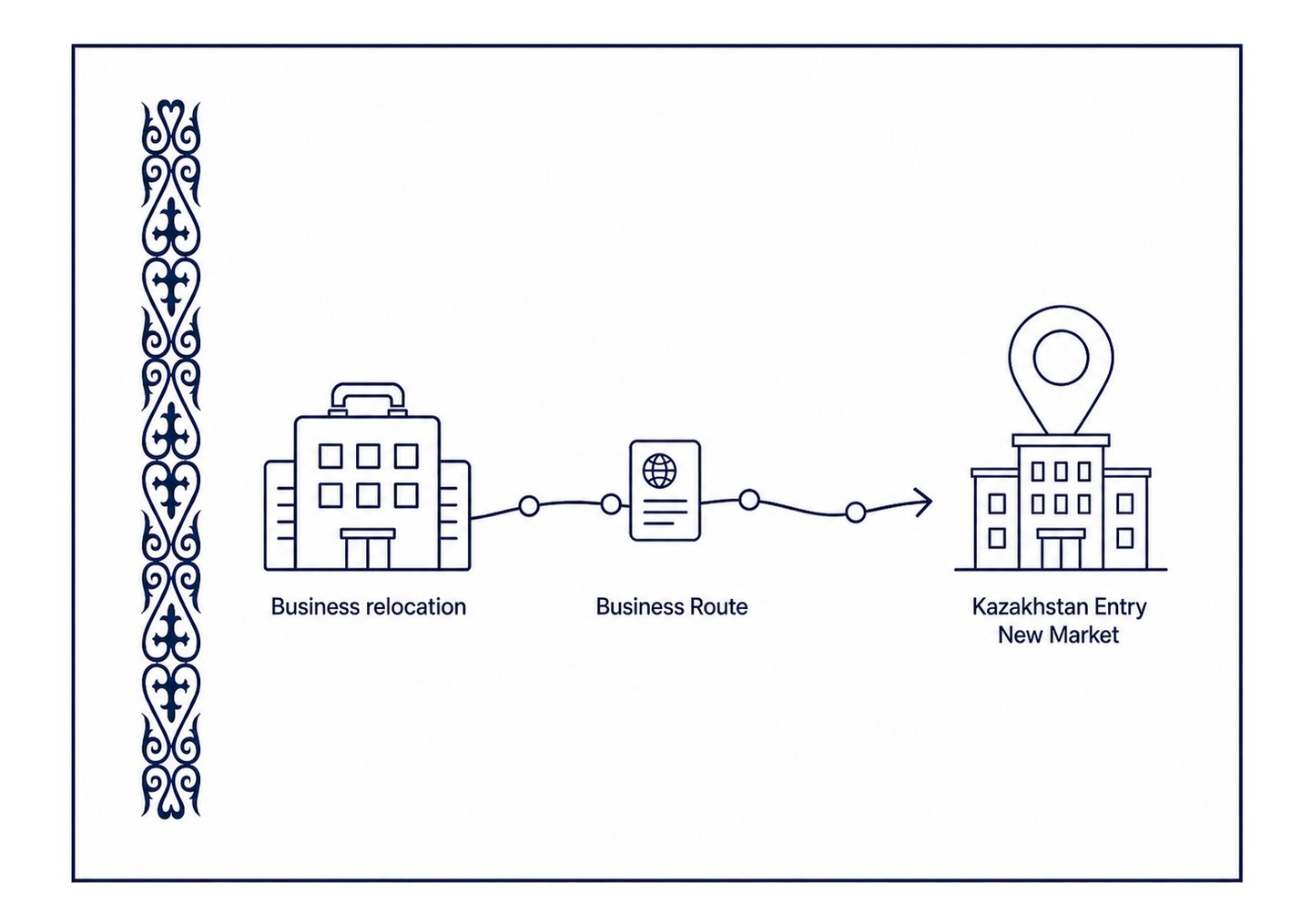
When a foreign company considers Kazakhstan, the question is rarely limited to a single registration. Usually, behind it stands a broader task: to move part of the operations, open a regional office, start working with Kazakhstan counterparties, hire a team, open an account, set up payments, understand the taxes and not get lost in the state services.
In practice, business relocation is not the move of one company from point A to point B. It is the assembly of a new working infrastructure. It contains a legal form, a director, an individual identification number (IIN), a business identification number (BIN), an electronic digital signature (EDS), a bank, a tax regime, accounting, contracts, migration documents, a Kazakhstan phone number, access to accounts and an understanding of who will be responsible for current actions after registration.
This is exactly why we always start with the question "how will the client actually work after registration". If the company is going to sell services to non-residents, one logic is needed. If it is going to import goods – another. If it is going to hire a foreign director – a third. If it is only necessary to open an account for a foreign company in Kazakhstan without creating a local LLP – this is a separate model.
1. Why Kazakhstan is chosen as an entry point
Kazakhstan is convenient for a foreign business for several reasons. It is a large economy in Central Asia, with a clear corporate form of a limited liability partnership (LLP), a developed banking system, electronic state services, the possibility to work with tenders, international payments, IT projects and local counterparties. For many clients, Kazakhstan becomes not only a local market, but also a platform for working with the region.
But this convenient system has a downside: many processes are connected with each other. You cannot think about registration separately and only then remember the bank. You cannot appoint a foreign director whose arrival in Kazakhstan is impossible. You cannot sign an international contract without agreeing it with consultants and only then think about passing currency control. The Kazakhstan system works quickly when the route is prepared in advance.
2. The model of presence is chosen first
A foreign business usually has several options. It is possible to open an LLP, a branch, a representative office, obtain a BIN for a foreign company or work through a contractual model without registering a separate presence. Everything depends on the tasks.
An LLP is suitable when the client wants to create a separate Kazakhstan company. The risks for obligations are limited to the company itself.
A branch is suitable when a foreign company wants to act in Kazakhstan directly through its subdivision. A branch is not an independent legal entity, so the obligations are in fact connected with the parent company.
A representative office is usually used for negotiations, the search for partners, marketing and the protection of the interests of the head company. For full-fledged commercial activity it is not always suitable. Of course, the obligations of a representative office, like those of a branch, are connected with the parent company.
A BIN for a foreign company may be needed if the foreign company wants to open an account in a Kazakhstan bank directly, participate in tenders or interact with partners without creating an LLP, a branch or a representative office.
3. Why the IIN often becomes the first real step
If a foreign citizen participates in the project, the question of the IIN almost always arises. It is needed by an individual. Without it, a foreign citizen will not be able to properly join the participants of the LLP, be appointed director, open a bank card, get a job or complete a number of corporate procedures.
From 2026, foreign citizens cannot obtain an IIN through the embassies and consulates of Kazakhstan abroad. Therefore, if the project requires the participation of a foreign citizen, the arrival in Kazakhstan must be planned in advance. It is important to understand that the IIN is not an additional option that can be done sometime later. In many scenarios it is the first working step after the client's arrival.
4. The bank must be considered before registration
One of the frequent mistakes is to believe that the bank is connected at the very end. In practice, the bank must be taken into account before registration. It will look at the ownership structure, the country of origin of the participants, the director, the source of funds, future operations, contracts, the economic meaning of the presence in Kazakhstan and compliance risks.
If the client has registered an LLP but cannot explain the business model to the bank, the account may not open quickly. If the director is a foreign citizen and has not come to Kazakhstan, it will not be possible to open a current account remotely. If a foreign company wants to open an account directly, it may need a BIN, but the BIN by itself does not guarantee a positive decision by the bank.
5. Migration status depends on the person's role
It is necessary to distinguish between a founder, a director and an employee. If a foreign citizen joins the participants, they may need a C5 business visa or a business-immigrant temporary residence permit (TRP), depending on citizenship. If they work in Kazakhstan, it may be a matter of a C3 visa or an employment TRP. If the director manages the company remotely from abroad and does not physically work in Kazakhstan, a C3 or an employment TRP for remote work outside Kazakhstan is not required by itself.
This is an important difference. There is no universal answer that "a director always needs a work visa". It is necessary to look at where they are physically located, how long they plan to be in Kazakhstan, what their role is and what actions they will perform on the territory of Kazakhstan.
6. The tax model must appear before the first contracts
The tax regime cannot be chosen only by the size of the rate. Corporate income tax, value added tax, the special tax regime, operations with non-residents, dividends, salaries, currency payments and expenses work in combination.
For example, a special tax regime of 3% of turnover may be convenient for a small business, but for counterparties on the generally established regime there may be restrictions on deductions. VAT may be mandatory or commercially important if the client works with large counterparties. International services require an analysis of withholding tax at the source of payment and of the documents confirming the reality of the expenses.
7. What a normal relocation route looks like
First, the model of presence is determined: an LLP, a branch, a representative office or another option. Then the structure of the participants is checked. After that, the foreign documents, the apostille or legalization, translations, powers of attorney, resolutions and documents on the director are prepared.
If the arrival of a foreign citizen is needed, obtaining the IIN, the EDS, a bank card, a Kazakhstan phone number and a current account is planned in advance. After registration, accounting, the tax model, contracts, HR documents and banking access are connected.
Such a route allows several tasks to be closed in one trip, instead of the client returning to Kazakhstan because of one missed document.
8. What usually slows the project down
Most often, a project is delayed not because of the complexity of the legislation, but because of the inconsistency of actions. The client prepared the documents, but prepared them independently without agreeing them with the consultants and came to Kazakhstan with them. The director arrived, but the translation of the passport was not prepared in advance. They registered an LLP, but the bank asks for an explanation of the business model. They obtained a number, but then lost access to the SMS. They chose a tax regime, but it is inconvenient for future counterparties.
Each of these problems can be solved. But it is cheaper and faster to foresee them before the start of the process.
9. How Qozhan Consulting helps
We accompany business relocation as a single process: structure, registration, IIN, BIN, EDS, bank, visas, TRP, taxes, accounting, contracts and further support. This approach is especially important for a foreign client who is not present in Kazakhstan every day and should not have to figure out each system separately on their own.
Conclusion
Business relocation to Kazakhstan is not one document and not one application. It is a built-out route. The earlier the client understands the connection between registration, the IIN, the director, the bank, taxes and migration documents, the faster the project turns into a working company rather than a set of unfinished procedures.