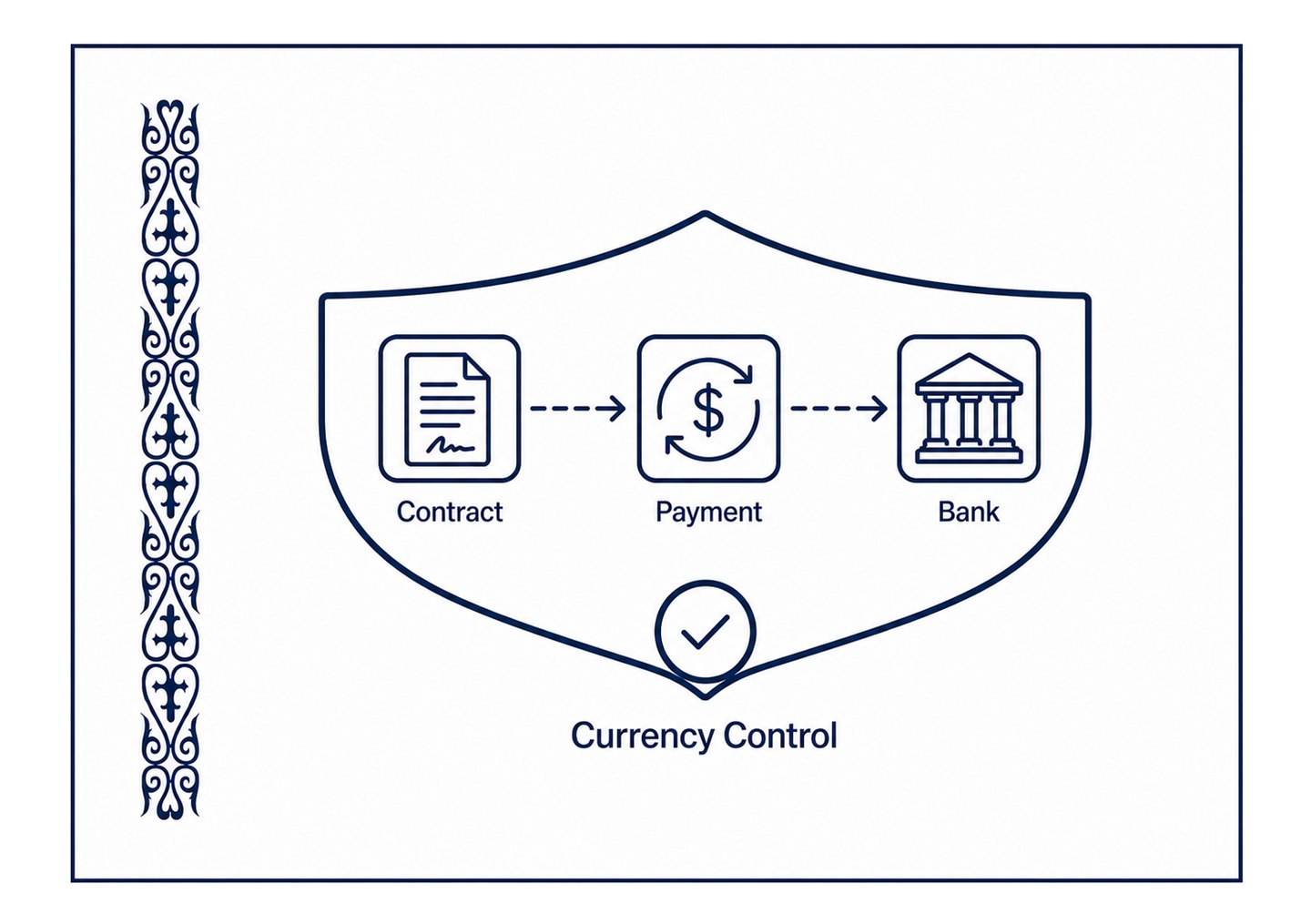
Foreign economic activity looks to a business like an ordinary commercial transaction: a company buys goods, sells products, receives a service, pays a foreign supplier or accepts payment from a non-resident. For the bank and the state it is also a currency operation. It must be clear in terms of the contract, deadlines, payments, documents and economic meaning.
That is why in foreign economic activity it is not enough to sign a good contract. It is necessary that the contract, the invoice, the payment, the customs documents, the tax reporting and the bank's currency control all speak of one and the same operation. It is precisely here that problems most often appear: the business sees a supply, the bank sees a currency risk, the accountant sees discrepancies in the documents, and the tax authority then asks questions about VAT or deductions.
1. The contract as the basis of a currency operation
Currency control begins with the contract. It must make clear the parties, the subject, the amount or the procedure for determining it, the currency, the deadlines for supply or provision of services, the payment procedure, the documents confirming performance, the liability and the applicable law. If the contract is written too generally, the bank may request explanations, because it must understand which operation it is servicing.
The deadlines are especially important. For currency control what matters is not only the fact of payment, but also when the goods must be supplied, the service rendered, the work performed or the money returned. If an advance went to a non-resident but the supply is delayed, the bank will look at the performance deadlines and the supporting documents. A vague contract complicates the explanation.
2. The registration number of a currency contract
For export and import contracts that reach the established threshold, a registration number of the currency contract may be required. In practice this means that the contract must be put on record with an authorized bank in the cases provided for. If the contract is a framework one, without a fixed amount, or the amount is determined by invoices, the question of the registration number must be checked in advance.
A mistake often arises when a company signs a framework contract, begins to pay invoices, and remembers the question of currency accounting only after the bank's request. Outwardly this seems like a technical delay, but in fact it concerns compliance with currency legislation. That is why, when working with a non-resident, you need to understand in advance whether it is an export or an import, whether there is an amount, how it is determined, whether it exceeds the threshold and when performance begins.
3. The payment must match the contract
The bank checks not only the presence of the contract, but also the connection of the payment with it. The payment purpose must make it possible to understand what the money is being transferred for, under which contract, invoice or act. If the payment purpose says too general a "for services", while the contract contains several different obligations, the bank may request explanations.
For business this means that the payment wording cannot be left to a random employee. The payment purpose must be connected with the contract, the invoice, the account and the accounting records. With regular payments you need to make sure that each payment does not look like a separate unclear operation, but fits into the overall logic of the contract.
4. One transaction is seen at once by several systems
When importing goods, one contract passes through the bank, customs, tax accounting and accounting. The bank looks at currency control, customs — at the movement of goods, the tax authority — at VAT, import forms, electronic invoices and the reflection of the operation in reporting. If the data diverge, the company receives additional questions.
It is better to check the transaction as a single chain:
The contract explains what the parties must do and within what deadlines.
The invoice specifies the supply, the amount, the goods or the service.
The payment confirms the movement of money and must be linked to the contract and the invoice.
The customs or closing documents confirm performance.
Accounting and tax records must reflect the same operation, and not another version of it.
5. Services and intangible results
Foreign economic activity in services is sometimes more complex than trade in goods. For goods there is transport, a warehouse, customs and physical movement. For services you need to prove the content of the result. A foreign contractor may issue an invoice for consulting, marketing, IT, management or technical services. The bank will pass the payment only if there are clear documents, and the tax authority may later ask what exactly the Kazakhstani company received and why this is connected with its activity.
That is why for services the terms of reference, the report, the correspondence, the results of the work and an act with content are important. The final phrase "the services were rendered" rarely helps if the amount is significant or the result is not obvious.
6. What happens with mistakes
Mistakes in foreign economic activity rarely appear at once in one place. First the bank asks to explain the payment. Then the accountant cannot correctly close the documents. Then the tax authority asks questions about VAT or deductions. If the performance deadlines are violated, a question of currency control and repatriation arises. If the documents are drawn up formally, a dispute may appear already with the counterparty.
Some mistakes can be corrected: provide an additional agreement, clarify the invoice, prepare an explanation, collect transport documents or carry out a reconciliation. But there are mistakes that are difficult to correct retroactively. For example, if the contract initially does not reflect the real transaction, if the deadlines do not correspond to the actual performance or if the payment went before the necessary documents were drawn up.
7. How to build a safe process
Safe foreign economic activity begins before the payment. First you need to check the contract and determine whether it falls under currency control and registration. Then you should agree on the payment wording, determine the closing documents, check the tax consequences and understand what documents the bank will need. After performance, the transaction must be closed not only commercially, but also documentarily.
If a company works with foreign clients regularly, this process must be standardized. Otherwise each supply or service turns into a manual mode where mistakes are inevitable.
8. How Qozhan Consulting helps
Qozhan Consulting helps check foreign economic contracts, payment wording, closing documents, currency accounting and the tax consequences of operations with non-residents. We assess the transaction before the payment, help prepare documents for the bank, analyze risks on VAT and deductions, and also accompany responses to requests from the bank or state authorities.
Conclusion
Foreign economic activity is not only a contract with a foreign partner. It is a system where the contract, the payment, the bank, customs, tax accounting and accounting must match. The earlier a company builds up this link, the lower the risk of a payment block, tax questions and disputes over documents.