Introduction
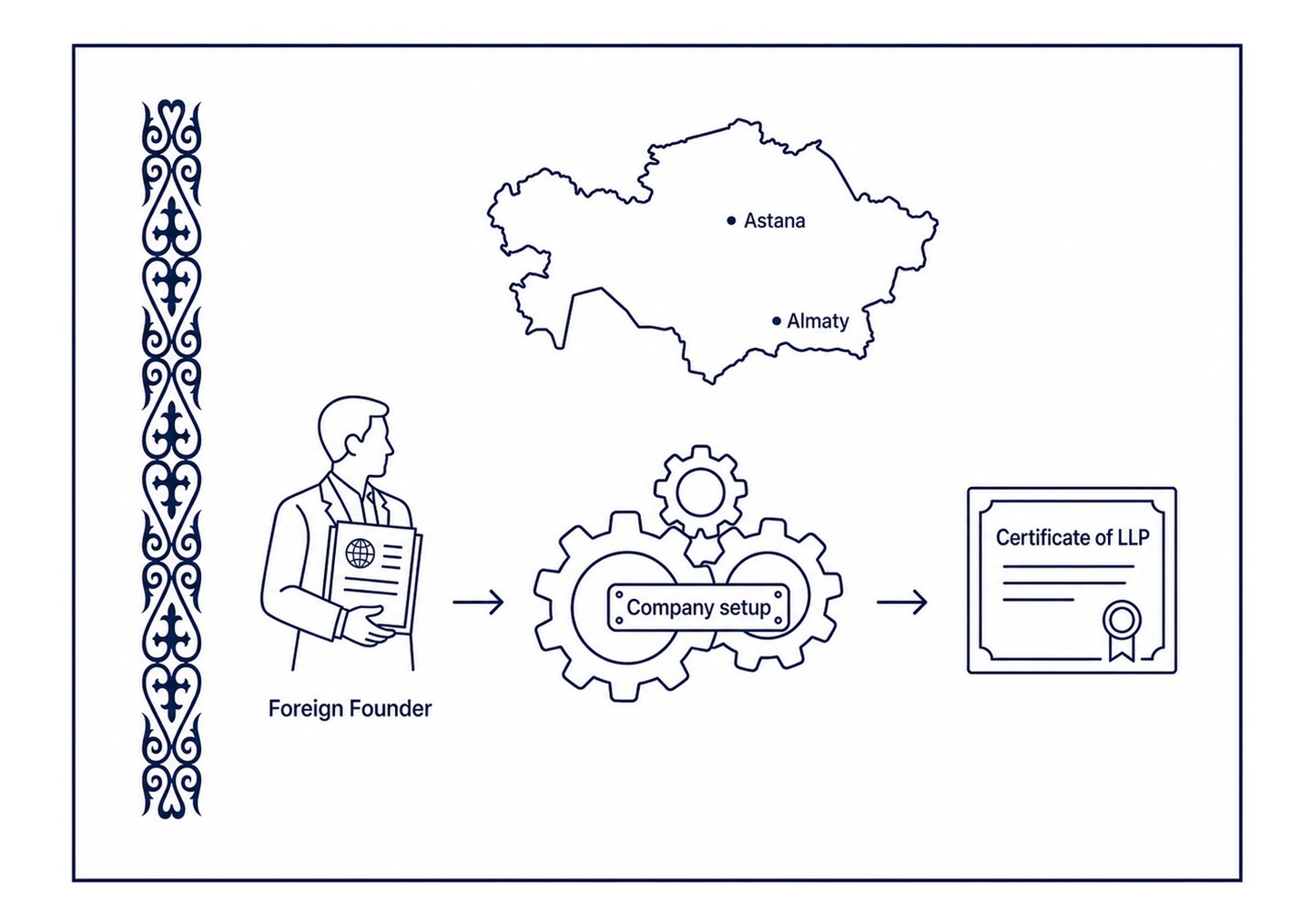
When a foreign client says: "We want to open a company in Kazakhstan", most often they imagine one simple procedure: prepare the documents, file an application and receive a ready-made legal entity. Formally, that is what registration looks like. But in practice, for a foreign business the registration of a limited liability partnership (LLP) consists of several connected steps: the structure of the founders, the individual identification number (IIN) for the director and the individual founder, migration status, the electronic digital signature (EDS), the bank, the tax regime and the legal address.
This is exactly why not only the fact of registration matters, but the order of actions. If you start the project with the wrong step, it may not lead to the expected result. A mandatory item is obtaining the IIN – it is a fundamental part of the work. Without an IIN, a foreign citizen will not be able to join the participants, be appointed director, open a bank card or complete a number of corporate procedures. The IIN for a foreign client is not a secondary formality, but one of the first practical steps after arriving in Kazakhstan.
In this article, we look at the registration of an LLP with foreign participation not as a general reference, but as a working route: what needs to be decided before filing the documents, when a foreigner needs to come, how an LLP differs from a branch and a representative office, when it is possible to act remotely, and how C5, C3, the temporary residence permit (TRP), the bank and the further work of the company are connected.
1. What an LLP is and why foreign clients most often choose this form
An LLP is an independent legal entity. This is an important point, because foreign clients often confuse this and treat a branch and a representative office as "subsidiaries". In fact, the difference is fundamental.
An LLP is created as a separate Kazakhstan company. An LLP is liable for its obligations with its own property. The participants of an LLP, as a rule, are not liable for the company's debts and bear the risk of losses within their contributions (shares). For a foreign investor this is convenient: the business in Kazakhstan can be separated from the head company, while at the same time retaining control and management over it. This is precisely the classic form of the concept of a "subsidiary".
A branch and a representative office work differently. They are not independent legal entities. They are separate subdivisions of the company that created them. A branch may perform all or part of the functions of the head company, while a representative office is usually used to protect interests, for negotiations, marketing, the search for partners and other representative tasks. But legally they remain part of the parent company. Therefore, the obligations of a branch or a representative office are in fact connected with the foreign company that opened them.
In simple terms, an LLP is an independent Kazakhstan company. Its liability, as a rule, is limited to the property of the company itself, so the risks do not pass directly to the foreign parent company.
A branch and a representative office are not separate companies, but part of the foreign company in Kazakhstan. Through them it is possible to conduct activities, conclude contracts, hire employees, open bank accounts and work with Kazakhstan counterparties.
The main difference lies in liability: for the obligations of an LLP the LLP itself is liable, while for the obligations of a branch or a representative office the foreign parent company bears liability.
A branch or a representative office may be the right solution in other situations: when it is important to preserve the direct presence of the foreign company, to participate in a specific project on behalf of the head office or to perform representative functions. But for regular commercial activity, especially if the business is only entering Kazakhstan, an LLP is usually clearer for the bank, the tax authorities, counterparties and the client themselves.
2. Who can be a founder of an LLP with foreign participation
The founder of an LLP may be a foreign citizen, a foreign company or several persons at once. The legislation of Kazakhstan allows foreign legal entities to own 100% of the participation share without involving a local partner. But before registration it is necessary to check the structure, because there is a restriction that many learn about too late.
An LLP cannot have as its sole participant another company consisting of one person. Therefore, if a foreign company plans to be the sole participant of a Kazakhstan LLP, it is necessary to check how many participants the foreign company itself has.
If the founder of the LLP is a foreign company consisting of one participant, and it alone joins the Kazakhstan LLP, such a model does not comply with the requirement of the law. If the foreign company consists of two or more participants, it may be the sole participant of the Kazakhstan LLP. If the foreign company consists of one participant, but together with it an individual or another company joins the participants of the Kazakhstan LLP, then the LLP will already have two participants, and the requirement of the law is not violated.
In practice, this looks like this:
- a foreign company with one participant as the sole founder of the LLP – does not qualify;
- a foreign company with two or more participants as the sole founder of the LLP – qualifies;
- a foreign company with one participant plus an individual, as two founders of the LLP – qualifies;
- two foreign companies, each of which consists of one participant, as two founders of the LLP – qualifies.
This must be checked before preparing the documents. If the client first legalizes the extract, makes the translation, prepares the resolution and the power of attorney, and then it turns out that the structure does not pass, the package of documents will have to be redone and supplemented. For a foreign business this is a loss of time, additional costs and a postponement of the arrival dates of the director or founder.
3. Where registration begins in practice
The registration of an LLP with foreign participation does not begin with filing an application. It begins with obtaining the individual identification number (IIN) for the foreign citizen.
If there is a foreign citizen among the participants, they need an IIN. The IIN is issued to an individual. With it, a foreign citizen can join the participants of the LLP, be appointed director, open a bank card, get a job, take part in corporate procedures and interact with state and banking systems.
If the future director of the LLP is a foreign citizen, they also need an IIN. Moreover, to open a bank account the director must be personally present in Kazakhstan. Therefore, the director's arrival must be planned in advance.
From 2026, foreign citizens cannot obtain an IIN and an EDS through the embassies and consulates of Kazakhstan abroad. Previously there was a pilot procedure that allowed foreigners to obtain an IIN abroad, but this mechanism is no longer available. Now, to obtain an IIN, a foreign citizen must come to Kazakhstan and personally visit a state body.
Separately, it is important to take the passport into account. The crossing of the state border must be carried out with the national passport. Before arrival, it is advisable to prepare a notarized translation of the passport, if this is required for the procedure. Then, after arrival, you can immediately go to the state body and not waste time on translation, a notary and clarifications on the spot. In practice, we most often take this service upon ourselves and provide it to the client independently, in order to ease their arrival in Kazakhstan and not create confusion in the translation of the passport and additional costs.
The EDS should also not be postponed. The electronic digital signature is needed to work with state portals, to file applications, for tax and statistical reporting, to sign documents and, in some cases, for banking services. But a foreigner cannot obtain an EDS without personal presence in Kazakhstan. Therefore, the IIN and EDS are better planned as one block during the client's arrival. All processes and the order of their step-by-step implementation will be carried out together with our team; we provide these services and the client has nothing to worry about at all – all actions will be planned before the client's arrival in Kazakhstan.
4. When registration can be organized remotely
Fully remote registration is not always possible. The most workable model for a remote launch looks like this: the founder of the future LLP is a foreign legal entity, and the director will be a citizen of Kazakhstan. In this situation, the foreign company and its representatives do not need to come to Kazakhstan, if the documents are correctly prepared in advance and handed over to the service provider.
The logic here is simple. The director is located in Kazakhstan and is the executive body of the company. It is precisely they who represent the company in current relations, apply to state bodies, go through banking procedures and sign documents within their powers. If the director is a citizen of Kazakhstan, many actions can be carried out without the arrival of foreign representatives.
But if the director is a foreign citizen, their personal presence in Kazakhstan is mandatory. This is not a question of the bank's convenience or the practice of a particular service provider. Without the arrival of a foreign director, it is impossible to complete the key actions: obtain an IIN, formalize an EDS, open a current account and complete the practical setup of the company.
If the founder of the LLP is a foreign individual, their personal presence is also required. In such a situation, first the entry into Kazakhstan is planned, then obtaining the IIN, preparing the documents and only then the registration of the LLP. An attempt to change the order leads to delays.
If the founder is a foreign legal entity, the presence of its participants or director is usually not required. But the documents of the foreign company must be prepared in advance: an extract from the trade register or another document confirming the existence of the company, a certificate of tax residency, the constituent documents of the foreign company, a resolution on the creation of the LLP/branch or representative office, a power of attorney, translations, an apostille or legalization depending on the country.
5. What documents are needed from the foreign founder
The package of documents depends on who acts as the founder: a foreign citizen or a foreign company.
If the founder is a foreign citizen, usually a business visa or a business-immigrant TRP, a passport, a notarized translation of the passport into Kazakh and Russian, an IIN and a resolution on the creation of the LLP are needed. In practice, the question of the visa or TRP is resolved first. After arrival in Kazakhstan, first of all, one might say straight off the plane, the IIN is formalized, because without it further actions will be limited.
If the founder is a foreign company, a document is needed confirming that it really exists under the legislation of its country. This is usually an extract from the trade register or a similar corporate document, as well as a certificate of tax registration. Both of these documents must be issued by the authorized state body of the foreign country. Such a document must be legalized at the embassy or consulate of Kazakhstan in the foreign country or apostilled, translated into Kazakh and Russian with notarial certification of the translation. A resolution of the foreign company on the creation of an LLP in Kazakhstan and a power of attorney for the representative are also prepared.
At this stage it is important not just to collect the documents, but to check their content. The extract must show the current data of the company. The resolution must correctly indicate the future participant, the share, the name of the LLP, the powers of the representative and the appointment of the director. The power of attorney must contain powers specifically for those actions that are needed: registration, signing of documents, filing of applications, receipt of results, interaction with the bank, if this is provided for.
Mistakes in foreign documents cost more than mistakes in the local form. If a document has already been apostilled, sent to Kazakhstan and translated, and then it turns out that it does not contain the necessary powers or the data does not match, the process starts over. Therefore, we always recommend agreeing on the drafts of the documents before they are signed and sent.
6. Director: who can be appointed and when personal presence is needed
The director of an LLP is not a formal figure. For the bank, the tax authorities, counterparties and state systems, the director is the person who acts on behalf of the company. Therefore, the question of the director must be resolved before registration.
The director may be a citizen of Kazakhstan or a foreign citizen. If the director is a citizen of Kazakhstan, registration can go faster, especially when a foreign company acts as the founder. Such a director is already in Kazakhstan, it is easier for them to obtain an EDS and use state services, since they are a resident of Kazakhstan and all the conveniences of digitalization are available to them.
If the director is a foreign citizen, they must come to Kazakhstan. They need to obtain an IIN, formalize the necessary documents, go through the procedures at the bank and confirm their identity where this is required. The company's current account cannot be opened remotely: the personal presence of the director is mandatory.
For a foreign director it is also necessary to separately analyze the migration status. It is one thing when the director is located outside Kazakhstan and manages the company remotely. It is another thing when they actually come to Kazakhstan, are here, sign documents, work in the office, meet with banks and counterparties. In the second case, questions of a visa, TRP and employment formalization may arise.
7. C5, C3, business-immigrant TRP and employment TRP: who needs what
With visas and TRPs, confusion most often arises. Clients hear different wordings: a C5 business visa, a C3 work visa, a business-immigrant TRP, an employment TRP, a permit to attract foreign labor. All these documents solve different tasks.
If a foreign citizen joins the participants of the LLP as a founder, one must look at their citizenship. For citizens of the countries of the Eurasian Economic Union (EAEU), as well as citizens of Azerbaijan, Tajikistan and Uzbekistan, a business-immigrant temporary residence permit (TRP) is usually considered. For other foreign citizens, a category C5 business visa applies. These are documents connected specifically with participation in business and entrepreneurial activity.
If a foreign citizen is going to work in Kazakhstan, it is already a matter of the employment model. For visa countries, a C3 visa may be required, which relates to carrying out employment activity. For visa-free countries, an employment TRP is often applied. Such a TRP is issued on the basis of an employment relationship and allows a person to be in Kazakhstan to work within the period established by the grounds and the permit issued by the migration authority.
Important: a C3 and an employment TRP are needed not because a person is simply a director on paper. They are needed when a foreign citizen actually is located and works on the territory of Kazakhstan beyond the permissible period established by their national passport for visa-free stay in Kazakhstan. If the director is located outside Kazakhstan and manages the company remotely, and all the work is outsourced, remote work from another country by itself does not mean that they automatically need a C3 or an employment TRP. These documents regulate presence and work on the territory of Kazakhstan.
There is another important point. Resolution of the Government of the Republic of Kazakhstan No. 1041 classifies as persons for whom a permit from local executive bodies to attract foreign labor is not required, including business immigrants, citizens of the EAEU states, as well as the first heads and their deputies of a Kazakhstan legal entity with 100% foreign participation (not more than one unit for such positions). This means that in certain cases the permit to attract foreign labor specifically is not required.
The practical breakdown is simple:
- a foreign individual founder: C5 or business-immigrant TRP, depending on citizenship;
- a foreign employee who physically works in Kazakhstan: C3 or employment TRP, depending on citizenship and the mode of entry, as well as whether the LLP has a "quota" for attracting foreign labor;
- a foreign citizen who is the first head and their deputy of an LLP with 100% foreign participation, for persons planning to work physically in Kazakhstan: exemption from the permit to attract foreign labor – the "quota" – and obtaining a C3 or an employment TRP;
- a foreign director who manages remotely from abroad: a C3 or an employment TRP for remote work outside Kazakhstan is not required.
It is precisely here that it is important not to use a universal piece of advice from the internet. The same position of director may require different actions depending on citizenship, the country of location, the period of stay, the share of foreign participation, the actual place of work and banking procedures.
8. Kazakhstan phone number, EDS and banking access
After the IIN and registration, the next practical question quickly arises: how to work "remotely", how the client will receive SMS, sign documents and log in to personal accounts. Kazakhstan is a very digital country. The phone number is used for banks, state services, identity confirmation and access recovery.
We recommend that clients have a separate Kazakhstan number and keep permanent access to it. It is better to use an ordinary SIM card rather than an eSIM. This is not a legal requirement, but a practical piece of advice. An ordinary SIM card is easier to move to another device, keep in a working phone, hand over for servicing or use abroad in SMS-receiving mode. With an eSIM it is more difficult, especially if the phone is lost, broken or the number needs to be transferred outside Kazakhstan.
Since 2025, requirements for the verification of devices brought into the country and planned for use with a Kazakhstan SIM card are in effect in Kazakhstan. If the client entered Kazakhstan with their device and further plans to use a Kazakhstan SIM card outside Kazakhstan, there is no need for device verification. A brought-in device must be verified only when it is brought in and planned for use in Kazakhstan for more than 30 days after arrival.
It is worth mentioning remote identity verification separately. For foreign citizens, remote identity confirmation through a telecom operator, a bank or a state service does not yet work in most key procedures the way it does for citizens of Kazakhstan. Therefore, a foreign client should not build a plan on the assumption that everything can be confirmed by a video call or through a mobile application. In critical procedures, personal presence remains the main working option.
9. Bank: why the account should not be left "for later"
Many clients think that the bank is the last stage: first we register the LLP, then we calmly open an account. In practice, the bank must be taken into account even before registration.
The bank looks not only at the registration documents. It is interested in the ownership structure, the country of origin of the participants, the director, the source of funds, future operations, counterparties, contracts, the economic meaning of the business in Kazakhstan and possible compliance risks. If the structure looks unclear or the documents are prepared formally, the bank may request additional explanations or refuse to open an account.
It is impossible to open a company's current account remotely. The director must be personally present at the bank. If the director is a foreign citizen, their arrival must be planned together with obtaining the IIN, the EDS, registration and banking procedures. Opening a debit card for a foreign citizen also requires personal presence.
Before going to the bank, it is better to prepare not only the mandatory package of documents, but also a brief description of the business: what the company does, who the clients are, where the money will come from, to whom the payments will go, why the company is being opened specifically in Kazakhstan. For a foreign business, this often decides more than the formal availability of all certificates.
10. Timelines: how long registration really takes
If the documents are prepared correctly, the registration of the LLP and the opening of the current account can take on average about 5 working days. But this period must be understood correctly. It does not include the time to prepare the documents in the country of residence, the apostille or legalization, the sending of the originals and the translation of the documents.
A real project is better planned by stages:
- Preliminary check of the structure and choice of the model.
- Study of the constituent documents of the foreign company.
- Preparation of the foreign documents in the country of residence.
- Translations, apostille or legalization.
- Planning the arrival of the foreign citizen.
- Arrival of the client to obtain the IIN.
- Issuance of a notarial power of attorney for filing the documents.
- Registration of the LLP.
- Opening of the bank account.
- Obtaining the EDS.
- Setup of tax and accounting support.
- Conclusion of contracts for outsourcing services.
If you go exactly in this order, registration becomes predictable. But if the client first takes one step, then learns about the second, then returns to the first, the process begins to drag on.
11. Frequent mistakes of foreign clients
The first mistake is to believe that the registration of an LLP is fully remote for all cases. This is not so. If there is a foreign citizen in the structure, personal presence almost always becomes a key stage.
The second mistake is not to check the structure of the foreign company. If a foreign company consists of one participant and wants to be the sole participant of a Kazakhstan LLP, a problem arises with the requirement of the law. This must be identified before preparing the documents.
The third mistake is to think that an IIN or an EDS can be obtained through the embassy. From 2026, such a path does not work for foreign citizens. It is necessary to plan an arrival in Kazakhstan.
The fourth mistake is to have no understanding of migration status. Founder, director and employee are different roles. C5, C3, the business-immigrant TRP and the employment TRP apply in different situations.
The fifth mistake is to go to the bank without an explanation of the business model. For the bank it is important to understand not only who registered the company, but also why it was opened, what payments will go through, who the counterparties are and what the source of funds is.
The sixth mistake is to buy an eSIM and then lose access to the number. For a foreign client, a Kazakhstan number is part of the digital infrastructure. It must be kept as carefully as a banking token or an EDS. The loss of access to the phone number leads to the only way out – a personal arrival in Kazakhstan.
12. How we usually structure the process
We begin not with the application form, but with the questions that really affect the result: who the founder is, who the director is, where the client is located, what citizenship the participants have, whether the director will come, what payments are planned, what counterparties the company will have, what tax model is expected.
After that, we propose a route. For example, if the founder is a foreign company and the director is a citizen of Kazakhstan, the process can be structured remotely for the foreign representatives. If the director is a foreign citizen, we prepare the documents, the translation of the passport, the arrival plan, obtaining the IIN, registration, the EDS and the bank in one logic in advance. If a foreign individual acts as the founder, we first resolve their migration questions, and only then move towards registration.
Our task is that the client comes not "to try to go through the procedure", but comes for a prepared route. Then in one trip it is possible to close several tasks: IIN, EDS, registration, bank, phone number, access and the initial setup of the company. This saves time and reduces the risk that the client will have to return again because of one missed detail.
13. Conclusion
The registration of an LLP with foreign participation in Kazakhstan is in itself not a complicated procedure. The complexity appears when the client does not see the whole chain: structure, IIN, director, visas or TRP, EDS, bank, taxes and documents. Therefore, correct registration begins before filing the application.
For a foreign business, an LLP remains a convenient and clear form of presence in Kazakhstan. It is an independent legal entity, allows the risks to be limited at the level of the Kazakhstan company, to work with banks and counterparties, to keep accounting and to build a full-fledged operational activity. But for this form to really work, it is necessary to check the corporate structure in advance and correctly plan the personal presence of those persons without whom the procedure cannot be completed.
Qozhan Consulting accompanies the registration of an LLP with foreign participation as a full-fledged business launch: from checking the structure and preparing the documents to the IIN, the EDS, the bank, the tax model and further support. This approach helps a foreign client not just to receive a registered company, but to start working in Kazakhstan without unnecessary delays and repeat visits.